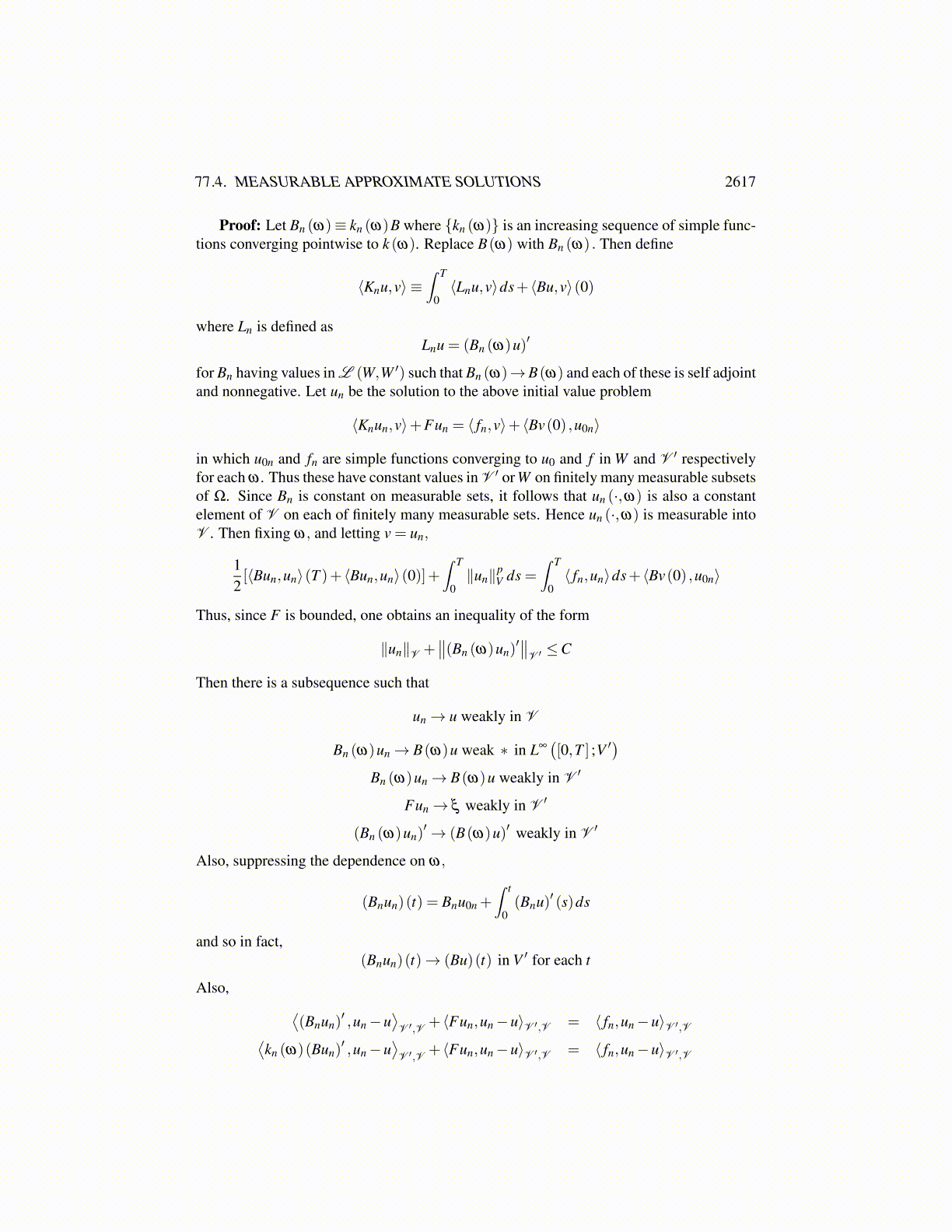
77.4. MEASURABLE APPROXIMATE SOLUTIONS 2617
So let v be smooth and equal to 0 except for t ∈ [0,δ ] and equals v0 at 0. Then as δ → 0,the integrals become increasingly small and so
⟨Bu(0) ,v0⟩= ⟨Bv0,u0⟩= ⟨Bu0,v0⟩
and since v0 is arbitrary in V , then it follows that Bu(0) = Bu0. Thus this has provided asolution u to the system
(Bu)′+Fu = f , Bu(0) = Bu0, u ∈ X
It remains to consider the assertion about continuity. First note that the solution to theabove initial value problem is unique due to the strict monotonicity of F. In fact, if thereare two solutions, u,w, then
12∥Bu(t)−Bw(t)∥2
W +∫ t
0⟨Fu−Fw,u−w⟩ds = 0
and so, in particular, ⟨Fu−Fw,u−w⟩V ′,V = 0 which implies u = w in V .Let u be the solution which goes with ( f ,u0) and let un denote the solution which goes
with ( fn,u0n) where it is assumed that fn → f in V ′ and u0n → u0 in W . It is desired toshow that un→ u weakly in V . First note that the un are bounded in V because
12⟨Bun,un⟩(T )−
12⟨Bu0n,u0n⟩+
∫ T
0∥un∥p
V ds =∫ T
0⟨ fn,un⟩ds≤ ∥ fn∥V ′ ∥un∥V
and this clearly implies that ∥un∥V is indeed bounded. Thus if this sequence fails to con-verge weakly to u, it must be the case that there is a subsequence, still denoted as un whichconverges weakly to w ̸= u in V . Then by the fact that F is bounded, there is an estimateof the form
∥un∥V +∥Lun∥V ′ ≤C
Thus, a further subsequence satisfies
un→ w weakly in V
Lun→ Lw weakly in V ′
Fun→ ξ weakly in V ′
then ∫ T
0
⟨(B(un−w))′ ,un−w
⟩dt
=12⟨B(un−w) ,(un−w)⟩(T )− 1
2⟨B(un−w) ,(un−w)⟩(0)
≥ −12⟨B(un−w) ,(un−w)⟩(0) =−1
2⟨B(un0−u0) ,un0−u0⟩
It follows
⟨Lw,un−w⟩V + ⟨Fun,un−w⟩V −12⟨B(un0−u0) ,un0−u0⟩ ≤ ⟨ fn,un−w⟩