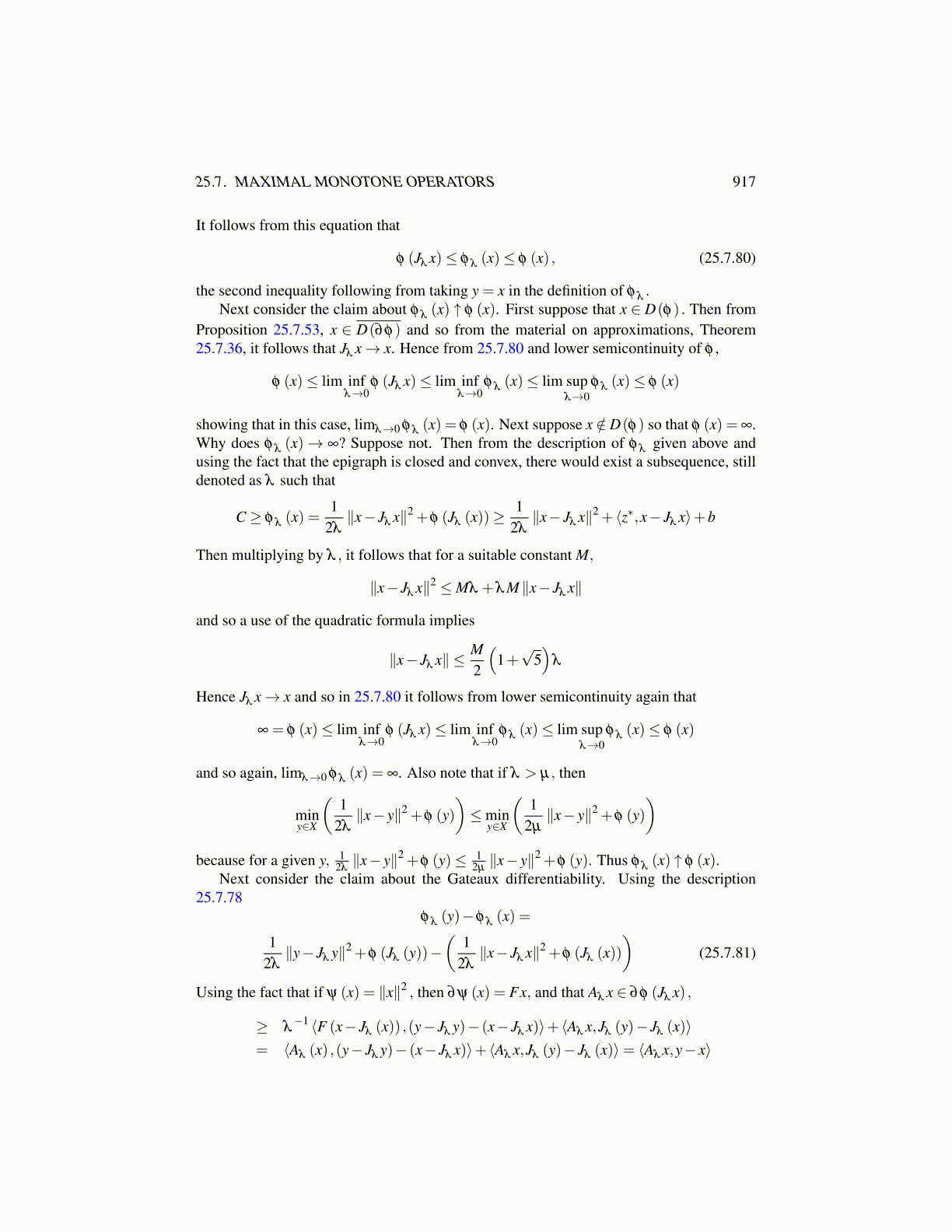
25.7. MAXIMAL MONOTONE OPERATORS 917
because this was how Jλ x was defined. Therefore,
φ λ (x) =1
2λ∥x− Jλ x∥2 +φ (Jλ (x)) =
λ
2∥Aλ x∥2 +φ (Jλ x) , A = ∂φ
It follows from this equation that
φ (Jλ x)≤ φ λ (x)≤ φ (x) , (25.7.80)
the second inequality following from taking y = x in the definition of φ λ .Next consider the claim about φ λ (x) ↑ φ (x). First suppose that x ∈ D(φ) . Then from
Proposition 25.7.53, x ∈ D(∂φ) and so from the material on approximations, Theorem25.7.36, it follows that Jλ x→ x. Hence from 25.7.80 and lower semicontinuity of φ ,
φ (x)≤ lim infλ→0
φ (Jλ x)≤ lim infλ→0
φ λ (x)≤ lim supλ→0
φ λ (x)≤ φ (x)
showing that in this case, limλ→0 φ λ (x) = φ (x). Next suppose x /∈D(φ) so that φ (x) = ∞.Why does φ λ (x)→ ∞? Suppose not. Then from the description of φ λ given above andusing the fact that the epigraph is closed and convex, there would exist a subsequence, stilldenoted as λ such that
C ≥ φ λ (x) =1
2λ∥x− Jλ x∥2 +φ (Jλ (x))≥
12λ∥x− Jλ x∥2 + ⟨z∗,x− Jλ x⟩+b
Then multiplying by λ , it follows that for a suitable constant M,
∥x− Jλ x∥2 ≤Mλ +λM ∥x− Jλ x∥
and so a use of the quadratic formula implies
∥x− Jλ x∥ ≤ M2
(1+√
5)
λ
Hence Jλ x→ x and so in 25.7.80 it follows from lower semicontinuity again that
∞ = φ (x)≤ lim infλ→0
φ (Jλ x)≤ lim infλ→0
φ λ (x)≤ lim supλ→0
φ λ (x)≤ φ (x)
and so again, limλ→0 φ λ (x) = ∞. Also note that if λ > µ, then
miny∈X
(1
2λ∥x− y∥2 +φ (y)
)≤min
y∈X
(1
2µ∥x− y∥2 +φ (y)
)because for a given y, 1
2λ∥x− y∥2 +φ (y)≤ 1
2µ∥x− y∥2 +φ (y). Thus φ λ (x) ↑ φ (x).
Next consider the claim about the Gateaux differentiability. Using the description25.7.78
φ λ (y)−φ λ (x) =
12λ∥y− Jλ y∥2 +φ (Jλ (y))−
(1
2λ∥x− Jλ x∥2 +φ (Jλ (x))
)(25.7.81)