25.8. PERTURBATION THEOREMS 927
Consider the claim about uniqueness and continuous dependence. Say you have fi ∈Lui +Aui, i = 1,2. Let z∗i ∈ Aui be such that equality holds in the two inclusions. Then
f1− f2 = z∗1− z∗2 +Lu1−Lu2
It follows that
⟨ f1− f2,u1−u2⟩= ⟨z∗1− z∗2 +Lu1−Lu2,u1−u2⟩ ≥ r (∥u1−u2∥)
Thus if f1 = f2, then u1 = u2. If fn→ f in V ′, then r (∥u−un∥)→ 0 where un goes with fnand u with f as just described, and so un→ u because the coercivity estimate given aboveshows that the un and u are all bounded. Thus the map just described is continuous.
The following lemma is interesting in terms of the hypotheses of the above theorem.[23]
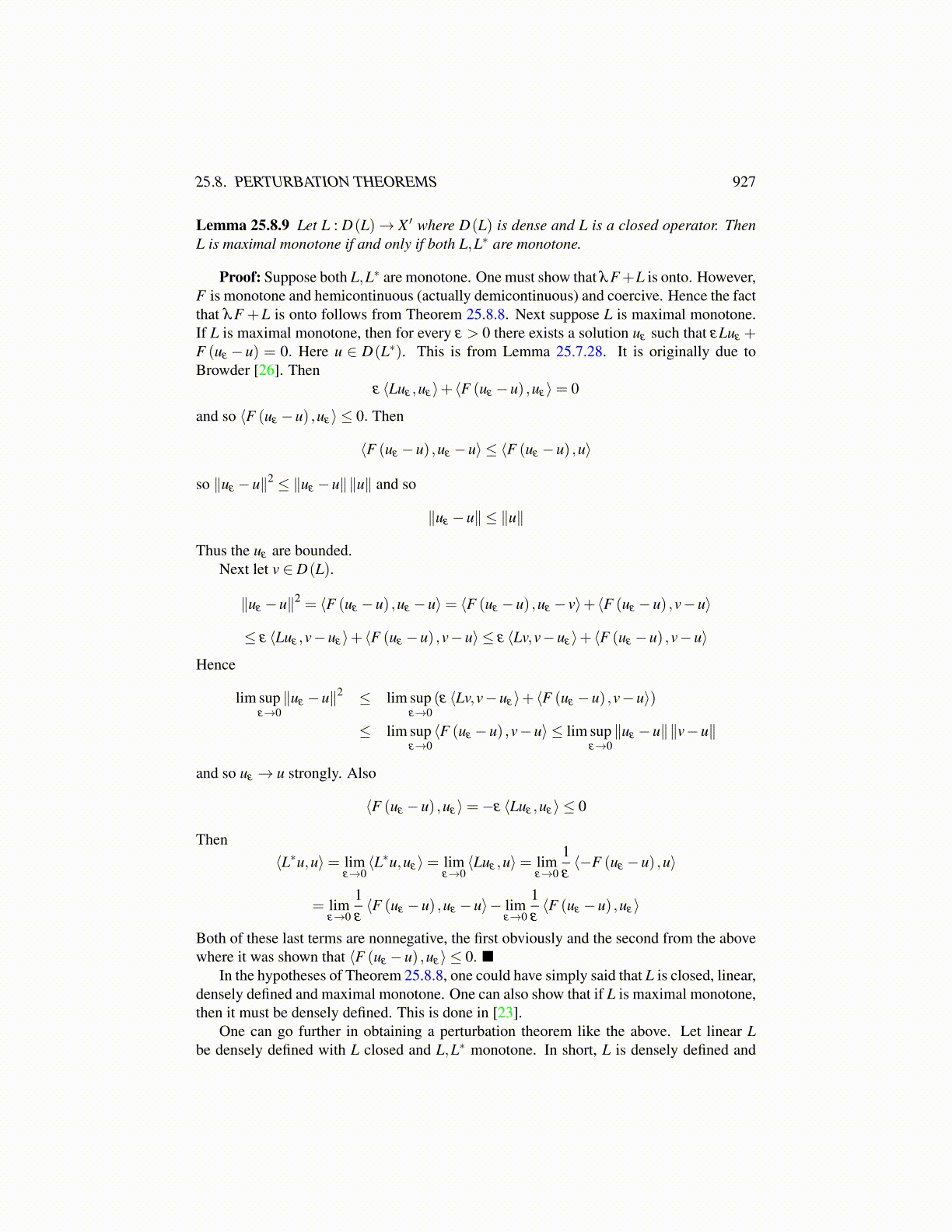
Lemma 25.8.9 Let L : D(L)→ X ′ where D(L) is dense and L is a closed operator. ThenL is maximal monotone if and only if both L,L∗ are monotone.
Proof: Suppose both L,L∗ are monotone. One must show that λF+L is onto. However,F is monotone and hemicontinuous (actually demicontinuous) and coercive. Hence the factthat λF +L is onto follows from Theorem 25.8.8. Next suppose L is maximal monotone.If L is maximal monotone, then for every ε > 0 there exists a solution uε such that εLuε +F (uε −u) = 0. Here u ∈ D(L∗). This is from Lemma 25.7.28. It is originally due toBrowder [26]. Then
ε ⟨Luε ,uε⟩+ ⟨F (uε −u) ,uε⟩= 0
and so ⟨F (uε −u) ,uε⟩ ≤ 0. Then
⟨F (uε −u) ,uε −u⟩ ≤ ⟨F (uε −u) ,u⟩
so ∥uε −u∥2 ≤ ∥uε −u∥∥u∥ and so
∥uε −u∥ ≤ ∥u∥
Thus the uε are bounded.Next let v ∈ D(L).
∥uε −u∥2 = ⟨F (uε −u) ,uε −u⟩= ⟨F (uε −u) ,uε − v⟩+ ⟨F (uε −u) ,v−u⟩
≤ ε ⟨Luε ,v−uε⟩+ ⟨F (uε −u) ,v−u⟩ ≤ ε ⟨Lv,v−uε⟩+ ⟨F (uε −u) ,v−u⟩
Hence
lim supε→0∥uε −u∥2 ≤ lim sup
ε→0(ε ⟨Lv,v−uε⟩+ ⟨F (uε −u) ,v−u⟩)
≤ lim supε→0⟨F (uε −u) ,v−u⟩ ≤ lim sup
ε→0∥uε −u∥∥v−u∥
and so uε → u strongly. Also
⟨F (uε −u) ,uε⟩=−ε ⟨Luε ,uε⟩ ≤ 0