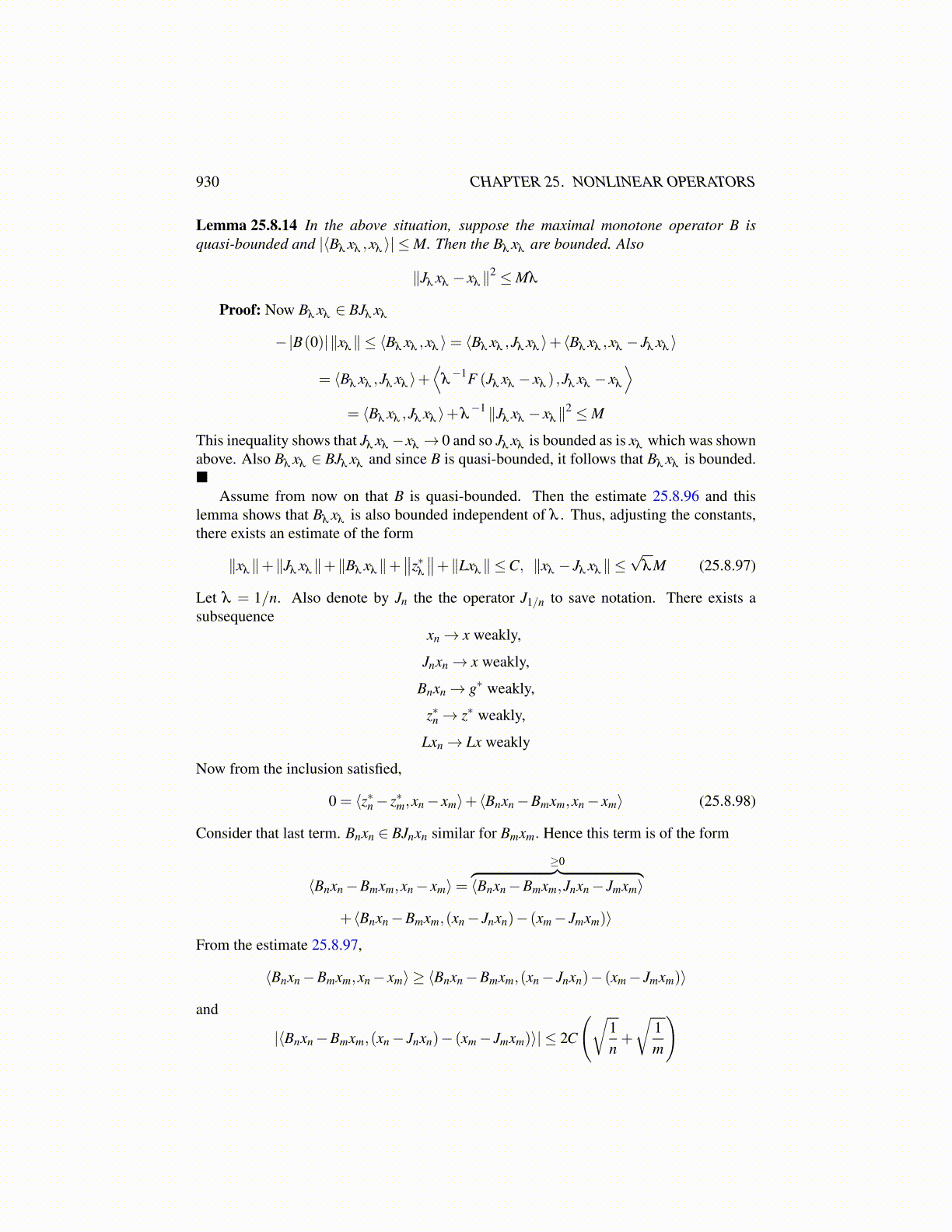
930 CHAPTER 25. NONLINEAR OPERATORS
Thus, from coercivity, ∥xλ∥ are bounded. Then since A is bounded, the z∗λ
are all boundedalso independent of λ . The top line shows also that
⟨y∗,xλ ⟩ = ⟨Lxλ ,xλ ⟩+⟨z∗
λ,xλ
⟩+ ⟨Bλ xλ ,xλ ⟩ ≥
⟨z∗
λ,xλ
⟩+ ⟨Bλ xλ ,xλ ⟩
≥ ⟨Bλ xλ ,xλ ⟩− M̂ ≥−|B(0)|∥xλ∥− M̂ (25.8.96)
where∣∣⟨z∗
λ,xλ
⟩∣∣≤ M̂ for all λ . Hence there is a constant M such that
|⟨Bλ xλ ,xλ ⟩| ≤M
Definition 25.8.13 A set valued operator B is quasi-bounded if whenever x ∈ D(B) andx∗ ∈ Bx are such that
|⟨x∗,x⟩| , ∥x∥ ≤M,
it follows that ∥x∗∥ ≤ KM . Bounded would mean that if ∥x∥ ≤M, then ∥x∗∥ ≤ KM . Hereyou only know this if there is another condition.
Lemma 25.8.14 In the above situation, suppose the maximal monotone operator B isquasi-bounded and |⟨Bλ xλ ,xλ ⟩| ≤M. Then the Bλ xλ are bounded. Also
∥Jλ xλ − xλ∥2 ≤Mλ
Proof: Now Bλ xλ ∈ BJλ xλ
−|B(0)|∥xλ∥ ≤ ⟨Bλ xλ ,xλ ⟩= ⟨Bλ xλ ,Jλ xλ ⟩+ ⟨Bλ xλ ,xλ − Jλ xλ ⟩
= ⟨Bλ xλ ,Jλ xλ ⟩+⟨
λ−1F (Jλ xλ − xλ ) ,Jλ xλ − xλ
⟩= ⟨Bλ xλ ,Jλ xλ ⟩+λ
−1 ∥Jλ xλ − xλ∥2 ≤M
This inequality shows that Jλ xλ −xλ → 0 and so Jλ xλ is bounded as is xλ which was shownabove. Also Bλ xλ ∈ BJλ xλ and since B is quasi-bounded, it follows that Bλ xλ is bounded.
Assume from now on that B is quasi-bounded. Then the estimate 25.8.96 and thislemma shows that Bλ xλ is also bounded independent of λ . Thus, adjusting the constants,there exists an estimate of the form
∥xλ∥+∥Jλ xλ∥+∥Bλ xλ∥+∥∥z∗
λ
∥∥+∥Lxλ∥ ≤C, ∥xλ − Jλ xλ∥ ≤√
λM (25.8.97)
Let λ = 1/n. Also denote by Jn the the operator J1/n to save notation. There exists asubsequence
xn→ x weakly,
Jnxn→ x weakly,
Bnxn→ g∗ weakly,
z∗n→ z∗ weakly,
Lxn→ Lx weakly