26.1. THE FUNDAMENTAL THEOREM OF CALCULUS 935
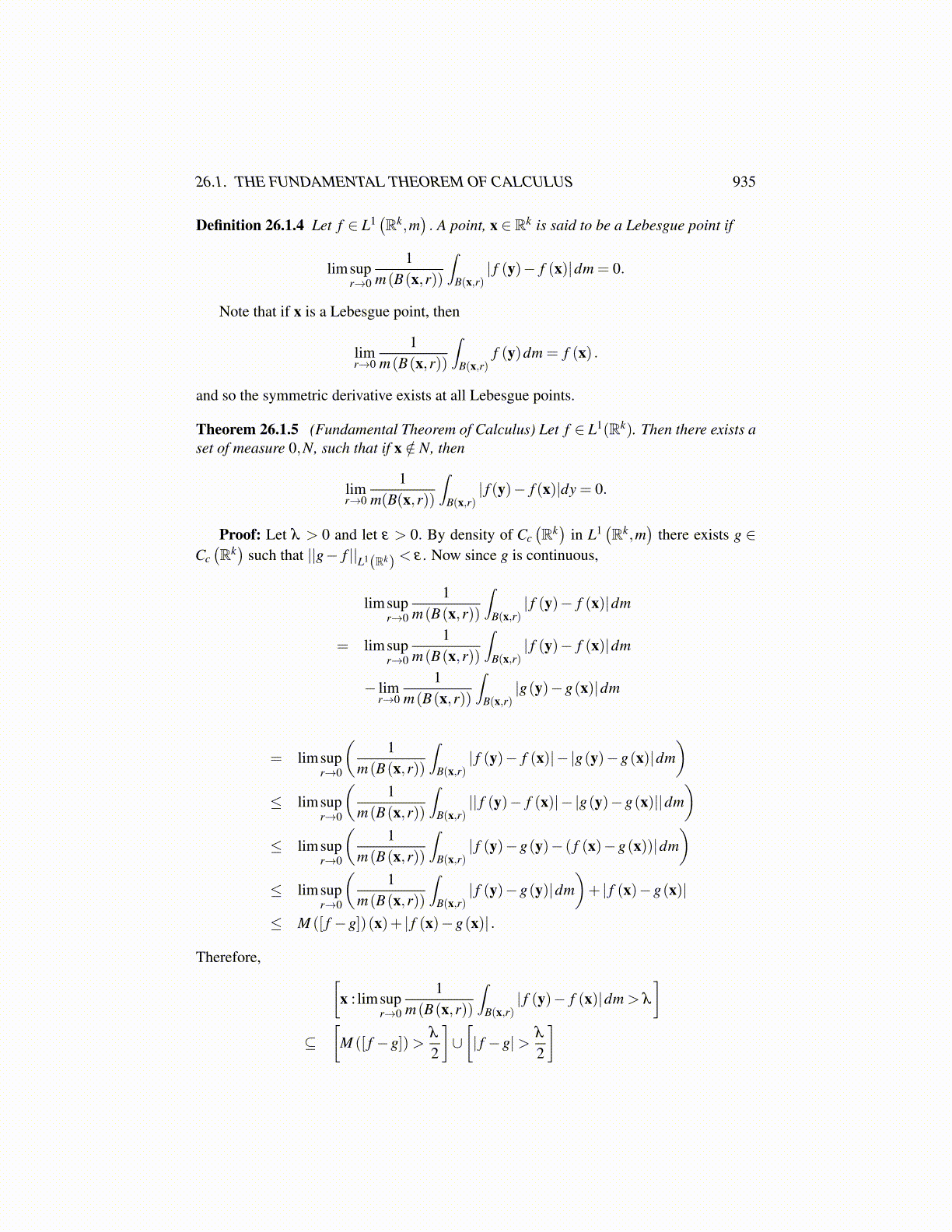
Definition 26.1.4 Let f ∈ L1(Rk,m
). A point, x ∈ Rk is said to be a Lebesgue point if
limsupr→0
1m(B(x,r))
∫B(x,r)
| f (y)− f (x)|dm = 0.
Note that if x is a Lebesgue point, then
limr→0
1m(B(x,r))
∫B(x,r)
f (y)dm = f (x) .
and so the symmetric derivative exists at all Lebesgue points.
Theorem 26.1.5 (Fundamental Theorem of Calculus) Let f ∈ L1(Rk). Then there exists aset of measure 0,N, such that if x /∈ N, then
limr→0
1m(B(x,r))
∫B(x,r)
| f (y)− f (x)|dy = 0.
Proof: Let λ > 0 and let ε > 0. By density of Cc(Rk)
in L1(Rk,m
)there exists g ∈
Cc(Rk)
such that ||g− f ||L1(Rk) < ε . Now since g is continuous,
limsupr→0
1m(B(x,r))
∫B(x,r)
| f (y)− f (x)|dm
= limsupr→0
1m(B(x,r))
∫B(x,r)
| f (y)− f (x)|dm
− limr→0
1m(B(x,r))
∫B(x,r)
|g(y)−g(x)|dm
= limsupr→0
(1
m(B(x,r))
∫B(x,r)
| f (y)− f (x)|− |g(y)−g(x)|dm)
≤ limsupr→0
(1
m(B(x,r))
∫B(x,r)
|| f (y)− f (x)|− |g(y)−g(x)||dm)
≤ limsupr→0
(1
m(B(x,r))
∫B(x,r)
| f (y)−g(y)− ( f (x)−g(x))|dm)
≤ limsupr→0
(1
m(B(x,r))
∫B(x,r)
| f (y)−g(y)|dm)+ | f (x)−g(x)|
≤ M ([ f −g]) (x)+ | f (x)−g(x)| .
Therefore, [x : limsup
r→0
1m(B(x,r))
∫B(x,r)
| f (y)− f (x)|dm > λ
]⊆
[M ([ f −g])>
λ
2
]∪[| f −g|> λ
2
]