940 CHAPTER 26. INTEGRALS AND DERIVATIVES
and shows V is absolutely continuous as claimed.
Lemma 26.2.4 Suppose f : [a,b]→ R is absolutely continuous and increasing. Then f ′
exists a.e., is in L1 ([a,b]) , and
f (x) = f (a)+∫ x
af ′ (t)dt.
Proof: Define L, a positive linear functional on C ([a,b]) by
Lg≡∫ b
agd f
where this integral is the Riemann Stieltjes integral with respect to the integrating function,f . By the Riesz representation theorem for positive linear functionals, there exists a uniqueRadon measure, µ such that Lg =
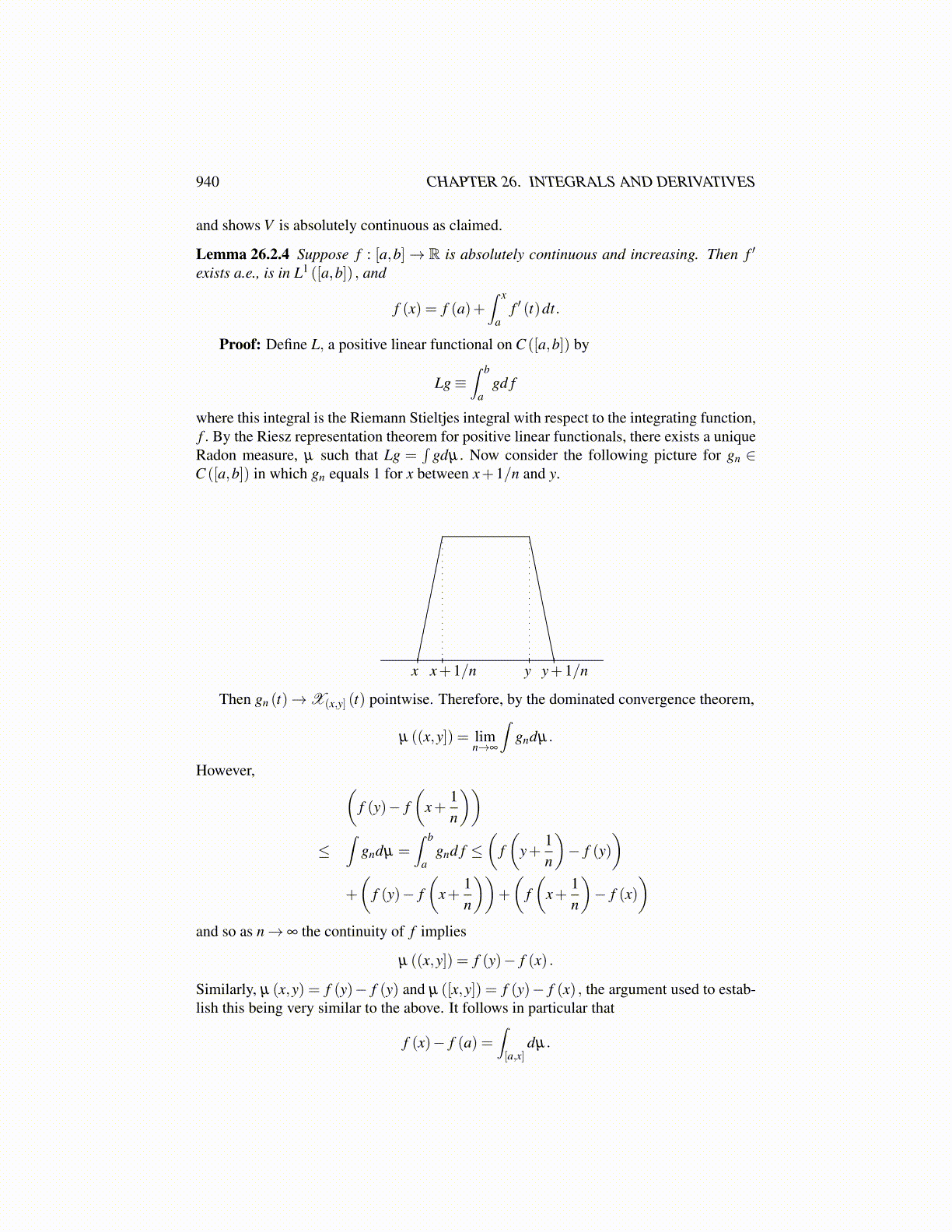
∫gdµ. Now consider the following picture for gn ∈
C ([a,b]) in which gn equals 1 for x between x+1/n and y.
x y+1/nx+1/n y
Then gn (t)→X(x,y] (t) pointwise. Therefore, by the dominated convergence theorem,
µ ((x,y]) = limn→∞
∫gndµ.
However, (f (y)− f
(x+
1n
))≤
∫gndµ =
∫ b
agnd f ≤
(f(
y+1n
)− f (y)
)+
(f (y)− f
(x+
1n
))+
(f(
x+1n
)− f (x)
)and so as n→ ∞ the continuity of f implies
µ ((x,y]) = f (y)− f (x) .
Similarly, µ (x,y) = f (y)− f (y) and µ ([x,y]) = f (y)− f (x) , the argument used to estab-lish this being very similar to the above. It follows in particular that
f (x)− f (a) =∫[a,x]
dµ.