956 CHAPTER 26. INTEGRALS AND DERIVATIVES
Now suppose x,y ∈ Rp and consider∣∣h(x)−h(y)
∣∣. Without loss of generality assumeh(x)≥ h(y) . (If not, repeat the following argument with x and y interchanged.) Pick w∈Ω
such thath(w)+K |y−w|− ε < h(y).
Then ∣∣h(x)−h(y)∣∣= h(x)−h(y)≤ h(w)+K |x−w|−
[h(w)+K |y−w|− ε]≤ K |x−y|+ ε.
Since ε is arbitrary, ∣∣h(x)−h(y)∣∣≤ K |x−y|
26.6 Rademacher’s TheoremIt turns out that Lipschitz functions on Rn can be differentiated a.e. This is called Radem-acher’s theorem. It also can be shown to follow from the Lebesgue theory of differentiation.
26.6.1 Morrey’s InequalityThe following inequality will be called Morrey’s inequality. It relates an expression whichis given pointwise to an integral of the pth power of the derivative.
Lemma 26.6.1 Let u∈C1 (Rn) and p > n. Then there exists a constant, C, depending onlyon n such that for any x, y ∈ Rn,
|u(x)−u(y)|
≤C(∫
B(x,2|x−y|)|∇u(z) |pdz
)1/p(| x− y|(1−n/p)
). (26.6.18)
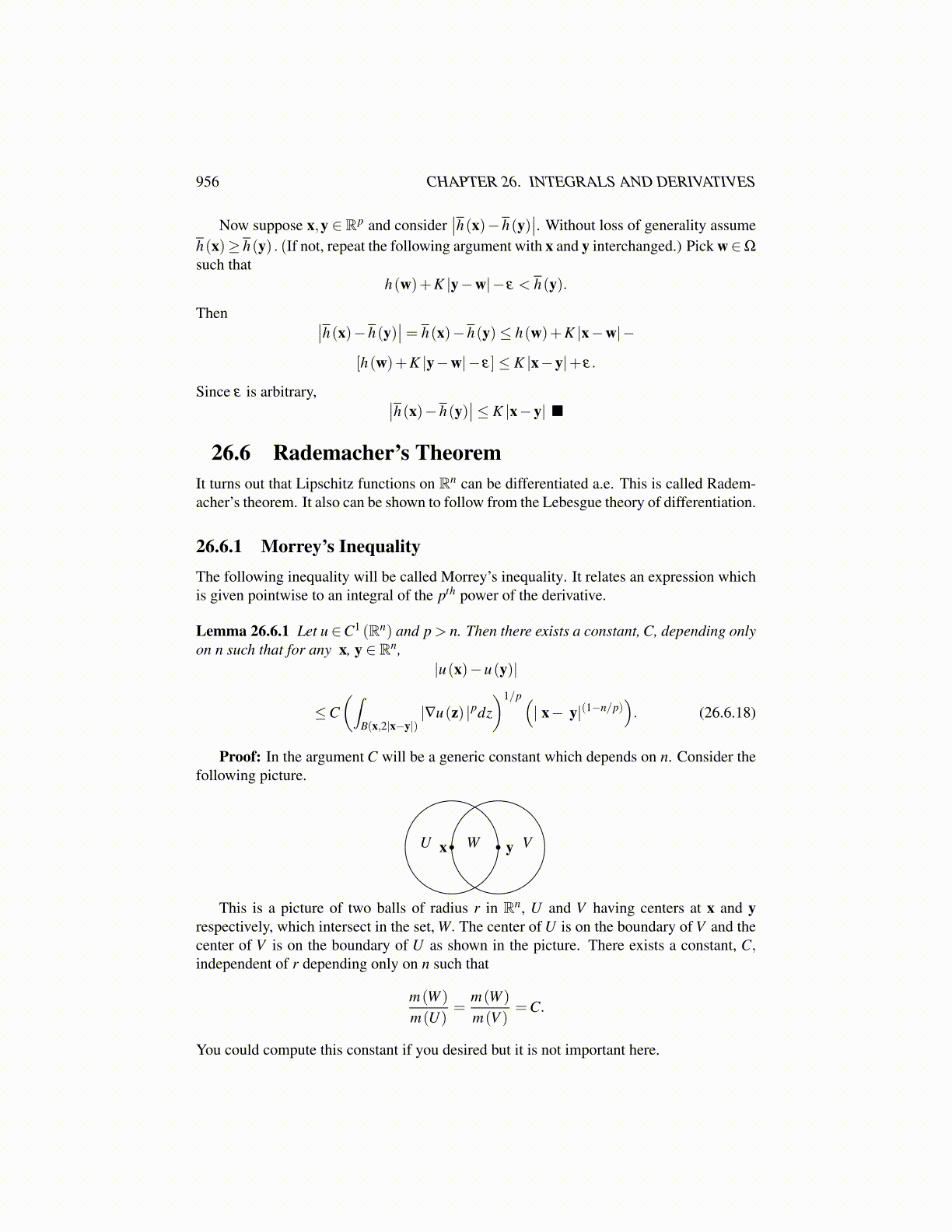
Proof: In the argument C will be a generic constant which depends on n. Consider thefollowing picture.
xU W Vy
This is a picture of two balls of radius r in Rn, U and V having centers at x and yrespectively, which intersect in the set, W. The center of U is on the boundary of V and thecenter of V is on the boundary of U as shown in the picture. There exists a constant, C,independent of r depending only on n such that
m(W )
m(U)=
m(W )
m(V )=C.
You could compute this constant if you desired but it is not important here.