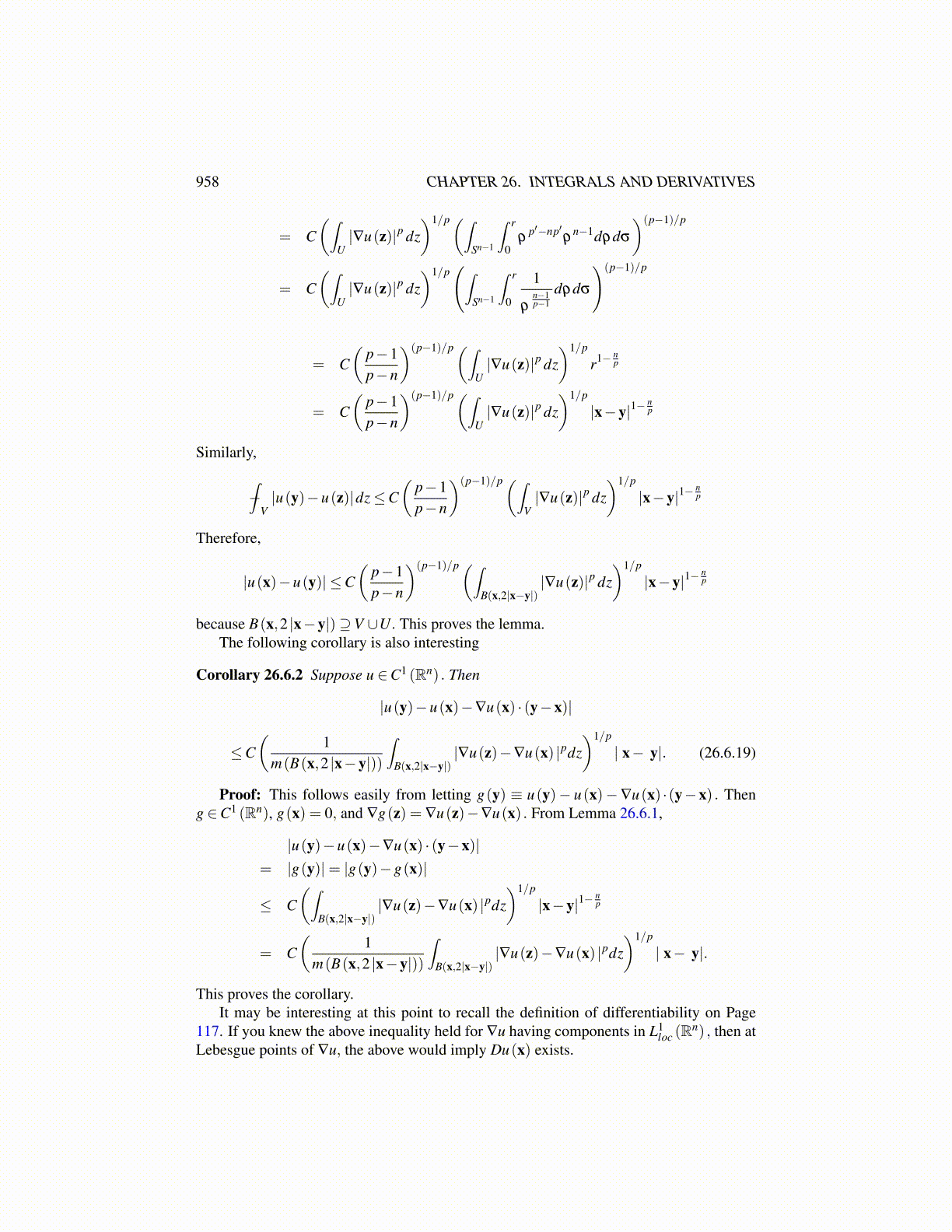
958 CHAPTER 26. INTEGRALS AND DERIVATIVES
= C(∫
U|∇u(z)|p dz
)1/p(∫Sn−1
∫ r
0ρ
p′−np′ρ
n−1dρdσ
)(p−1)/p
= C(∫
U|∇u(z)|p dz
)1/p(∫
Sn−1
∫ r
0
1
ρn−1p−1
dρdσ
)(p−1)/p
= C(
p−1p−n
)(p−1)/p(∫U|∇u(z)|p dz
)1/p
r1− np
= C(
p−1p−n
)(p−1)/p(∫U|∇u(z)|p dz
)1/p
|x−y|1−np
Similarly,∫−
V|u(y)−u(z)|dz≤C
(p−1p−n
)(p−1)/p(∫V|∇u(z)|p dz
)1/p
|x−y|1−np
Therefore,
|u(x)−u(y)| ≤C(
p−1p−n
)(p−1)/p(∫B(x,2|x−y|)
|∇u(z)|p dz)1/p
|x−y|1−np
because B(x,2 |x−y|)⊇V ∪U. This proves the lemma.The following corollary is also interesting
Corollary 26.6.2 Suppose u ∈C1 (Rn) . Then
|u(y)−u(x)−∇u(x) · (y−x)|
≤C(
1m(B(x,2 |x−y|))
∫B(x,2|x−y|)
|∇u(z)−∇u(x) |pdz)1/p
| x− y|. (26.6.19)
Proof: This follows easily from letting g(y) ≡ u(y)− u(x)−∇u(x) ·(y−x) . Theng ∈C1 (Rn), g(x) = 0, and ∇g(z) = ∇u(z)−∇u(x) . From Lemma 26.6.1,
|u(y)−u(x)−∇u(x) · (y−x)|= |g(y)|= |g(y)−g(x)|
≤ C(∫
B(x,2|x−y|)|∇u(z)−∇u(x) |pdz
)1/p
|x−y|1−np
= C(
1m(B(x,2 |x−y|))
∫B(x,2|x−y|)
|∇u(z)−∇u(x) |pdz)1/p
| x− y|.
This proves the corollary.It may be interesting at this point to recall the definition of differentiability on Page
117. If you knew the above inequality held for ∇u having components in L1loc (Rn) , then at
Lebesgue points of ∇u, the above would imply Du(x) exists.