26.7. DIFFERENTIATION OF MEASURES 967
B(0,M)
N∩B(0,M)
H
Bi
Bk(M)
For each x ∈ Bk (M) , there exist arbitrarily small r > 0 such that B(x,r)⊆ B(0,M)\Hand
µ (B(x,r))m(B(x,r))
>1k. (26.7.25)
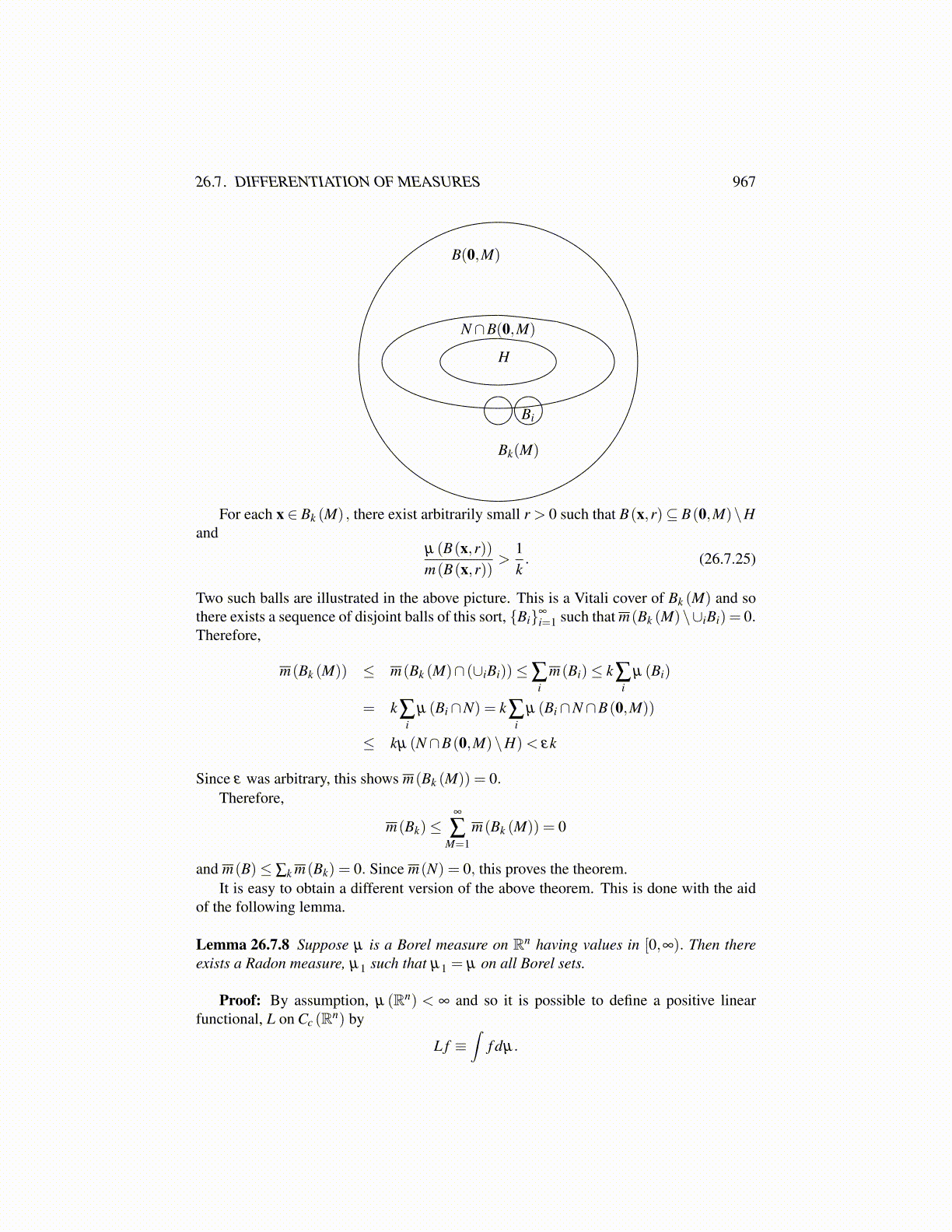
Two such balls are illustrated in the above picture. This is a Vitali cover of Bk (M) and sothere exists a sequence of disjoint balls of this sort, {Bi}∞
i=1 such that m(Bk (M)\∪iBi) = 0.Therefore,
m(Bk (M)) ≤ m(Bk (M)∩ (∪iBi))≤∑i
m(Bi)≤ k∑i
µ (Bi)
= k∑i
µ (Bi∩N) = k∑i
µ (Bi∩N∩B(0,M))
≤ kµ (N∩B(0,M)\H)< εk
Since ε was arbitrary, this shows m(Bk (M)) = 0.Therefore,
m(Bk)≤∞
∑M=1
m(Bk (M)) = 0
and m(B)≤ ∑k m(Bk) = 0. Since m(N) = 0, this proves the theorem.It is easy to obtain a different version of the above theorem. This is done with the aid
of the following lemma.
Lemma 26.7.8 Suppose µ is a Borel measure on Rn having values in [0,∞). Then thereexists a Radon measure, µ1 such that µ1 = µ on all Borel sets.
Proof: By assumption, µ (Rn) < ∞ and so it is possible to define a positive linearfunctional, L on Cc (Rn) by
L f ≡∫
f dµ.