27.1. BASIC THEORY 985
Since r is arbitrary, this shows that f ∈ EA (Ω) which proves the proposition.Next is a comparison of these function spaces for different choices of the N function.
The notation X ↪→Y for two normed linear spaces means X is a subset of Y and the identitymap is continuous.
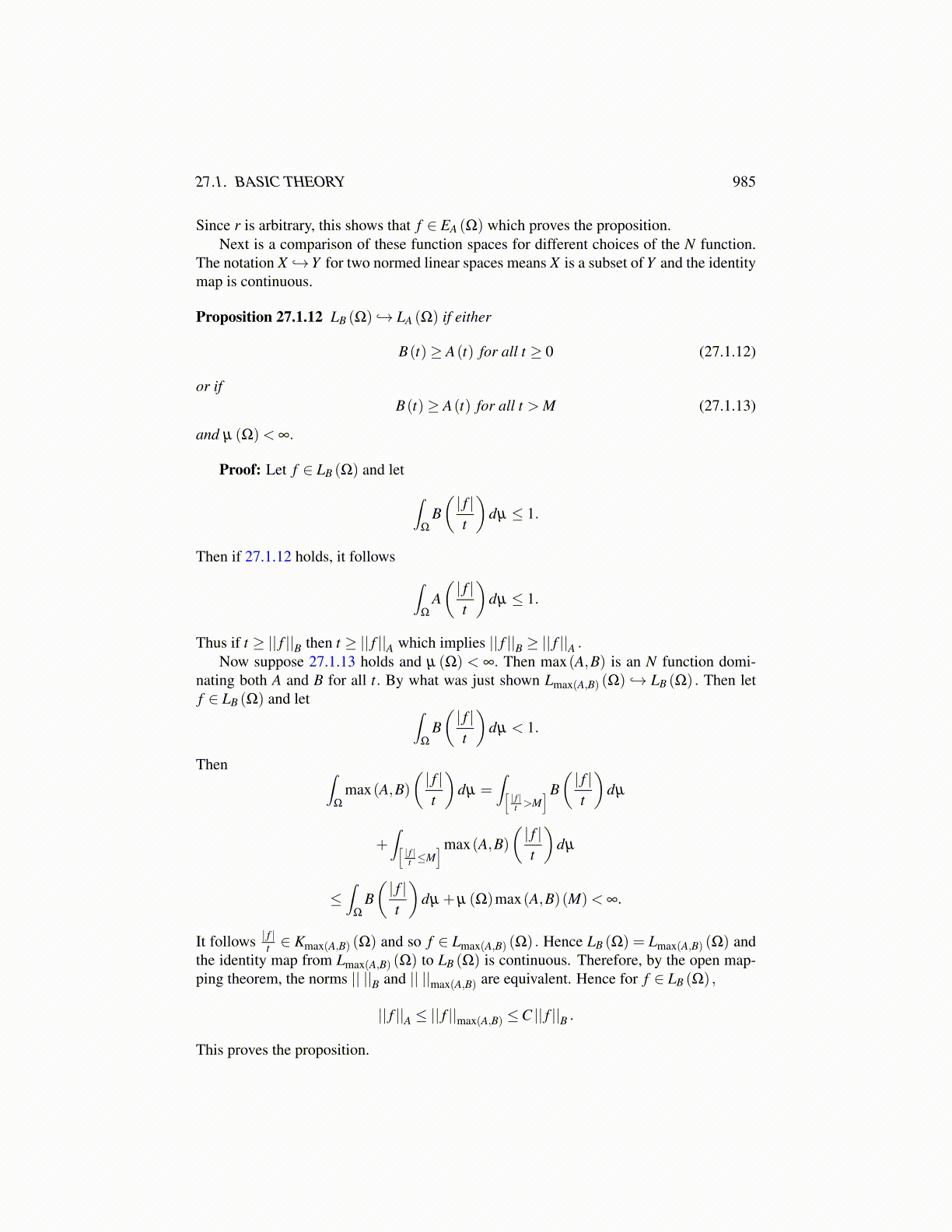
Proposition 27.1.12 LB (Ω) ↪→ LA (Ω) if either
B(t)≥ A(t) for all t ≥ 0 (27.1.12)
or ifB(t)≥ A(t) for all t > M (27.1.13)
and µ (Ω)< ∞.
Proof: Let f ∈ LB (Ω) and let ∫Ω
B(| f |t
)dµ ≤ 1.
Then if 27.1.12 holds, it follows ∫Ω
A(| f |t
)dµ ≤ 1.
Thus if t ≥ || f ||B then t ≥ || f ||A which implies || f ||B ≥ || f ||A .Now suppose 27.1.13 holds and µ (Ω) < ∞. Then max(A,B) is an N function domi-
nating both A and B for all t. By what was just shown Lmax(A,B) (Ω) ↪→ LB (Ω) . Then letf ∈ LB (Ω) and let ∫
Ω
B(| f |t
)dµ < 1.
Then ∫Ω
max(A,B)(| f |t
)dµ =
∫[| f |t >M
]B(| f |t
)dµ
+∫[| f |t ≤M
]max(A,B)(| f |t
)dµ
≤∫
Ω
B(| f |t
)dµ +µ (Ω)max(A,B)(M)< ∞.
It follows | f |t ∈ Kmax(A,B) (Ω) and so f ∈ Lmax(A,B) (Ω) . Hence LB (Ω) = Lmax(A,B) (Ω) andthe identity map from Lmax(A,B) (Ω) to LB (Ω) is continuous. Therefore, by the open map-ping theorem, the norms || ||B and || ||max(A,B) are equivalent. Hence for f ∈ LB (Ω) ,
|| f ||A ≤ || f ||max(A,B) ≤C || f ||B .
This proves the proposition.