988 CHAPTER 27. ORLITZ SPACES
Defining Lv for v ∈ Ã by
Lv (u)≡∫
Ω
uvdµ,
it follows Lv ∈ LA (Ω)′ . From now on assume the measure space is σ finite. That is, thereexist measurable sets, Ωk satisfying the following:
Ω = ∪∞k=1Ωk, µ (Ωk)< ∞, Ωk ⊆Ωk+1.
Then
Proposition 27.2.1 For v ∈ LÃ (Ω) , the following inequality holds.
||v||Ã ≤ ||Lv|| ≤ 2 ||v||Ã .
Here Lv is considered as either an element of EA (Ω)′ or LA (Ω)′ and ||Lv|| refers to theoperator norm in either dual space.
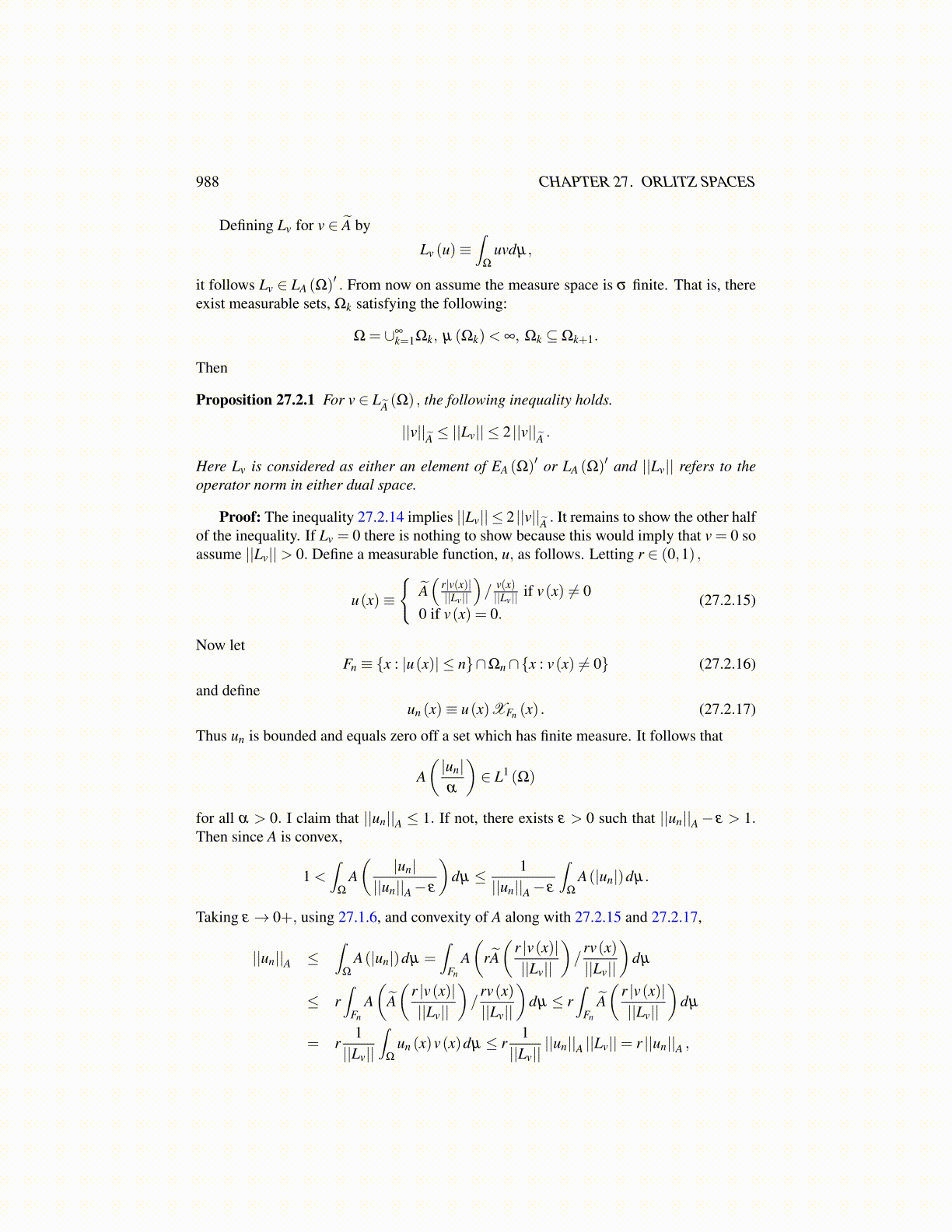
Proof: The inequality 27.2.14 implies ||Lv|| ≤ 2 ||v||Ã . It remains to show the other halfof the inequality. If Lv = 0 there is nothing to show because this would imply that v = 0 soassume ||Lv||> 0. Define a measurable function, u, as follows. Letting r ∈ (0,1) ,
u(x)≡
{Ã(
r|v(x)|||Lv||
)/ v(x)||Lv|| if v(x) ̸= 0
0 if v(x) = 0.(27.2.15)
Now letFn ≡ {x : |u(x)| ≤ n}∩Ωn∩{x : v(x) ̸= 0} (27.2.16)
and defineun (x)≡ u(x)XFn (x) . (27.2.17)
Thus un is bounded and equals zero off a set which has finite measure. It follows that
A(|un|α
)∈ L1 (Ω)
for all α > 0. I claim that ||un||A ≤ 1. If not, there exists ε > 0 such that ||un||A− ε > 1.Then since A is convex,
1 <∫
Ω
A(
|un|||un||A− ε
)dµ ≤ 1
||un||A− ε
∫Ω
A(|un|)dµ.
Taking ε → 0+, using 27.1.6, and convexity of A along with 27.2.15 and 27.2.17,
||un||A ≤∫
Ω
A(|un|)dµ =∫
Fn
A(
rÃ(
r |v(x)|||Lv||
)/
rv(x)||Lv||
)dµ
≤ r∫
Fn
A(
Ã(
r |v(x)|||Lv||
)/
rv(x)||Lv||
)dµ ≤ r
∫Fn
Ã(
r |v(x)|||Lv||
)dµ
= r1||Lv||
∫Ω
un (x)v(x)dµ ≤ r1||Lv||
||un||A ||Lv||= r ||un||A ,