28.2. H p AND mp 997
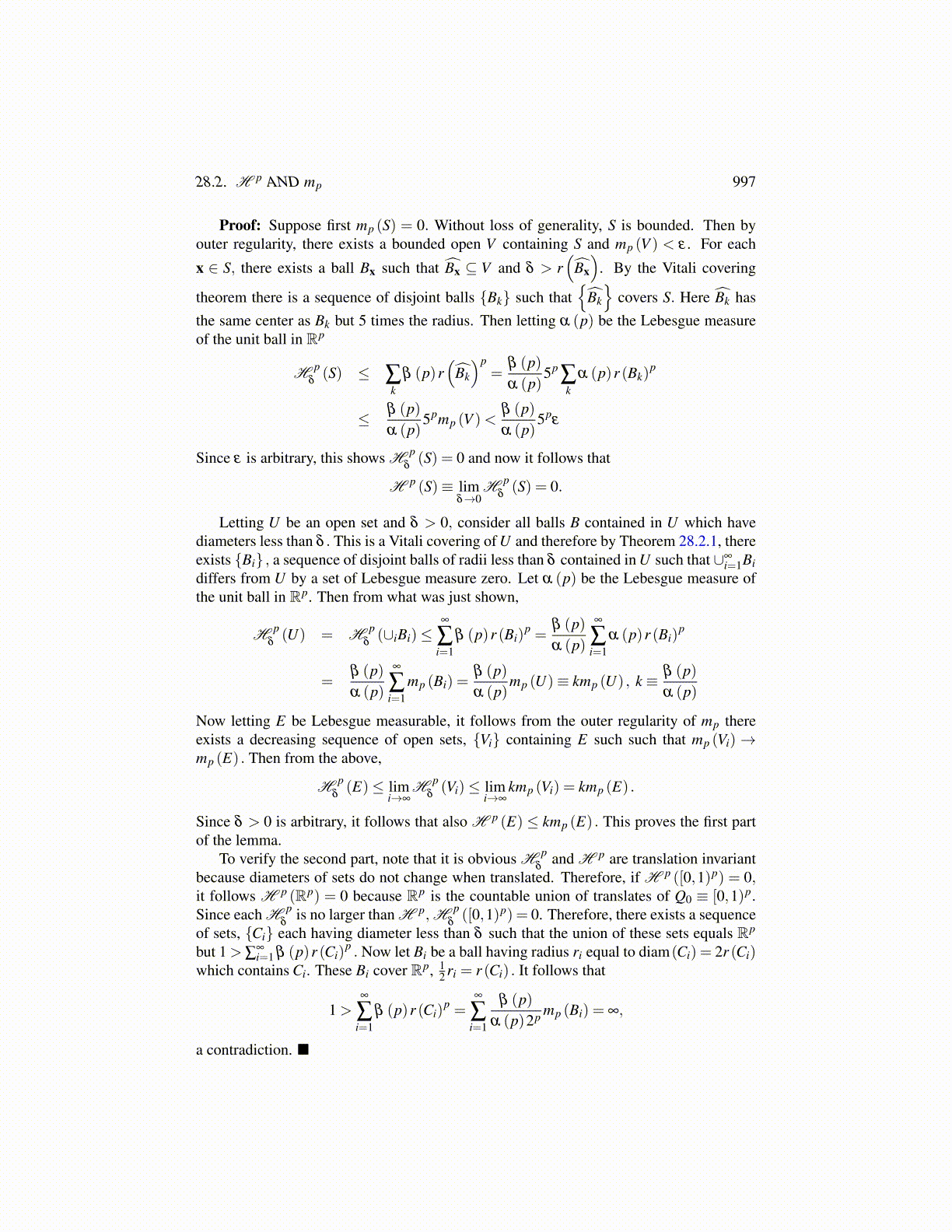
Proof: Suppose first mp (S) = 0. Without loss of generality, S is bounded. Then byouter regularity, there exists a bounded open V containing S and mp (V ) < ε . For each
x ∈ S, there exists a ball Bx such that B̂x ⊆ V and δ > r(
B̂x
). By the Vitali covering
theorem there is a sequence of disjoint balls {Bk} such that{
B̂k
}covers S. Here B̂k has
the same center as Bk but 5 times the radius. Then letting α (p) be the Lebesgue measureof the unit ball in Rp
H pδ(S) ≤ ∑
kβ (p)r
(B̂k
)p=
β (p)α (p)
5p∑k
α (p)r (Bk)p
≤ β (p)α (p)
5pmp (V )<β (p)α (p)
5pε
Since ε is arbitrary, this shows H pδ(S) = 0 and now it follows that
H p (S)≡ limδ→0
H pδ(S) = 0.
Letting U be an open set and δ > 0, consider all balls B contained in U which havediameters less than δ . This is a Vitali covering of U and therefore by Theorem 28.2.1, thereexists {Bi} , a sequence of disjoint balls of radii less than δ contained in U such that ∪∞
i=1Bidiffers from U by a set of Lebesgue measure zero. Let α (p) be the Lebesgue measure ofthe unit ball in Rp. Then from what was just shown,
H pδ(U) = H p
δ(∪iBi)≤
∞
∑i=1
β (p)r (Bi)p =
β (p)α (p)
∞
∑i=1
α (p)r (Bi)p
=β (p)α (p)
∞
∑i=1
mp (Bi) =β (p)α (p)
mp (U)≡ kmp (U) , k ≡ β (p)α (p)
Now letting E be Lebesgue measurable, it follows from the outer regularity of mp thereexists a decreasing sequence of open sets, {Vi} containing E such such that mp (Vi)→mp (E) . Then from the above,
H pδ(E)≤ lim
i→∞H p
δ(Vi)≤ lim
i→∞kmp (Vi) = kmp (E) .
Since δ > 0 is arbitrary, it follows that also H p (E) ≤ kmp (E) . This proves the first partof the lemma.
To verify the second part, note that it is obvious H pδ
and H p are translation invariantbecause diameters of sets do not change when translated. Therefore, if H p ([0,1)p) = 0,it follows H p (Rp) = 0 because Rp is the countable union of translates of Q0 ≡ [0,1)p.Since each H p
δis no larger than H p, H p
δ([0,1)p) = 0. Therefore, there exists a sequence
of sets, {Ci} each having diameter less than δ such that the union of these sets equals Rp
but 1 > ∑∞i=1 β (p)r (Ci)
p . Now let Bi be a ball having radius ri equal to diam(Ci) = 2r (Ci)which contains Ci. These Bi cover Rp, 1
2 ri = r (Ci) . It follows that
1 >∞
∑i=1
β (p)r (Ci)p =
∞
∑i=1
β (p)α (p)2p mp (Bi) = ∞,
a contradiction.