28.3. TECHNICAL CONSIDERATIONS 999
This inequality may seem obvious at first but it is not really. The reason it is not is thatthere are sets which are not subsets of any sphere having the same diameter as the set. Forexample, consider an equilateral triangle.
Lemma 28.3.1 Let f : Rn−1→ [0,∞) be Borel measurable and let
S = {(x,y) :|y|< f (x)}.
Then S is a Borel set in Rn.
Proof: Set sk be an increasing sequence of Borel measurable functions convergingpointwise to f .
sk(x) =Nk
∑m=1
ckmXEk
m(x).
LetSk = ∪Nk
m=1Ekm× (−ck
m,ckm).
Then (x,y) ∈ Sk if and only if f (x) > 0 and |y| < sk(x) ≤ f (x). It follows that Sk ⊆ Sk+1and
S = ∪∞k=1Sk.
But each Sk is a Borel set and so S is also a Borel set. This proves the lemma.Let Pi be the projection onto
span(e1, · · ·,ei−1,ei+1, · · · ,en)
where the ek are the standard basis vectors in Rn, ek being the vector having a 1 in the kth
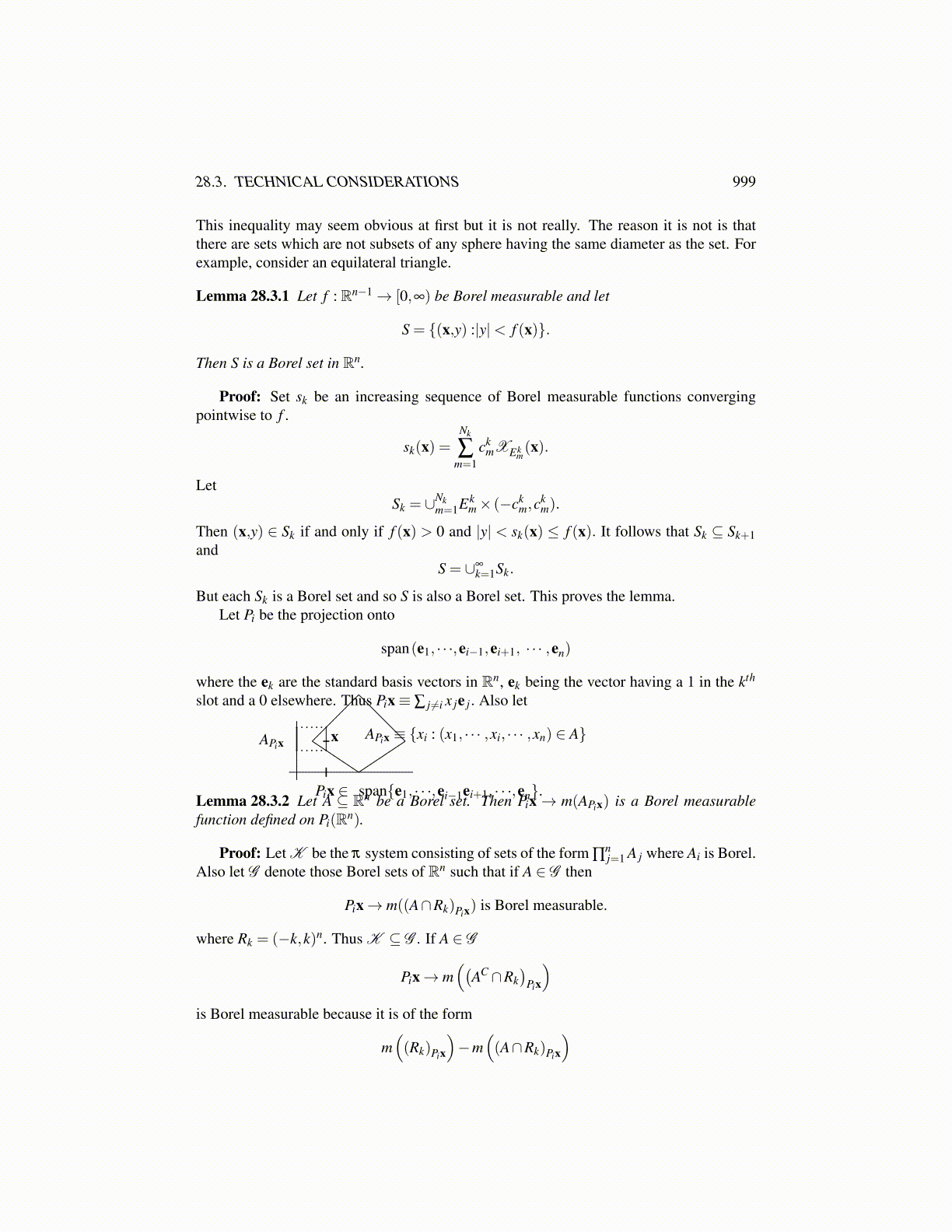
slot and a 0 elsewhere. Thus Pix≡ ∑ j ̸=i x je j. Also let
APix ≡ {xi : (x1, · · · ,xi, · · · ,xn) ∈ A}xAPix
Pix ∈ span{e1, · · ·,ei−1ei+1, · · ·,en}.Lemma 28.3.2 Let A ⊆ Rn be a Borel set. Then Pix→ m(APix) is a Borel measurablefunction defined on Pi(Rn).
Proof: Let K be the π system consisting of sets of the form ∏nj=1 A j where Ai is Borel.
Also let G denote those Borel sets of Rn such that if A ∈ G then
Pix→ m((A∩Rk)Pix) is Borel measurable.
where Rk = (−k,k)n. Thus K ⊆ G . If A ∈ G
Pix→ m((
AC ∩Rk)
Pix
)is Borel measurable because it is of the form
m((Rk)Pix
)−m
((A∩Rk)Pix
)