13.3. COMPUTING GENERALIZED INTEGRALS 311
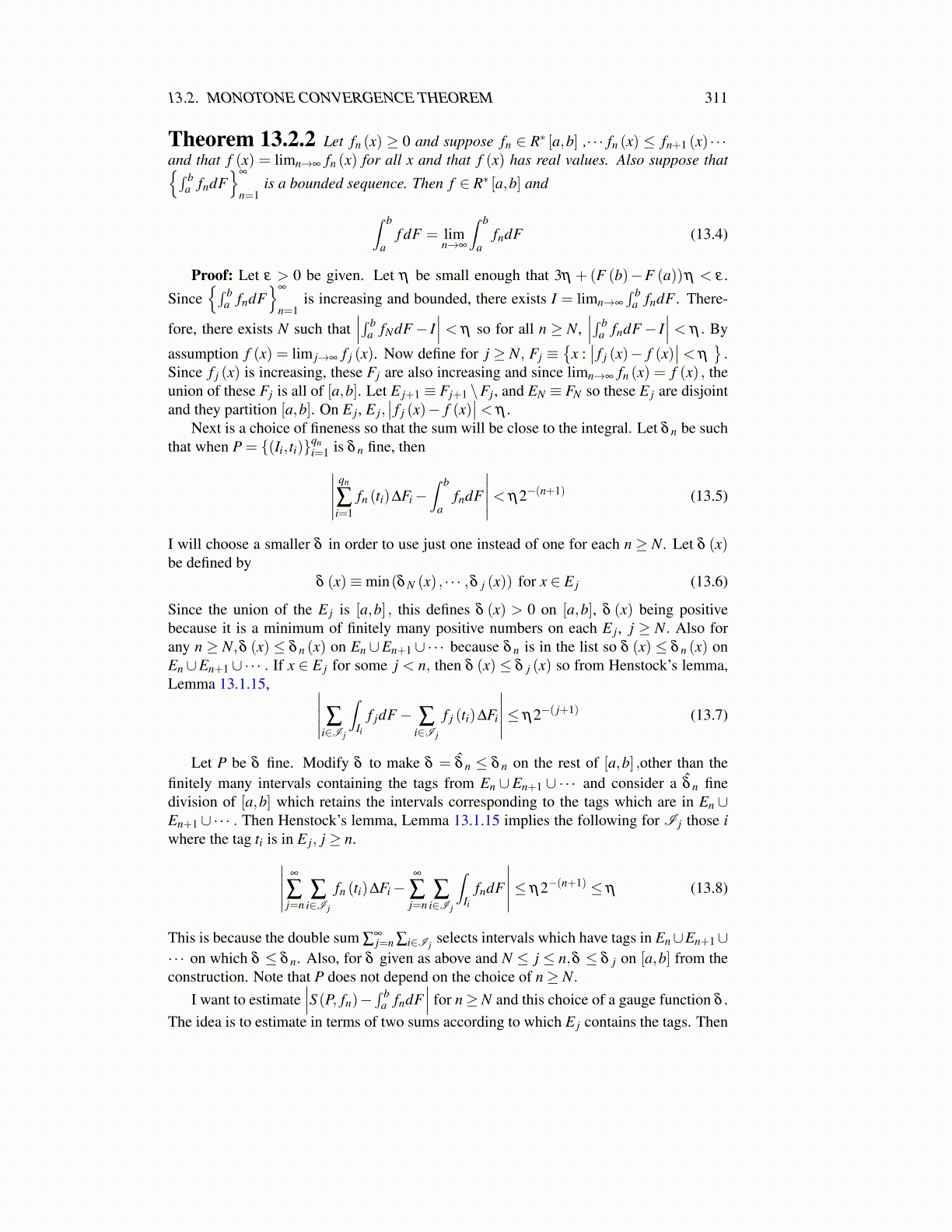
which comes from 13.7. Next consider 13.14. Since ti ∈ E j, this term satisfies∣∣∣∣∣n−1
∑j=N
∑i∈I j
f j (ti)∆Fi−n−1
∑j=N
∑i∈I j
fn (ti)∆Fi
∣∣∣∣∣≤
n−1
∑j=N
∑i∈I j
( fn (ti)− f j (ti))∆Fi ≤n−1
∑j=N
∑i∈I j
η∆Fi ≤ η (F (b)−F (a))
Since fn (ti)− f j (ti)≤ f (ti)− f j (ti)< η . It follows that∣∣∣∣S (P, fn)−∫ b
afndF
∣∣∣∣ ≤ η +η +η +η (F (b)−F (a))
< 3η +η (F (b)−F (a))< ε.
Now let n→ ∞ and this yields |S (P, f )− I| =∣∣∣S (P, f )− limn→∞
∫ ba fndF
∣∣∣ < ε . Since ε is
arbitrary, it follows that f ∈ R∗ [a,b] and I =∫ b
a f dF.
13.3 Computing Generalized IntegralsHere we give some idea of how to compute these generalized Riemann integrals. It turnsout they can integrate many things which the earlier Riemann Stieltjes integral cannot. Inparticular, you can have jumps in the integrator function at points of discontinuity of thefunction. You can also integrate functions which are continuous nowhere.
Example 13.3.1 Let
f (x) ={
1 if x ∈Q0 if x /∈Q
Then f ∈ R∗ [0,1] and for F (x) = x, ∫ 1
0f dF = 0.
This is obvious. Let fn (x) equal 1 on the first n rational numbers in an enumerationof the rationals and zero everywhere else. Clearly fn (x) ↑ f (x) for every x and also fn isRiemann integrable and has integral 0. Now apply the monotone convergence theorem.Note this example is one which has no Riemann or Darboux integral.
Example 13.3.2 Let F (x) be an integrator function given by
F (x)≡
0 if x≤ 11 if x ∈ (1,2)2 if x≥ 2
Thus this has a jump at 1 and 2. Let f (x) = X(1,2) (x). We assume x ∈[0,3√
2]
where the
fact√
2 is irrational is convenient. Note that here the integrator function and the functionbeing integrated are both discontinuous at the two points 1,2.