10.4. SPHERICAL COORDINATES IN p DIMENSIONS 249
Observe that#(y) = n(y) a.e. (10.6)
because n(y) = #(y) if y /∈ h(Z), a set of measure 0. Therefore, # is a measurable functionbecause of completeness of Lebesgue measure.
Theorem 10.3.3 Let g≥ 0, g measurable, and let h be C1(U). Then∫h(U)
#(y)g(y)dmp =∫
Ug(h(x))|detDh(x)|dmp. (10.7)
In fact, you can have E some Borel measurable subset of U and conclude that∫h(E)
#(y)g(y)dmp =∫
Eg(h(x))|detDh(x)|dmp
Proof: From 10.6 and Lemma 10.3.1, 10.7 holds for all g, a nonnegative simple func-tion. Approximating an arbitrary measurable nonnegative function g, with an increasingpointwise convergent sequence of simple functions and using the monotone convergencetheorem, yields 10.7 for an arbitrary nonnegative measurable function g. To get the lastclaim, simply replace g with gXh(E) in the first formula. ■
10.4 Spherical Coordinates in p DimensionsSometimes there is a need to deal with spherical coordinates in more than three dimen-sions. In this section, this concept is defined and formulas are derived for these coordinatesystems. Recall polar coordinates are of the form
y1 = ρ cosθ
y2 = ρ sinθ
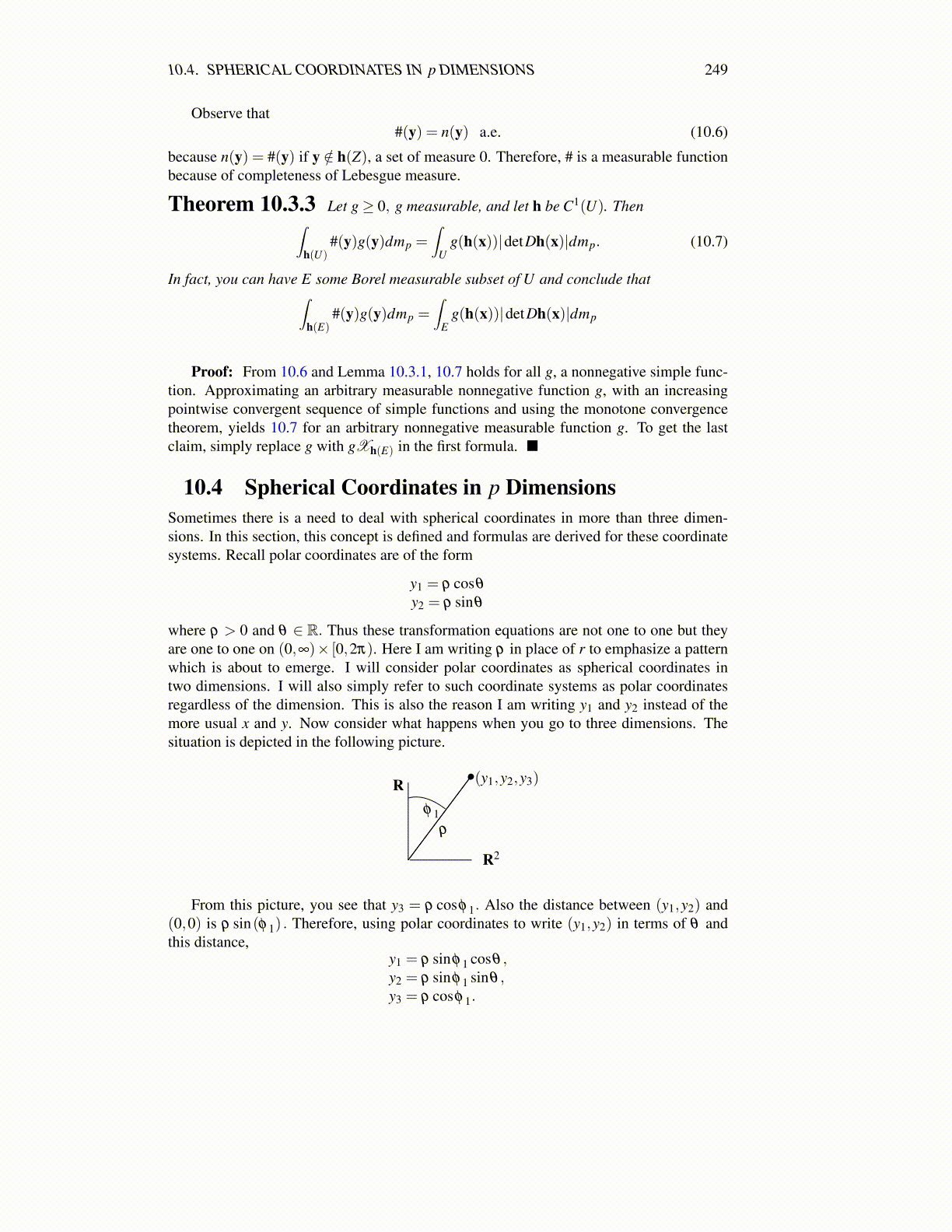
where ρ > 0 and θ ∈ R. Thus these transformation equations are not one to one but theyare one to one on (0,∞)× [0,2π). Here I am writing ρ in place of r to emphasize a patternwhich is about to emerge. I will consider polar coordinates as spherical coordinates intwo dimensions. I will also simply refer to such coordinate systems as polar coordinatesregardless of the dimension. This is also the reason I am writing y1 and y2 instead of themore usual x and y. Now consider what happens when you go to three dimensions. Thesituation is depicted in the following picture.
φ 1ρ
•(y1,y2,y3)
R2
R
From this picture, you see that y3 = ρ cosφ 1. Also the distance between (y1,y2) and(0,0) is ρ sin(φ 1) . Therefore, using polar coordinates to write (y1,y2) in terms of θ andthis distance,
y1 = ρ sinφ 1 cosθ ,y2 = ρ sinφ 1 sinθ ,y3 = ρ cosφ 1.