250 CHAPTER 10. CHANGE OF VARIABLES
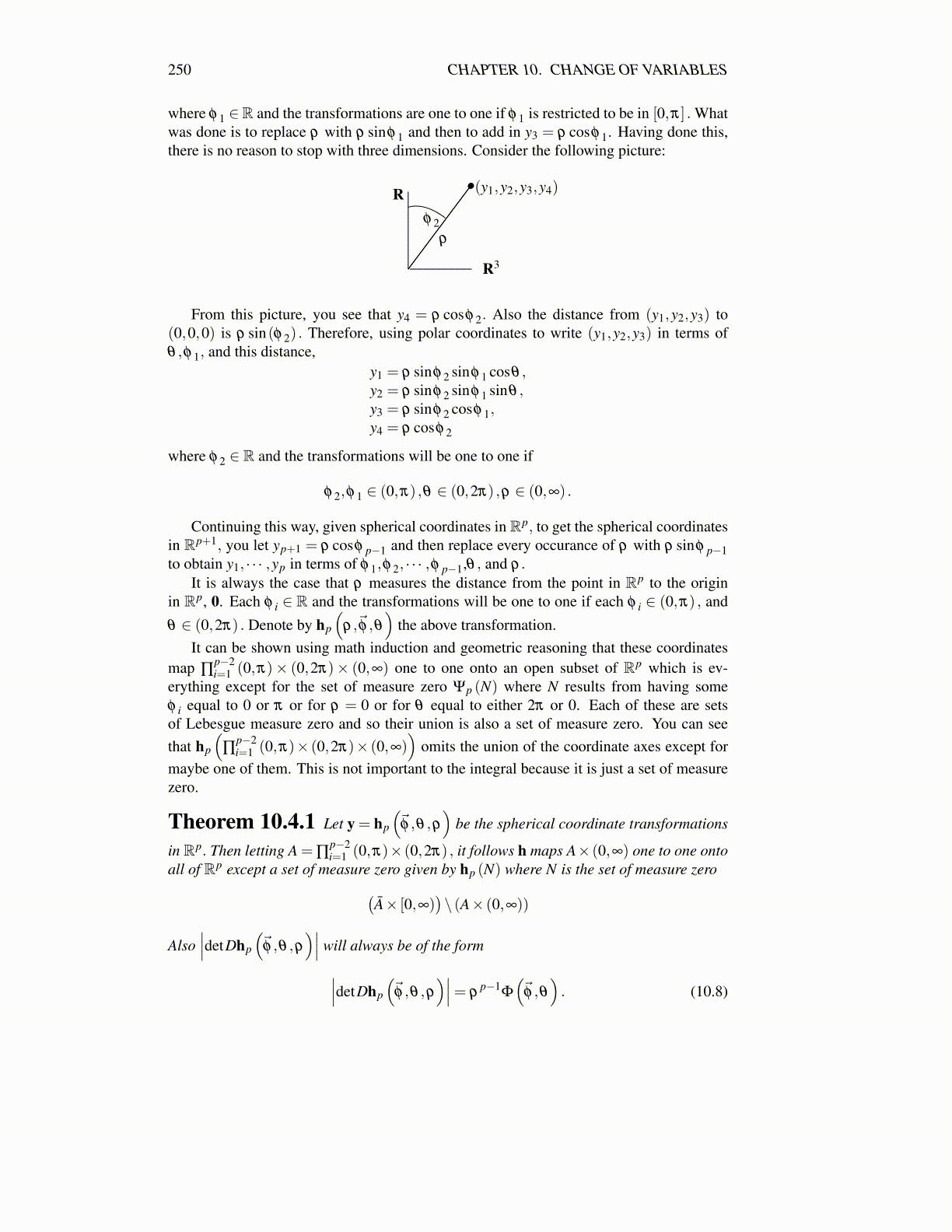
where φ 1 ∈R and the transformations are one to one if φ 1 is restricted to be in [0,π] . Whatwas done is to replace ρ with ρ sinφ 1 and then to add in y3 = ρ cosφ 1. Having done this,there is no reason to stop with three dimensions. Consider the following picture:
φ 2ρ
•(y1,y2,y3,y4)
R3
R
From this picture, you see that y4 = ρ cosφ 2. Also the distance from (y1,y2,y3) to(0,0,0) is ρ sin(φ 2) . Therefore, using polar coordinates to write (y1,y2,y3) in terms ofθ ,φ 1, and this distance,
y1 = ρ sinφ 2 sinφ 1 cosθ ,y2 = ρ sinφ 2 sinφ 1 sinθ ,y3 = ρ sinφ 2 cosφ 1,y4 = ρ cosφ 2
where φ 2 ∈ R and the transformations will be one to one if
φ 2,φ 1 ∈ (0,π) ,θ ∈ (0,2π) ,ρ ∈ (0,∞) .
Continuing this way, given spherical coordinates in Rp, to get the spherical coordinatesin Rp+1, you let yp+1 = ρ cosφ p−1 and then replace every occurance of ρ with ρ sinφ p−1to obtain y1, · · · ,yp in terms of φ 1,φ 2, · · · ,φ p−1,θ , and ρ.
It is always the case that ρ measures the distance from the point in Rp to the originin Rp, 0. Each φ i ∈ R and the transformations will be one to one if each φ i ∈ (0,π) , and
θ ∈ (0,2π) . Denote by hp
(ρ, φ⃗ ,θ
)the above transformation.
It can be shown using math induction and geometric reasoning that these coordinatesmap ∏
p−2i=1 (0,π)× (0,2π)× (0,∞) one to one onto an open subset of Rp which is ev-
erything except for the set of measure zero Ψp (N) where N results from having someφ i equal to 0 or π or for ρ = 0 or for θ equal to either 2π or 0. Each of these are setsof Lebesgue measure zero and so their union is also a set of measure zero. You can seethat hp
(∏
p−2i=1 (0,π)× (0,2π)× (0,∞)
)omits the union of the coordinate axes except for
maybe one of them. This is not important to the integral because it is just a set of measurezero.
Theorem 10.4.1 Let y = hp
(⃗φ ,θ ,ρ
)be the spherical coordinate transformations
in Rp. Then letting A = ∏p−2i=1 (0,π)× (0,2π) , it follows h maps A× (0,∞) one to one onto
all of Rp except a set of measure zero given by hp (N) where N is the set of measure zero(Ā× [0,∞)
)\ (A× (0,∞))
Also∣∣∣detDhp
(⃗φ ,θ ,ρ
)∣∣∣ will always be of the form∣∣∣detDhp
(⃗φ ,θ ,ρ
)∣∣∣= ρp−1
Φ
(⃗φ ,θ
). (10.8)