10.4. SPHERICAL COORDINATES IN p DIMENSIONS 251
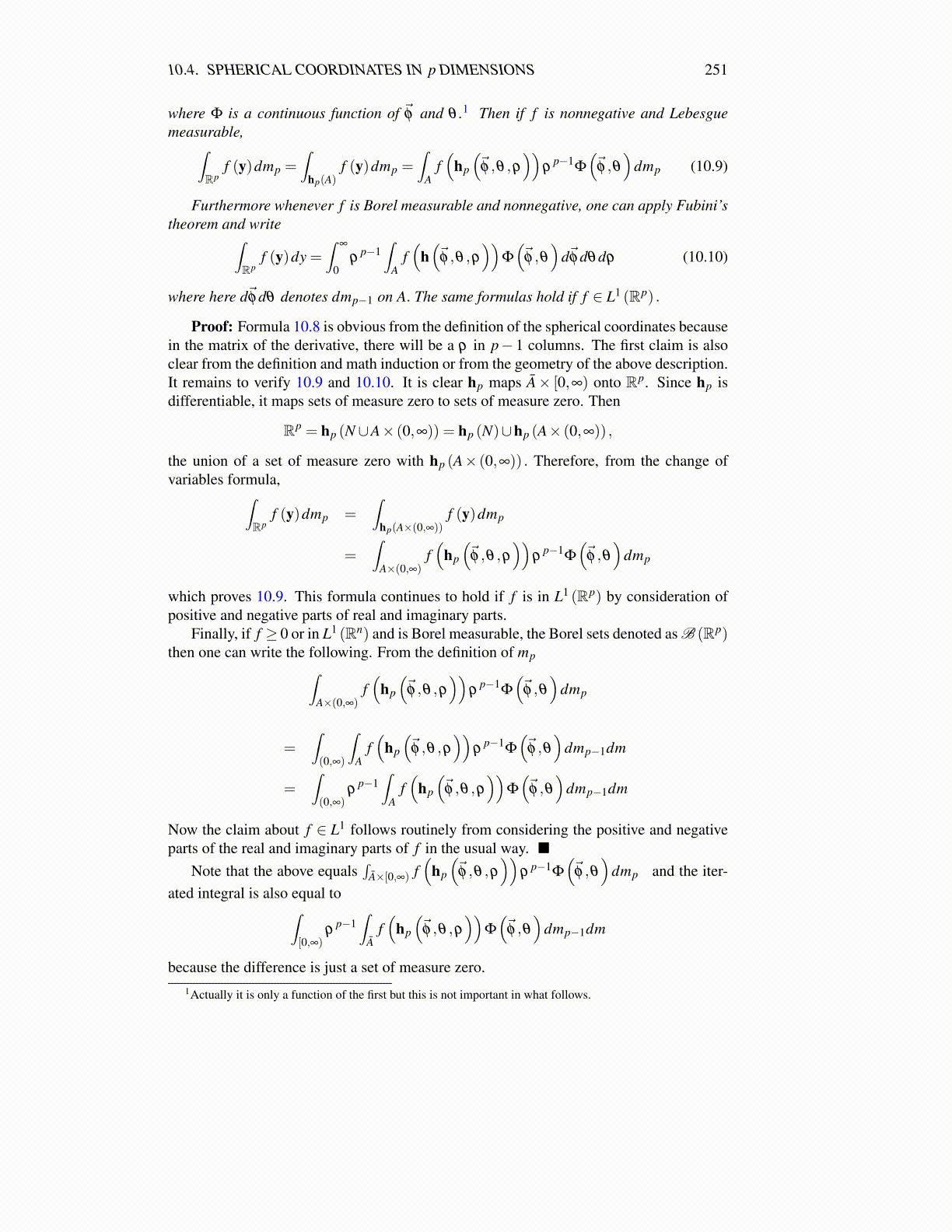
where Φ is a continuous function of φ⃗ and θ .1 Then if f is nonnegative and Lebesguemeasurable,∫
Rpf (y)dmp =
∫hp(A)
f (y)dmp =∫
Af(
hp
(⃗φ ,θ ,ρ
))ρ
p−1Φ
(⃗φ ,θ
)dmp (10.9)
Furthermore whenever f is Borel measurable and nonnegative, one can apply Fubini’stheorem and write∫
Rpf (y)dy =
∫∞
0ρ
p−1∫
Af(
h(⃗
φ ,θ ,ρ))
Φ
(⃗φ ,θ
)dφ⃗dθdρ (10.10)
where here dφ⃗dθ denotes dmp−1 on A. The same formulas hold if f ∈ L1 (Rp) .
Proof: Formula 10.8 is obvious from the definition of the spherical coordinates becausein the matrix of the derivative, there will be a ρ in p− 1 columns. The first claim is alsoclear from the definition and math induction or from the geometry of the above description.It remains to verify 10.9 and 10.10. It is clear hp maps Ā× [0,∞) onto Rp. Since hp isdifferentiable, it maps sets of measure zero to sets of measure zero. Then
Rp = hp (N∪A× (0,∞)) = hp (N)∪hp (A× (0,∞)) ,
the union of a set of measure zero with hp (A× (0,∞)) . Therefore, from the change ofvariables formula,∫
Rpf (y)dmp =
∫hp(A×(0,∞))
f (y)dmp
=∫
A×(0,∞)f(
hp
(⃗φ ,θ ,ρ
))ρ
p−1Φ
(⃗φ ,θ
)dmp
which proves 10.9. This formula continues to hold if f is in L1 (Rp) by consideration ofpositive and negative parts of real and imaginary parts.
Finally, if f ≥ 0 or in L1 (Rn) and is Borel measurable, the Borel sets denoted as B (Rp)then one can write the following. From the definition of mp∫
A×(0,∞)f(
hp
(⃗φ ,θ ,ρ
))ρ
p−1Φ
(⃗φ ,θ
)dmp
=∫(0,∞)
∫A
f(
hp
(⃗φ ,θ ,ρ
))ρ
p−1Φ
(⃗φ ,θ
)dmp−1dm
=∫(0,∞)
ρp−1
∫A
f(
hp
(⃗φ ,θ ,ρ
))Φ
(⃗φ ,θ
)dmp−1dm
Now the claim about f ∈ L1 follows routinely from considering the positive and negativeparts of the real and imaginary parts of f in the usual way. ■
Note that the above equals∫
Ā×[0,∞) f(
hp
(⃗φ ,θ ,ρ
))ρ p−1Φ
(⃗φ ,θ
)dmp and the iter-
ated integral is also equal to∫[0,∞)
ρp−1
∫Ā
f(
hp
(⃗φ ,θ ,ρ
))Φ
(⃗φ ,θ
)dmp−1dm
because the difference is just a set of measure zero.1Actually it is only a function of the first but this is not important in what follows.