10.7. SEPARABILITY 257
and since x is arbitrary, this establishes uniform convergence. ■Here is an easier proof if you know the Weierstrass approximation theorem.
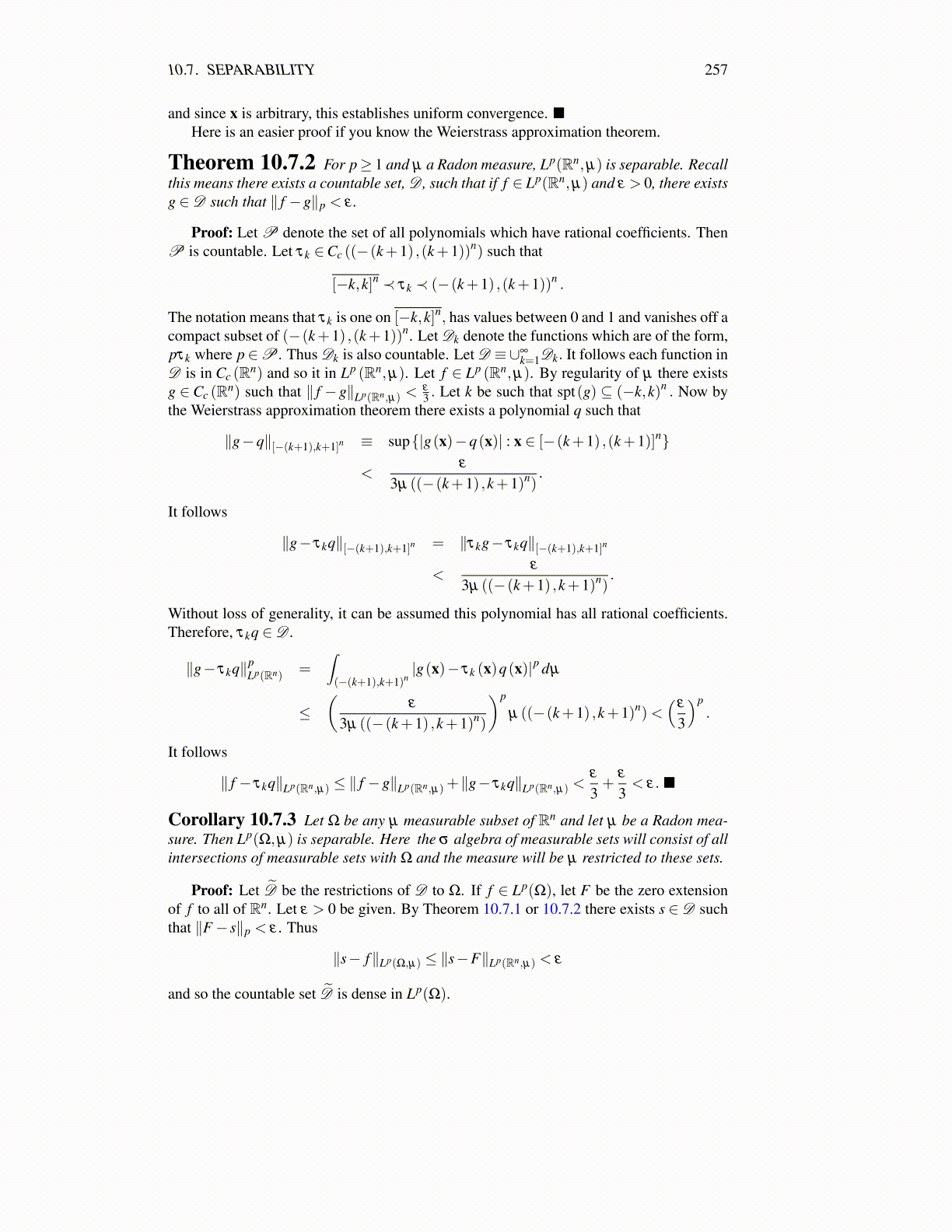
Theorem 10.7.2 For p≥ 1 and µ a Radon measure, Lp(Rn,µ) is separable. Recallthis means there exists a countable set, D , such that if f ∈ Lp(Rn,µ) and ε > 0, there existsg ∈D such that ∥ f −g∥p < ε .
Proof: Let P denote the set of all polynomials which have rational coefficients. ThenP is countable. Let τk ∈Cc ((−(k+1) ,(k+1))n) such that
[−k,k]n ≺ τk ≺ (−(k+1) ,(k+1))n .
The notation means that τk is one on [−k,k]n, has values between 0 and 1 and vanishes off acompact subset of (−(k+1) ,(k+1))n. Let Dk denote the functions which are of the form,pτk where p∈P . Thus Dk is also countable. Let D ≡∪∞
k=1Dk. It follows each function inD is in Cc (Rn) and so it in Lp (Rn,µ). Let f ∈ Lp (Rn,µ). By regularity of µ there existsg ∈Cc (Rn) such that ∥ f −g∥Lp(Rn,µ) <
ε
3 . Let k be such that spt(g) ⊆ (−k,k)n . Now bythe Weierstrass approximation theorem there exists a polynomial q such that
∥g−q∥[−(k+1),k+1]n ≡ sup{|g(x)−q(x)| : x ∈ [−(k+1) ,(k+1)]n}
<ε
3µ ((−(k+1) ,k+1)n).
It follows
∥g− τkq∥[−(k+1),k+1]n = ∥τkg− τkq∥[−(k+1),k+1]n
<ε
3µ ((−(k+1) ,k+1)n).
Without loss of generality, it can be assumed this polynomial has all rational coefficients.Therefore, τkq ∈D .
∥g− τkq∥pLp(Rn)
=∫(−(k+1),k+1)n
|g(x)− τk (x)q(x)|p dµ
≤(
ε
3µ ((−(k+1) ,k+1)n)
)p
µ ((−(k+1) ,k+1)n)<(
ε
3
)p.
It follows
∥ f − τkq∥Lp(Rn,µ) ≤ ∥ f −g∥Lp(Rn,µ)+∥g− τkq∥Lp(Rn,µ) <ε
3+
ε
3< ε. ■
Corollary 10.7.3 Let Ω be any µ measurable subset of Rn and let µ be a Radon mea-sure. Then Lp(Ω,µ) is separable. Here the σ algebra of measurable sets will consist of allintersections of measurable sets with Ω and the measure will be µ restricted to these sets.
Proof: Let D̃ be the restrictions of D to Ω. If f ∈ Lp(Ω), let F be the zero extensionof f to all of Rn. Let ε > 0 be given. By Theorem 10.7.1 or 10.7.2 there exists s ∈D suchthat ∥F− s∥p < ε . Thus
∥s− f∥Lp(Ω,µ) ≤ ∥s−F∥Lp(Rn,µ) < ε
and so the countable set D̃ is dense in Lp(Ω).