258 CHAPTER 10. CHANGE OF VARIABLES
10.8 Green’s TheoremIt will always be assumed in this section that the bounding curves are piecewise C1 mean-ing that there is a parametrization t → R(t) ≡ (x(t) ,y(t)) for t ∈ [a,b] and a partition of[a,b] ,{x0, · · · ,xn} such that x,y are C1 ([xi−1,xi]).
Definition 10.8.1 Here and elsewhere, an open connected set will be called a re-gion unless another use for this term is specified.
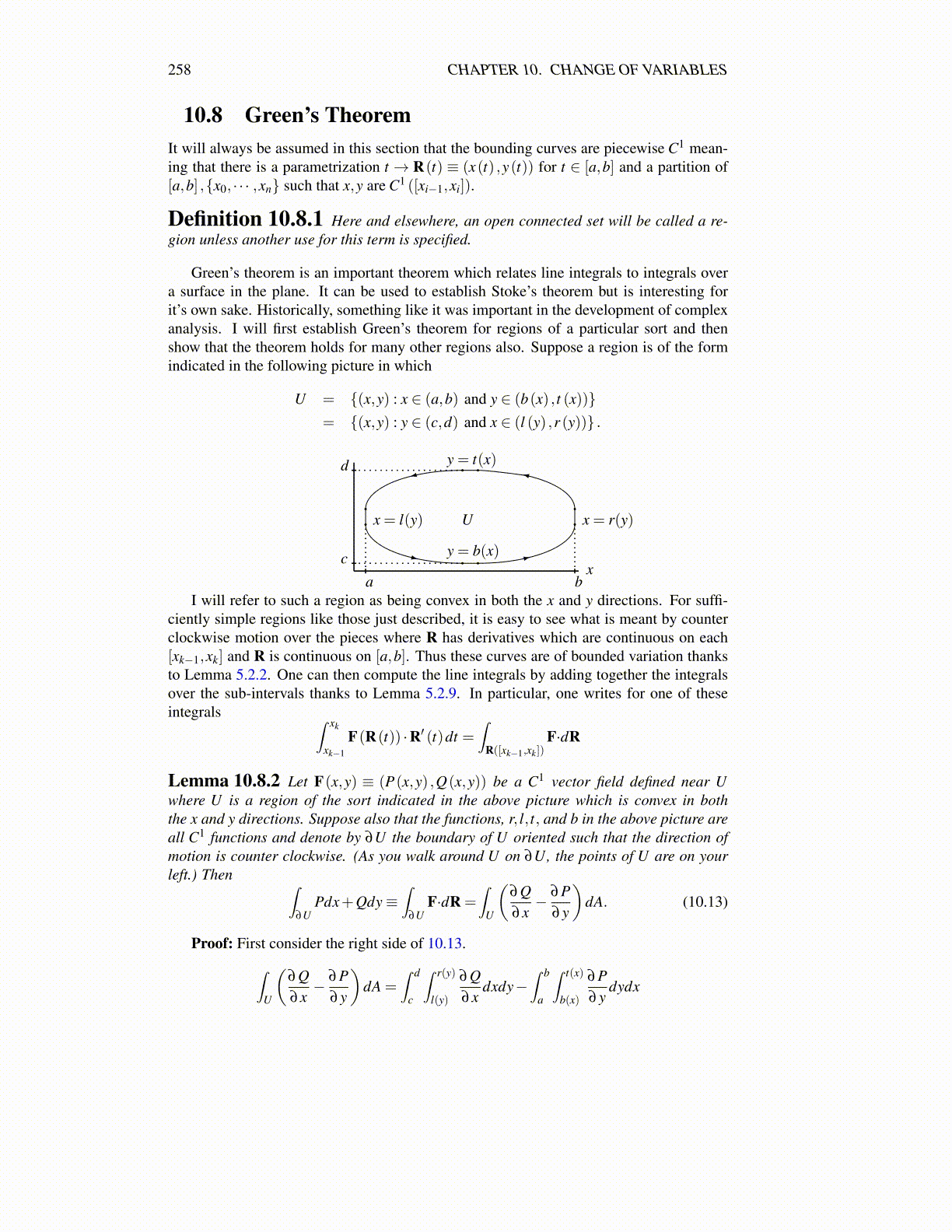
Green’s theorem is an important theorem which relates line integrals to integrals overa surface in the plane. It can be used to establish Stoke’s theorem but is interesting forit’s own sake. Historically, something like it was important in the development of complexanalysis. I will first establish Green’s theorem for regions of a particular sort and thenshow that the theorem holds for many other regions also. Suppose a region is of the formindicated in the following picture in which
U = {(x,y) : x ∈ (a,b) and y ∈ (b(x) , t (x))}= {(x,y) : y ∈ (c,d) and x ∈ (l (y) ,r (y))} .
U x = r(y)x = l(y)
y = t(x)
y = b(x)c
d
a bx
I will refer to such a region as being convex in both the x and y directions. For suffi-ciently simple regions like those just described, it is easy to see what is meant by counterclockwise motion over the pieces where R has derivatives which are continuous on each[xk−1,xk] and R is continuous on [a,b]. Thus these curves are of bounded variation thanksto Lemma 5.2.2. One can then compute the line integrals by adding together the integralsover the sub-intervals thanks to Lemma 5.2.9. In particular, one writes for one of theseintegrals ∫ xk
xk−1
F(R(t)) ·R′ (t)dt =∫
R([xk−1,xk])F·dR
Lemma 10.8.2 Let F(x,y) ≡ (P(x,y) ,Q(x,y)) be a C1 vector field defined near Uwhere U is a region of the sort indicated in the above picture which is convex in boththe x and y directions. Suppose also that the functions, r, l, t, and b in the above picture areall C1 functions and denote by ∂U the boundary of U oriented such that the direction ofmotion is counter clockwise. (As you walk around U on ∂U, the points of U are on yourleft.) Then ∫
∂UPdx+Qdy≡
∫∂U
F·dR =∫
U
(∂Q∂x− ∂P
∂y
)dA. (10.13)
Proof: First consider the right side of 10.13.∫U
(∂Q∂x− ∂P
∂y
)dA =
∫ d
c
∫ r(y)
l(y)
∂Q∂x
dxdy−∫ b
a
∫ t(x)
b(x)
∂P∂y
dydx