10.8. GREEN’S THEOREM 259
=∫ d
c(Q(r (y) ,y)−Q(l (y) ,y))dy+
∫ b
a(P(x,b(x)))−P(x, t (x))dx. (10.14)
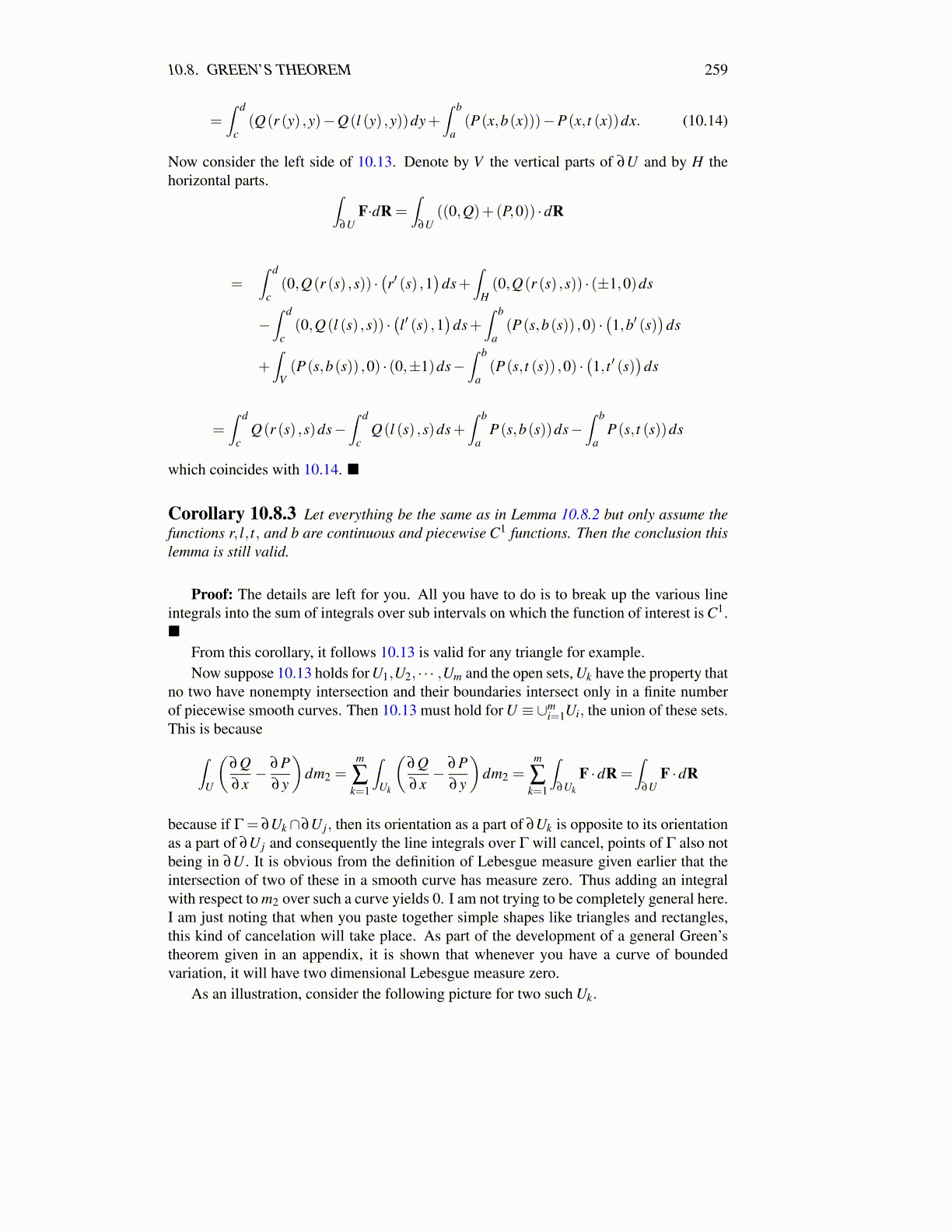
Now consider the left side of 10.13. Denote by V the vertical parts of ∂U and by H thehorizontal parts. ∫
∂UF·dR =
∫∂U
((0,Q)+(P,0)) ·dR
=∫ d
c(0,Q(r (s) ,s)) ·
(r′ (s) ,1
)ds+
∫H(0,Q(r (s) ,s)) · (±1,0)ds
−∫ d
c(0,Q(l (s) ,s)) ·
(l′ (s) ,1
)ds+
∫ b
a(P(s,b(s)) ,0) ·
(1,b′ (s)
)ds
+∫
V(P(s,b(s)) ,0) · (0,±1)ds−
∫ b
a(P(s, t (s)) ,0) ·
(1, t ′ (s)
)ds
=∫ d
cQ(r (s) ,s)ds−
∫ d
cQ(l (s) ,s)ds+
∫ b
aP(s,b(s))ds−
∫ b
aP(s, t (s))ds
which coincides with 10.14. ■
Corollary 10.8.3 Let everything be the same as in Lemma 10.8.2 but only assume thefunctions r, l, t, and b are continuous and piecewise C1 functions. Then the conclusion thislemma is still valid.
Proof: The details are left for you. All you have to do is to break up the various lineintegrals into the sum of integrals over sub intervals on which the function of interest is C1.■
From this corollary, it follows 10.13 is valid for any triangle for example.Now suppose 10.13 holds for U1,U2, · · · ,Um and the open sets, Uk have the property that
no two have nonempty intersection and their boundaries intersect only in a finite numberof piecewise smooth curves. Then 10.13 must hold for U ≡∪m
i=1Ui, the union of these sets.This is because∫
U
(∂Q∂x− ∂P
∂y
)dm2 =
m
∑k=1
∫Uk
(∂Q∂x− ∂P
∂y
)dm2 =
m
∑k=1
∫∂Uk
F ·dR =∫
∂UF ·dR
because if Γ = ∂Uk∩∂U j, then its orientation as a part of ∂Uk is opposite to its orientationas a part of ∂U j and consequently the line integrals over Γ will cancel, points of Γ also notbeing in ∂U. It is obvious from the definition of Lebesgue measure given earlier that theintersection of two of these in a smooth curve has measure zero. Thus adding an integralwith respect to m2 over such a curve yields 0. I am not trying to be completely general here.I am just noting that when you paste together simple shapes like triangles and rectangles,this kind of cancelation will take place. As part of the development of a general Green’stheorem given in an appendix, it is shown that whenever you have a curve of boundedvariation, it will have two dimensional Lebesgue measure zero.
As an illustration, consider the following picture for two such Uk.