260 CHAPTER 10. CHANGE OF VARIABLES
U1
U2
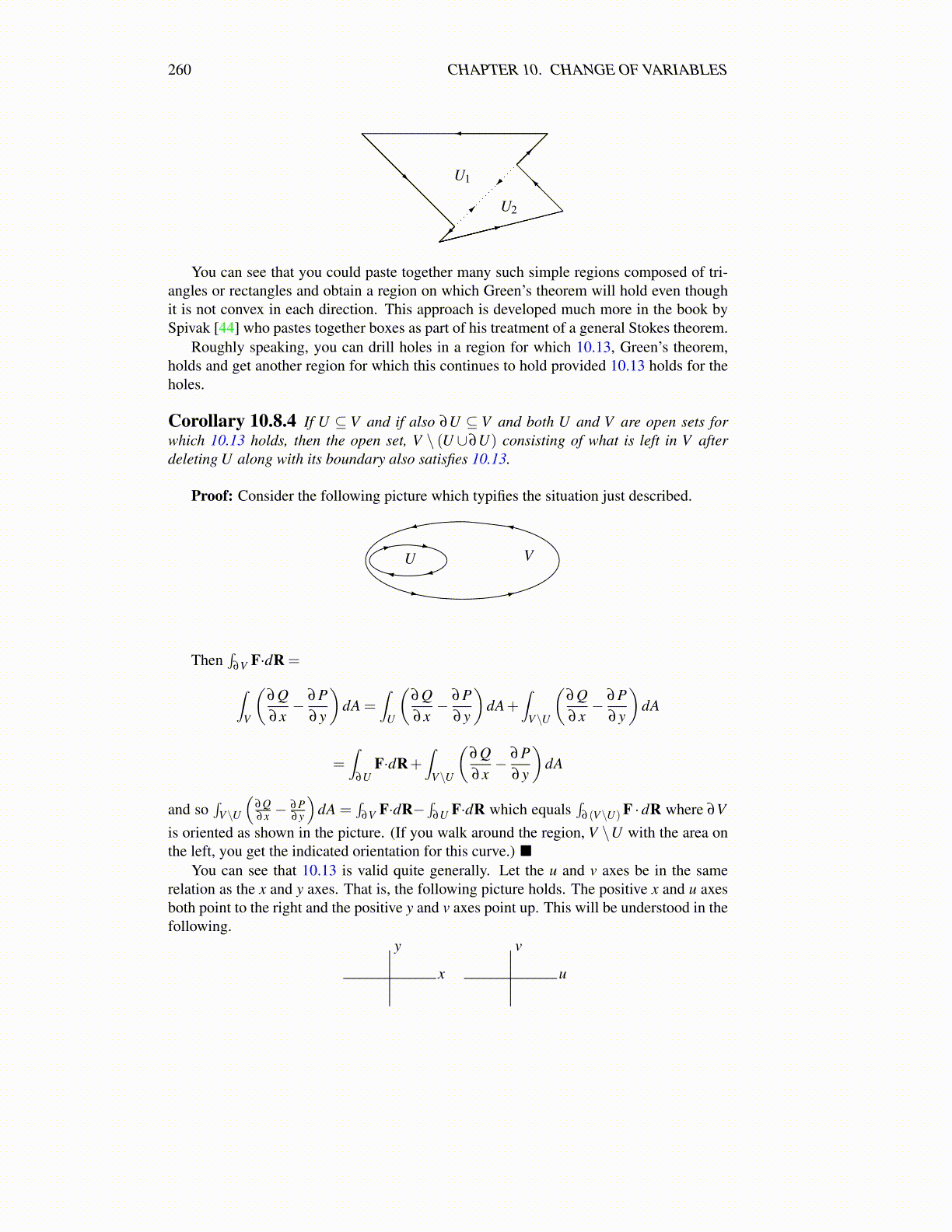
You can see that you could paste together many such simple regions composed of tri-angles or rectangles and obtain a region on which Green’s theorem will hold even thoughit is not convex in each direction. This approach is developed much more in the book bySpivak [44] who pastes together boxes as part of his treatment of a general Stokes theorem.
Roughly speaking, you can drill holes in a region for which 10.13, Green’s theorem,holds and get another region for which this continues to hold provided 10.13 holds for theholes.
Corollary 10.8.4 If U ⊆ V and if also ∂U ⊆ V and both U and V are open sets forwhich 10.13 holds, then the open set, V \ (U ∪∂U) consisting of what is left in V afterdeleting U along with its boundary also satisfies 10.13.
Proof: Consider the following picture which typifies the situation just described.
VU
Then∫
∂V F·dR =
∫V
(∂Q∂x− ∂P
∂y
)dA =
∫U
(∂Q∂x− ∂P
∂y
)dA+
∫V\U
(∂Q∂x− ∂P
∂y
)dA
=∫
∂UF·dR+
∫V\U
(∂Q∂x− ∂P
∂y
)dA
and so∫
V\U
(∂Q∂x −
∂P∂y
)dA =
∫∂V F·dR−
∫∂U F·dR which equals
∫∂ (V\U) F ·dR where ∂V
is oriented as shown in the picture. (If you walk around the region, V \U with the area onthe left, you get the indicated orientation for this curve.) ■
You can see that 10.13 is valid quite generally. Let the u and v axes be in the samerelation as the x and y axes. That is, the following picture holds. The positive x and u axesboth point to the right and the positive y and v axes point up. This will be understood in thefollowing.
x
y
u
v