11.3. FOURIER TRANSFORM 271
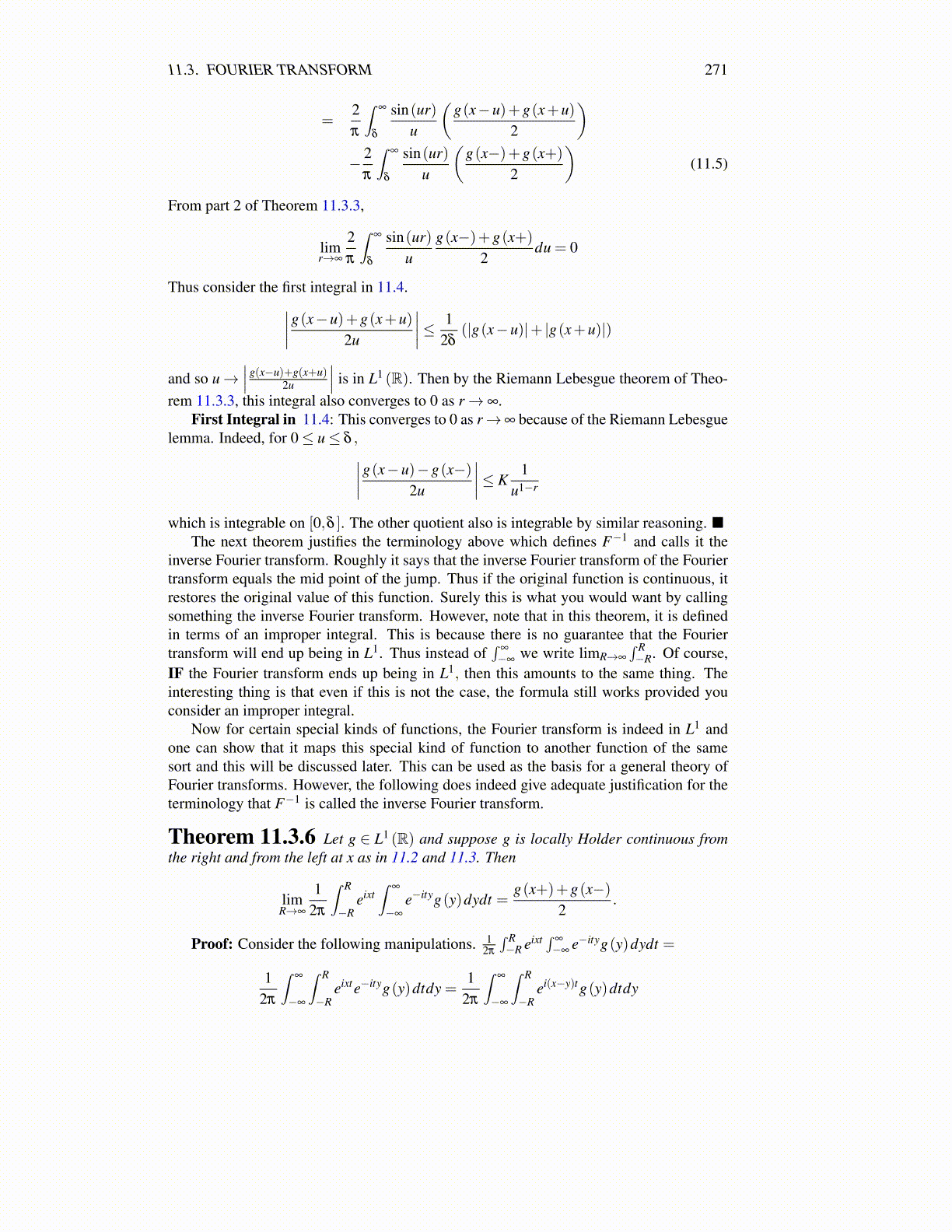
=2π
∫∞
δ
sin(ur)u
(g(x−u)+g(x+u)
2
)− 2
π
∫∞
δ
sin(ur)u
(g(x−)+g(x+)
2
)(11.5)
From part 2 of Theorem 11.3.3,
limr→∞
2π
∫∞
δ
sin(ur)u
g(x−)+g(x+)
2du = 0
Thus consider the first integral in 11.4.∣∣∣∣g(x−u)+g(x+u)2u
∣∣∣∣≤ 12δ
(|g(x−u)|+ |g(x+u)|)
and so u→∣∣∣ g(x−u)+g(x+u)
2u
∣∣∣ is in L1 (R). Then by the Riemann Lebesgue theorem of Theo-rem 11.3.3, this integral also converges to 0 as r→ ∞.
First Integral in 11.4: This converges to 0 as r→∞ because of the Riemann Lebesguelemma. Indeed, for 0≤ u≤ δ ,∣∣∣∣g(x−u)−g(x−)
2u
∣∣∣∣≤ K1
u1−r
which is integrable on [0,δ ]. The other quotient also is integrable by similar reasoning. ■The next theorem justifies the terminology above which defines F−1 and calls it the
inverse Fourier transform. Roughly it says that the inverse Fourier transform of the Fouriertransform equals the mid point of the jump. Thus if the original function is continuous, itrestores the original value of this function. Surely this is what you would want by callingsomething the inverse Fourier transform. However, note that in this theorem, it is definedin terms of an improper integral. This is because there is no guarantee that the Fouriertransform will end up being in L1. Thus instead of
∫∞
−∞we write limR→∞
∫ R−R. Of course,
IF the Fourier transform ends up being in L1, then this amounts to the same thing. Theinteresting thing is that even if this is not the case, the formula still works provided youconsider an improper integral.
Now for certain special kinds of functions, the Fourier transform is indeed in L1 andone can show that it maps this special kind of function to another function of the samesort and this will be discussed later. This can be used as the basis for a general theory ofFourier transforms. However, the following does indeed give adequate justification for theterminology that F−1 is called the inverse Fourier transform.
Theorem 11.3.6 Let g ∈ L1 (R) and suppose g is locally Holder continuous fromthe right and from the left at x as in 11.2 and 11.3. Then
limR→∞
12π
∫ R
−Reixt∫
∞
−∞
e−ityg(y)dydt =g(x+)+g(x−)
2.
Proof: Consider the following manipulations. 12π
∫ R−R eixt ∫ ∞
−∞e−ityg(y)dydt =
12π
∫∞
−∞
∫ R
−Reixte−ityg(y)dtdy =
12π
∫∞
−∞
∫ R
−Rei(x−y)tg(y)dtdy