278 CHAPTER 11. FUNDAMENTAL TRANSFORMS
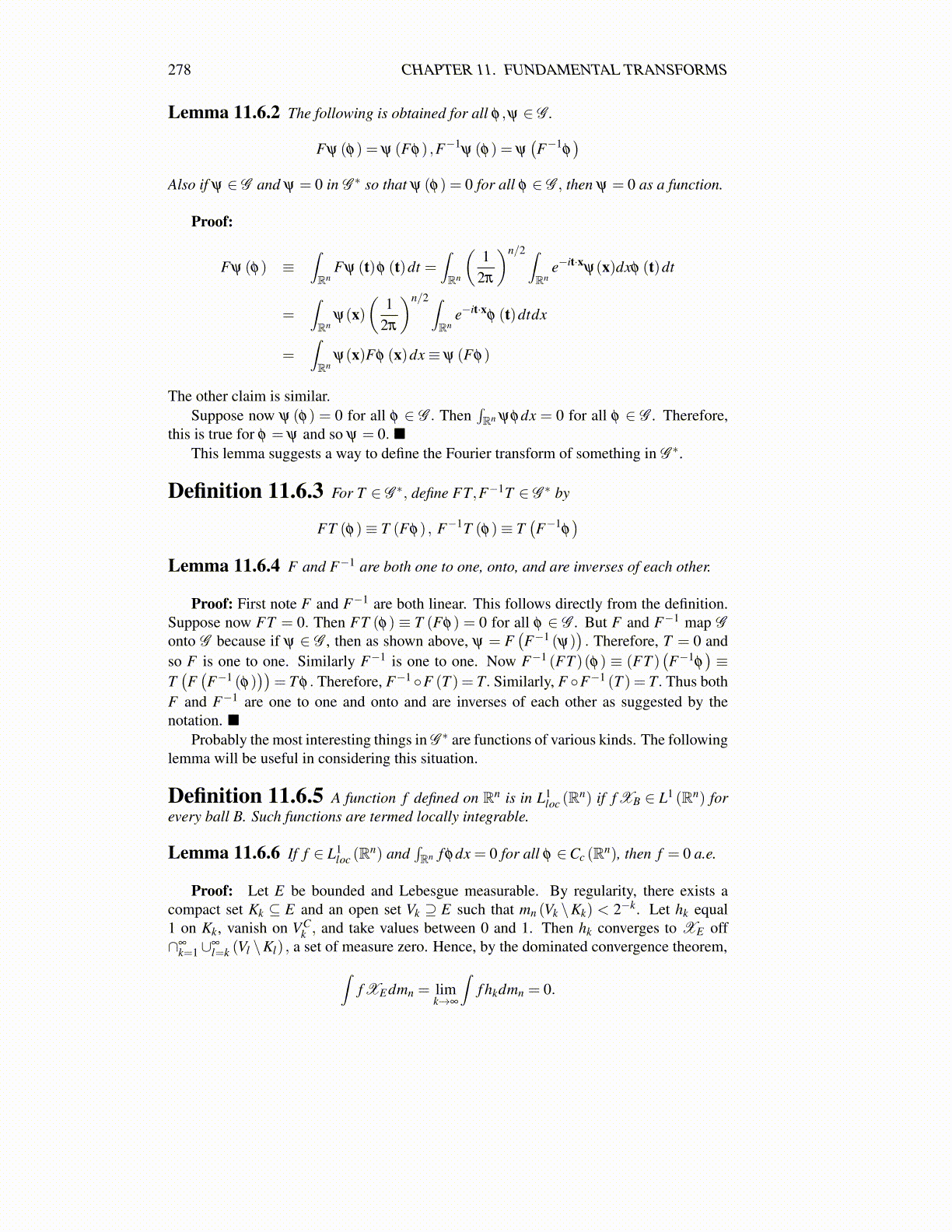
Lemma 11.6.2 The following is obtained for all φ ,ψ ∈ G .
Fψ (φ) = ψ (Fφ) ,F−1ψ (φ) = ψ
(F−1
φ)
Also if ψ ∈ G and ψ = 0 in G ∗ so that ψ (φ) = 0 for all φ ∈ G , then ψ = 0 as a function.
Proof:
Fψ (φ) ≡∫Rn
Fψ (t)φ (t)dt =∫Rn
(1
2π
)n/2 ∫Rn
e−it·xψ(x)dxφ (t)dt
=∫Rn
ψ(x)(
12π
)n/2 ∫Rn
e−it·xφ (t)dtdx
=∫Rn
ψ(x)Fφ (x)dx≡ ψ (Fφ)
The other claim is similar.Suppose now ψ (φ) = 0 for all φ ∈ G . Then
∫Rn ψφdx = 0 for all φ ∈ G . Therefore,
this is true for φ = ψ and so ψ = 0. ■This lemma suggests a way to define the Fourier transform of something in G ∗.
Definition 11.6.3 For T ∈ G ∗, define FT,F−1T ∈ G ∗ by
FT (φ)≡ T (Fφ) , F−1T (φ)≡ T(F−1
φ)
Lemma 11.6.4 F and F−1 are both one to one, onto, and are inverses of each other.
Proof: First note F and F−1 are both linear. This follows directly from the definition.Suppose now FT = 0. Then FT (φ) ≡ T (Fφ) = 0 for all φ ∈ G . But F and F−1 map Gonto G because if ψ ∈ G , then as shown above, ψ = F
(F−1 (ψ)
). Therefore, T = 0 and
so F is one to one. Similarly F−1 is one to one. Now F−1 (FT )(φ) ≡ (FT )(F−1φ
)≡
T(F(F−1 (φ)
))= T φ . Therefore, F−1 ◦F (T ) = T. Similarly, F ◦F−1 (T ) = T. Thus both
F and F−1 are one to one and onto and are inverses of each other as suggested by thenotation. ■
Probably the most interesting things in G ∗ are functions of various kinds. The followinglemma will be useful in considering this situation.
Definition 11.6.5 A function f defined on Rn is in L1loc (Rn) if fXB ∈ L1 (Rn) for
every ball B. Such functions are termed locally integrable.
Lemma 11.6.6 If f ∈ L1loc (Rn) and
∫Rn f φdx = 0 for all φ ∈Cc (Rn), then f = 0 a.e.
Proof: Let E be bounded and Lebesgue measurable. By regularity, there exists acompact set Kk ⊆ E and an open set Vk ⊇ E such that mn (Vk \Kk) < 2−k. Let hk equal1 on Kk, vanish on VC
k , and take values between 0 and 1. Then hk converges to XE off∩∞
k=1∪∞l=k (Vl \Kl) , a set of measure zero. Hence, by the dominated convergence theorem,∫
f XEdmn = limk→∞
∫f hkdmn = 0.