11.6. FOURIER TRANSFORMS OF JUST ABOUT ANYTHING 279
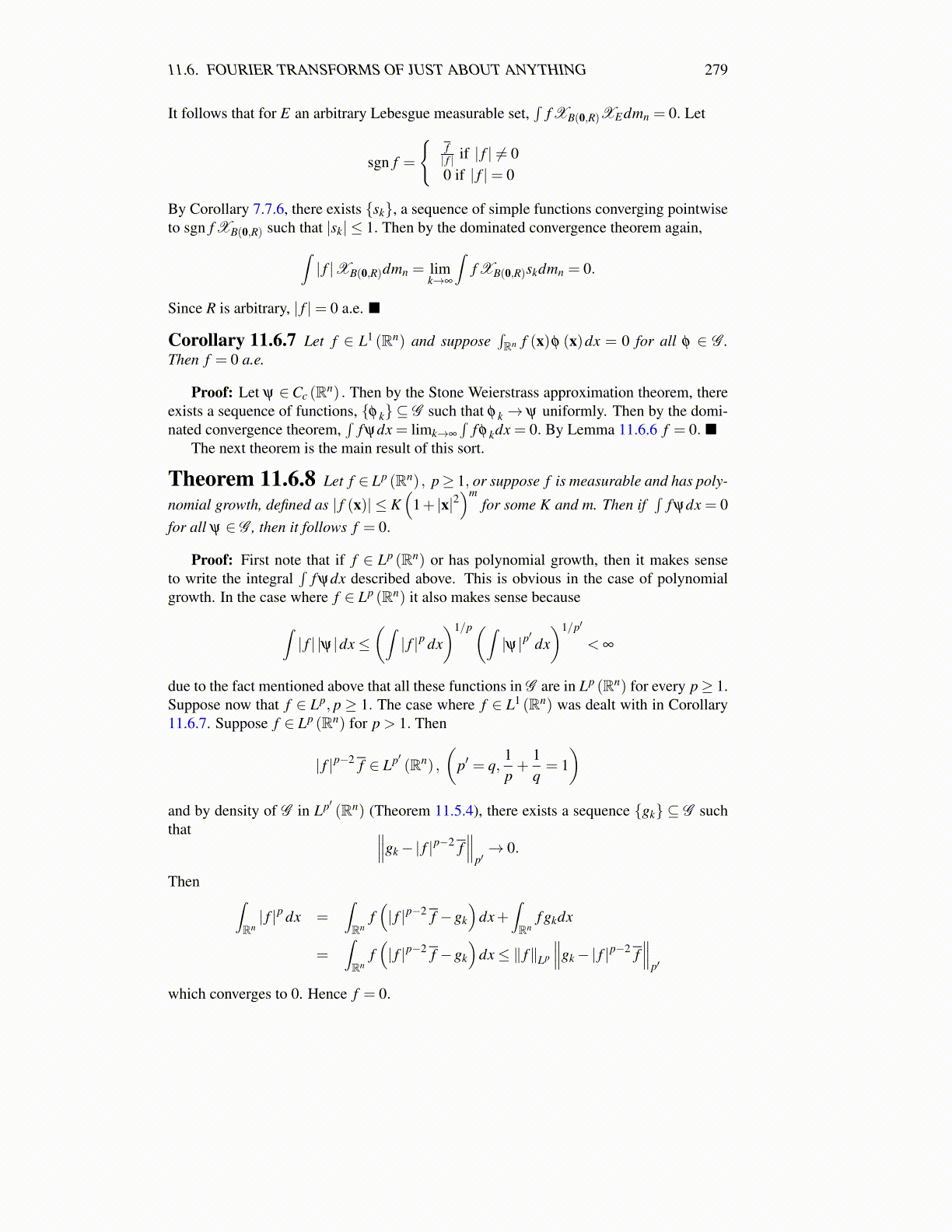
It follows that for E an arbitrary Lebesgue measurable set,∫
f XB(0,R)XEdmn = 0. Let
sgn f =
{f| f | if | f | ̸= 00 if | f |= 0
By Corollary 7.7.6, there exists {sk}, a sequence of simple functions converging pointwiseto sgn f XB(0,R) such that |sk| ≤ 1. Then by the dominated convergence theorem again,∫
| f |XB(0,R)dmn = limk→∞
∫f XB(0,R)skdmn = 0.
Since R is arbitrary, | f |= 0 a.e. ■
Corollary 11.6.7 Let f ∈ L1 (Rn) and suppose∫Rn f (x)φ (x)dx = 0 for all φ ∈ G .
Then f = 0 a.e.
Proof: Let ψ ∈Cc (Rn) . Then by the Stone Weierstrass approximation theorem, thereexists a sequence of functions, {φ k} ⊆ G such that φ k→ ψ uniformly. Then by the domi-nated convergence theorem,
∫f ψdx = limk→∞
∫f φ kdx = 0. By Lemma 11.6.6 f = 0. ■
The next theorem is the main result of this sort.
Theorem 11.6.8 Let f ∈ Lp (Rn) , p≥ 1, or suppose f is measurable and has poly-
nomial growth, defined as | f (x)| ≤ K(
1+ |x|2)m
for some K and m. Then if∫
f ψdx = 0for all ψ ∈ G , then it follows f = 0.
Proof: First note that if f ∈ Lp (Rn) or has polynomial growth, then it makes senseto write the integral
∫f ψdx described above. This is obvious in the case of polynomial
growth. In the case where f ∈ Lp (Rn) it also makes sense because
∫| f | |ψ|dx≤
(∫| f |p dx
)1/p(∫|ψ|p
′dx)1/p′
< ∞
due to the fact mentioned above that all these functions in G are in Lp (Rn) for every p≥ 1.Suppose now that f ∈ Lp, p ≥ 1. The case where f ∈ L1 (Rn) was dealt with in Corollary11.6.7. Suppose f ∈ Lp (Rn) for p > 1. Then
| f |p−2 f ∈ Lp′ (Rn) ,
(p′ = q,
1p+
1q= 1)
and by density of G in Lp′ (Rn) (Theorem 11.5.4), there exists a sequence {gk} ⊆ G suchthat ∥∥∥gk−| f |p−2 f
∥∥∥p′→ 0.
Then ∫Rn| f |p dx =
∫Rn
f(| f |p−2 f −gk
)dx+
∫Rn
f gkdx
=∫Rn
f(| f |p−2 f −gk
)dx≤ ∥ f∥Lp
∥∥∥gk−| f |p−2 f∥∥∥
p′
which converges to 0. Hence f = 0.