292 CHAPTER 11. FUNDAMENTAL TRANSFORMS
subspace even though this n− 1 dimensional subspace has measure zero, wheneverof u ∈ H1 (Rn). Hint: u(x′,0) =
∫∞
0 Dn
(−e−s2
u(x′,s))
ds =∫
∞
0 −2se−s2u(x′,s)−
e−s2Dnu(x′,s)ds.
Thus ∣∣γu(x′)∣∣2 ≤C
(∫∞
02se−s2 ∣∣u(x′,s)∣∣2 ds+
∫∞
0e−s2 ∣∣Dnu
(x′,s)∣∣2 ds
).
Now do∫Rn−1 to both sides.
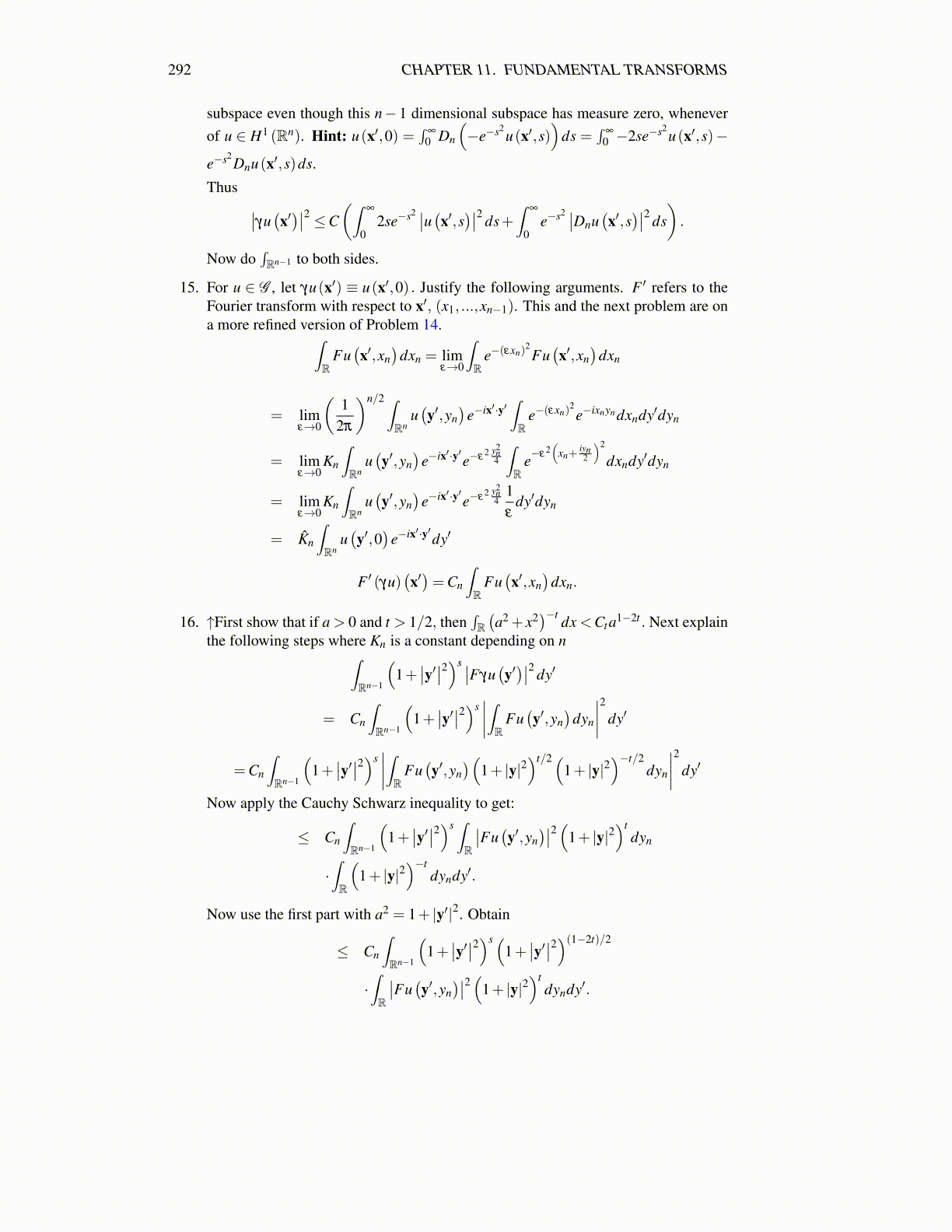
15. For u ∈ G , let γu(x′) ≡ u(x′,0) . Justify the following arguments. F ′ refers to theFourier transform with respect to x′, (x1, ...,xn−1). This and the next problem are ona more refined version of Problem 14.∫
RFu(x′,xn
)dxn = lim
ε→0
∫R
e−(εxn)2Fu(x′,xn
)dxn
= limε→0
(1
2π
)n/2 ∫Rn
u(y′,yn
)e−ix′·y′
∫R
e−(εxn)2e−ixnyndxndy′dyn
= limε→0
Kn
∫Rn
u(y′,yn
)e−ix′·y′e−ε2 y2
n4
∫R
e−ε2(
xn+iyn2
)2
dxndy′dyn
= limε→0
Kn
∫Rn
u(y′,yn
)e−ix′·y′e−ε2 y2
n4
1ε
dy′dyn
= K̂n
∫Rn
u(y′,0
)e−ix′·y′dy′
F ′ (γu)(x′)=Cn
∫R
Fu(x′,xn
)dxn.
16. ↑First show that if a > 0 and t > 1/2, then∫R(a2 + x2
)−t dx <Cta1−2t . Next explainthe following steps where Kn is a constant depending on n∫
Rn−1
(1+∣∣y′∣∣2)s ∣∣Fγu
(y′)∣∣2 dy′
= Cn
∫Rn−1
(1+∣∣y′∣∣2)s
∣∣∣∣∫RFu(y′,yn
)dyn
∣∣∣∣2 dy′
=Cn
∫Rn−1
(1+∣∣y′∣∣2)s
∣∣∣∣∫RFu(y′,yn
)(1+ |y|2
)t/2(1+ |y|2
)−t/2dyn
∣∣∣∣2 dy′
Now apply the Cauchy Schwarz inequality to get:
≤ Cn
∫Rn−1
(1+∣∣y′∣∣2)s ∫
R
∣∣Fu(y′,yn
)∣∣2(1+ |y|2)t
dyn
·∫R
(1+ |y|2
)−tdyndy′.
Now use the first part with a2 = 1+ |y′|2. Obtain
≤ Cn
∫Rn−1
(1+∣∣y′∣∣2)s(
1+∣∣y′∣∣2)(1−2t)/2
·∫R
∣∣Fu(y′,yn
)∣∣2(1+ |y|2)t
dyndy′.