11.7. EXERCISES 293
Conclude that if s+ 1−2t2 = s+ 1
2 − t ≤ 0 and t > 1/2, then ∥γ(u)∥2s,2 ≤Cn ∥u∥2
t,2. Inparticular, if t = 1 and s = 1/2, you have ∥γ(u)∥2
(1/2),2 ≤Cn ∥u∥21,2 . This exhibits the
phenomenon of the loss of 1/2 derivative when considering γu on an n− 1 dimen-sional subspace.
17. In dealing with Sobolev spaces, the following interpolation inequality is very useful.Let 0≤ r < s < t. Then if u ∈ Ht (Rn) ,
∥u∥Hs(Rn) ≤ ∥u∥θ
Hr(Rn) ∥u∥1−θ
Ht (Rn)
where θ ∈ (0,1) such that θr+(1−θ) t = s. Hint:
∥u∥Hs(Rn) =
(∫Rn
(1+ |x|2
)θr(1+ |x|2
)(1−θ)t|Fu(x)|2 dx
)1/2
.
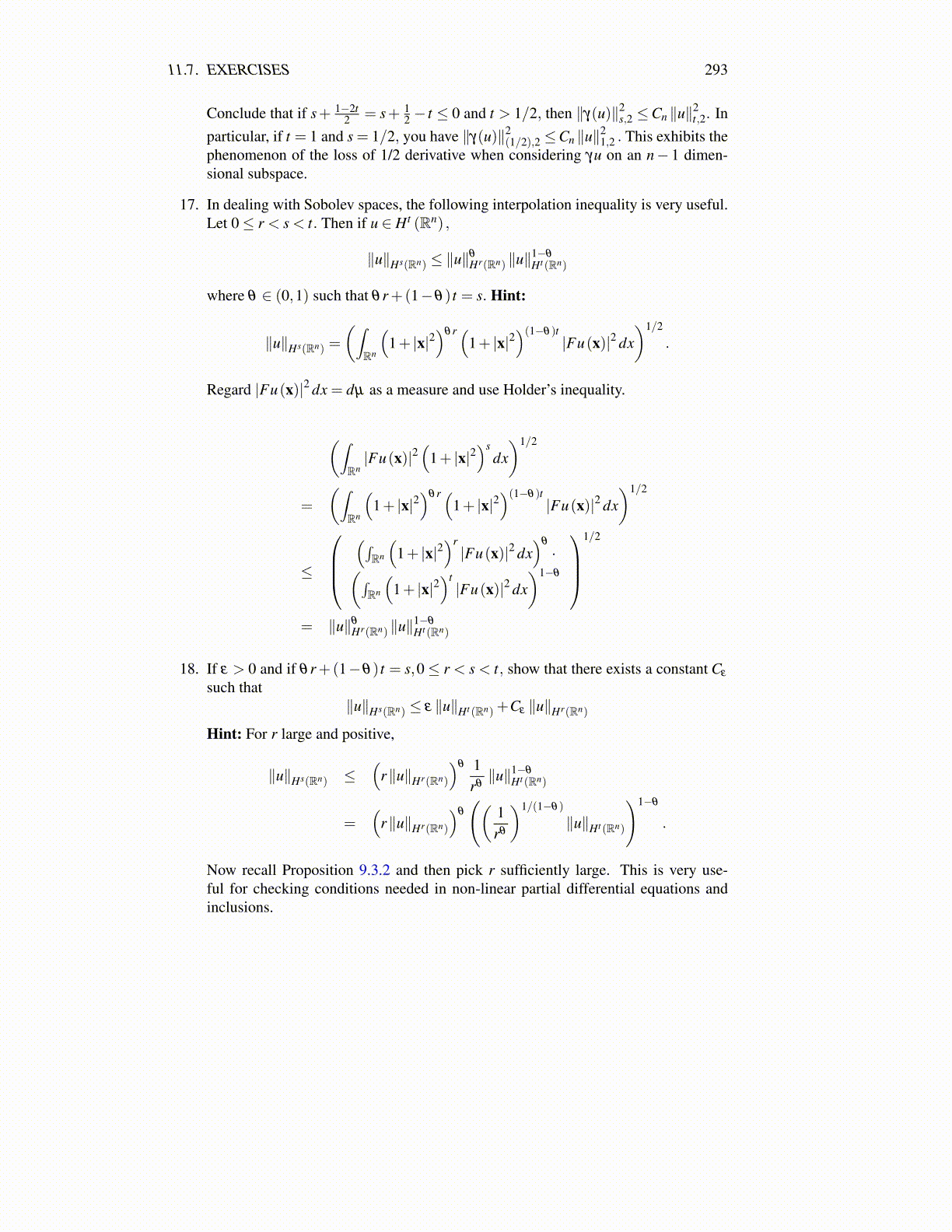
Regard |Fu(x)|2 dx = dµ as a measure and use Holder’s inequality.
(∫Rn|Fu(x)|2
(1+ |x|2
)sdx)1/2
=
(∫Rn
(1+ |x|2
)θr(1+ |x|2
)(1−θ)t|Fu(x)|2 dx
)1/2
≤
(∫Rn
(1+ |x|2
)r|Fu(x)|2 dx
)θ
·(∫Rn
(1+ |x|2
)t|Fu(x)|2 dx
)1−θ
1/2
= ∥u∥θ
Hr(Rn) ∥u∥1−θ
Ht (Rn)
18. If ε > 0 and if θr+(1−θ) t = s,0≤ r < s < t, show that there exists a constant Cε
such that∥u∥Hs(Rn) ≤ ε ∥u∥Ht (Rn)+Cε ∥u∥Hr(Rn)
Hint: For r large and positive,
∥u∥Hs(Rn) ≤(
r∥u∥Hr(Rn)
)θ 1rθ∥u∥1−θ
Ht (Rn)
=(
r∥u∥Hr(Rn)
)θ
((1rθ
)1/(1−θ)
∥u∥Ht (Rn)
)1−θ
.
Now recall Proposition 9.3.2 and then pick r sufficiently large. This is very use-ful for checking conditions needed in non-linear partial differential equations andinclusions.