1014 CHAPTER 29. THE AREA FORMULA

•b•c

B(c, 1i )

B(b, 2i )

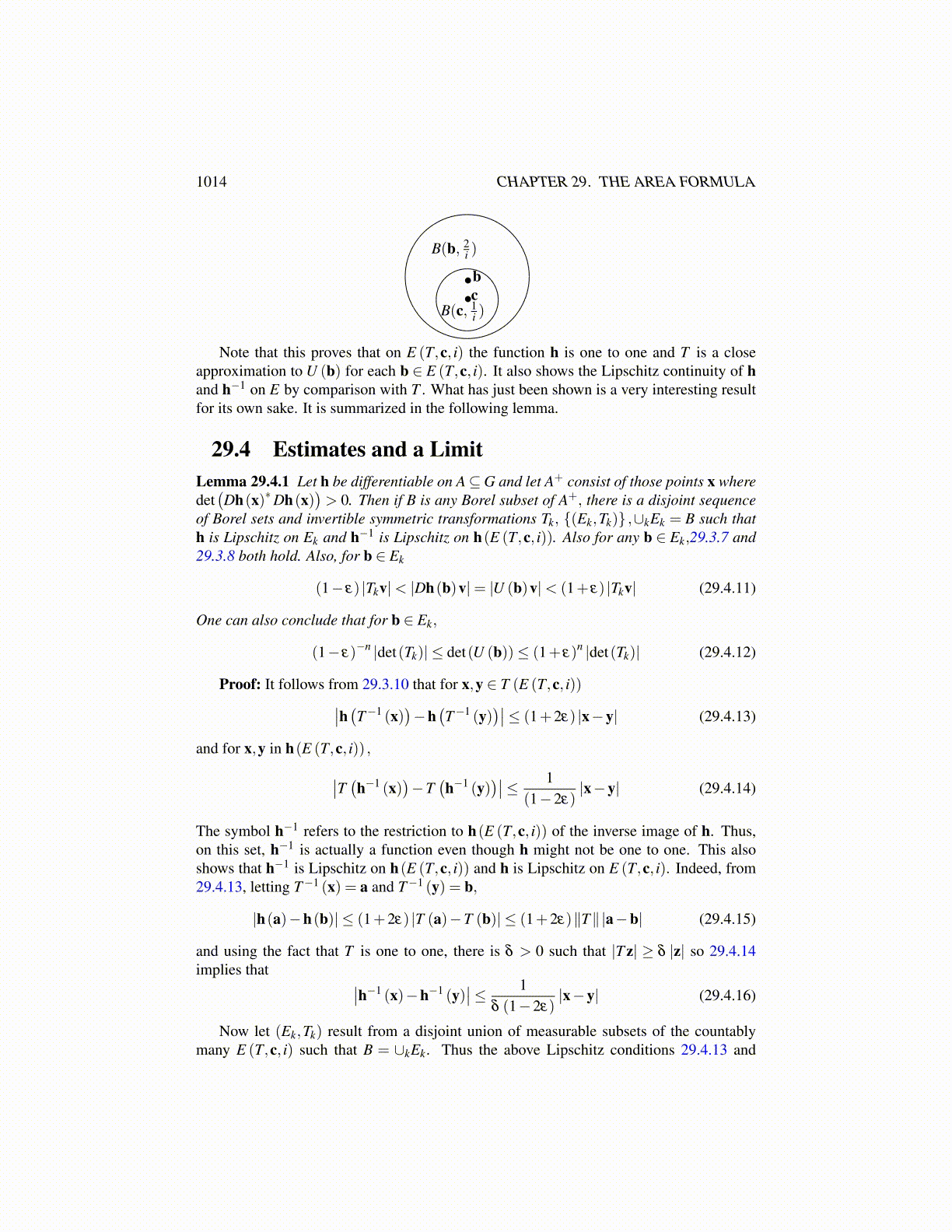
Note that this proves that on E (T,c, i) the function h is one to one and T is a closeapproximation to U (b) for each b ∈ E (T,c, i). It also shows the Lipschitz continuity of hand h−1 on E by comparison with T . What has just been shown is a very interesting resultfor its own sake. It is summarized in the following lemma.

29.4 Estimates and a LimitLemma 29.4.1 Let h be differentiable on A⊆G and let A+ consist of those points x wheredet(Dh(x)∗Dh(x)

)> 0. Then if B is any Borel subset of A+, there is a disjoint sequence

of Borel sets and invertible symmetric transformations Tk, {(Ek,Tk)} ,∪kEk = B such thath is Lipschitz on Ek and h−1 is Lipschitz on h(E (T,c, i)). Also for any b ∈ Ek,29.3.7 and29.3.8 both hold. Also, for b ∈ Ek

(1− ε) |Tkv|< |Dh(b)v|= |U (b)v|< (1+ ε) |Tkv| (29.4.11)

One can also conclude that for b ∈ Ek,

(1− ε)−n |det(Tk)| ≤ det(U (b))≤ (1+ ε)n |det(Tk)| (29.4.12)

Proof: It follows from 29.3.10 that for x,y ∈ T (E (T,c, i))∣∣h(T−1 (x))−h

(T−1 (y)

)∣∣≤ (1+2ε) |x−y| (29.4.13)

and for x,y in h(E (T,c, i)) ,∣∣T (h−1 (x))−T

(h−1 (y)

)∣∣≤ 1(1−2ε)

|x−y| (29.4.14)

The symbol h−1 refers to the restriction to h(E (T,c, i)) of the inverse image of h. Thus,on this set, h−1 is actually a function even though h might not be one to one. This alsoshows that h−1 is Lipschitz on h(E (T,c, i)) and h is Lipschitz on E (T,c, i). Indeed, from29.4.13, letting T−1 (x) = a and T−1 (y) = b,

|h(a)−h(b)| ≤ (1+2ε) |T (a)−T (b)| ≤ (1+2ε)∥T∥|a−b| (29.4.15)

and using the fact that T is one to one, there is δ > 0 such that |T z| ≥ δ |z| so 29.4.14implies that ∣∣h−1 (x)−h−1 (y)

∣∣≤ 1δ (1−2ε)

|x−y| (29.4.16)

Now let (Ek,Tk) result from a disjoint union of measurable subsets of the countablymany E (T,c, i) such that B = ∪kEk. Thus the above Lipschitz conditions 29.4.13 and

1014 CHAPTER 29. THE AREA FORMULANote that this proves that on E (T,c,i) the function h is one to one and T is a closeapproximation to U (b) for each b € E (T,¢,7). It also shows the Lipschitz continuity of hand h~! on E by comparison with T. What has just been shown is a very interesting resultfor its own sake. It is summarized in the following lemma.29.4 Estimates and a LimitLemma 29.4.1 Leth be differentiable on A C G and let AT consist of those points x wheredet (Dh (x)* Dh (x)) > 0. Then if B is any Borel subset of A*, there is a disjoint sequenceof Borel sets and invertible symmetric transformations T;, {(Ex,Tk)} ,UgE% = B such thath is Lipschitz on E, and h~! is Lipschitz on h(E (T,¢,i)). Also for any b € Ex,29.3.7 and29.3.8 both hold. Also, for b € Ex(1—€)|T.v| < |Dh(b) v| = |U (b) v| < (1 +8) |%v| (29.4.11)One can also conclude that for b € Ex,(1—e) "|det (7;,)| < det (U (b)) < (1 +e)" |det (7;)| (29.4.12)Proof: It follows from 29.3.10 that for x,y € T (E (T,¢,i))|h(7~' (x)) —h(T! (y))| < (1 +2) |x—y| (29.4.13)and for x,y inh (E (T,¢,i)),1T (bh! (x)) —T (bh! < ——_ |x- 29.4.14Ir (he '(%) —T (0H "Y)|< Gaze ky (29.4.14)The symbol h7! refers to the restriction to h(E (T,c,7)) of the inverse image of h. Thus,on this set, h! is actually a function even though h might not be one to one. This alsoshows that h~! is Lipschitz on h(E (T,¢,i)) and h is Lipschitz on E (T,c,i). Indeed, from29.4.13, letting T~! (x) =aand T~!(y) =b,|h(a) —h(b)| < (1 +2€) |T (a) —T (b)| < (14 2e) ||7|| |a— Db] (29.4.15)and using the fact that T is one to one, there is 6 > 0 such that |Tz| > 6|z| so 29.4.14implies that_ _ 1|p! (x) —h"! (y)| < 50a (29.4.16)Now let (Ex, 7;) result from a disjoint union of measurable subsets of the countablymany E(T,c,i) such that B = UxE,. Thus the above Lipschitz conditions 29.4.13 and