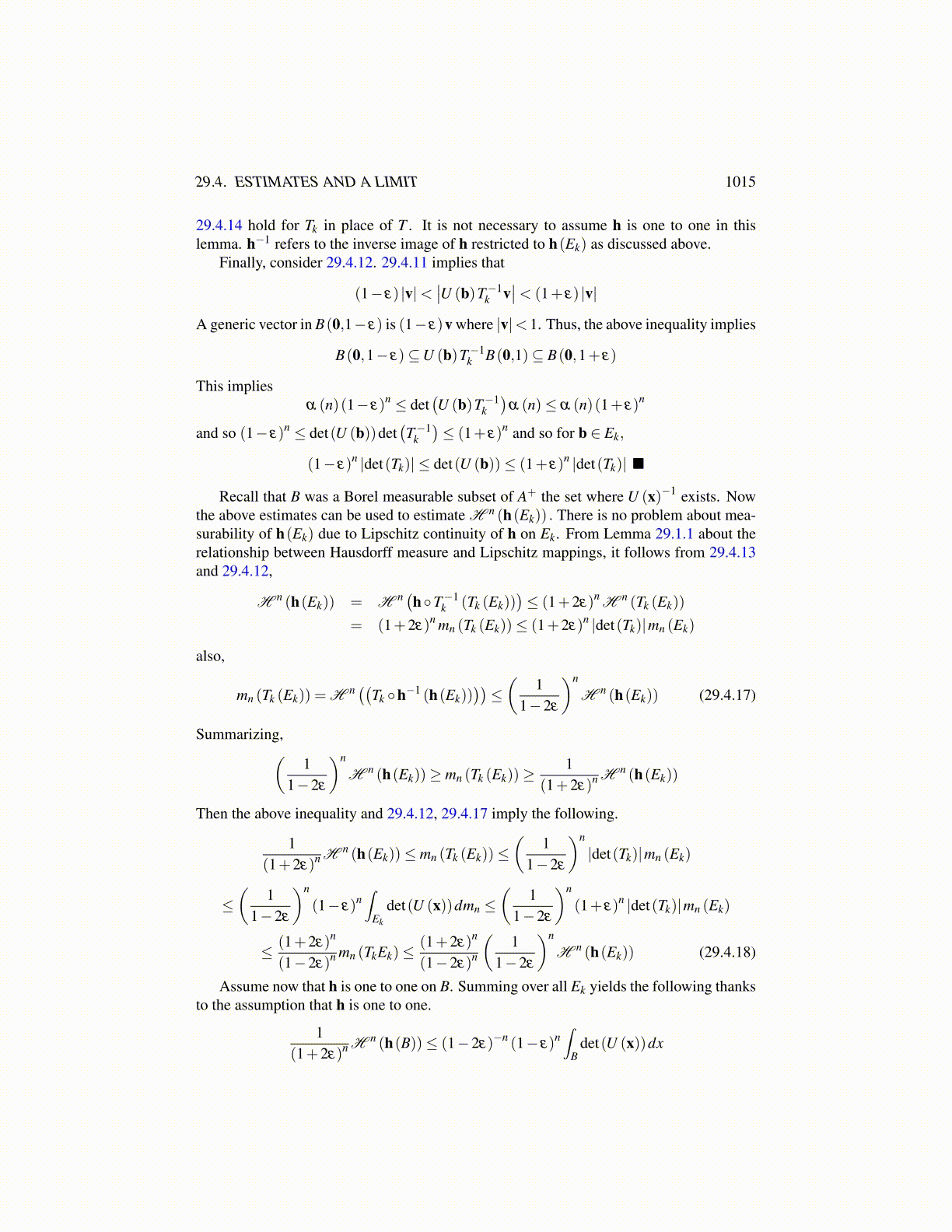
29.4. ESTIMATES AND A LIMIT 1015
29.4.14 hold for Tk in place of T . It is not necessary to assume h is one to one in thislemma. h−1 refers to the inverse image of h restricted to h(Ek) as discussed above.
Finally, consider 29.4.12. 29.4.11 implies that
(1− ε) |v|<∣∣U (b)T−1
k v∣∣< (1+ ε) |v|
A generic vector in B(0,1− ε) is (1− ε)v where |v|< 1. Thus, the above inequality implies
B(0,1− ε)⊆U (b)T−1k B(0,1)⊆ B(0,1+ ε)
This impliesα (n)(1− ε)n ≤ det
(U (b)T−1
k
)α (n)≤ α (n)(1+ ε)n
and so (1− ε)n ≤ det(U (b))det(T−1
k
)≤ (1+ ε)n and so for b ∈ Ek,
(1− ε)n |det(Tk)| ≤ det(U (b))≤ (1+ ε)n |det(Tk)|
Recall that B was a Borel measurable subset of A+ the set where U (x)−1 exists. Nowthe above estimates can be used to estimate H n (h(Ek)) . There is no problem about mea-surability of h(Ek) due to Lipschitz continuity of h on Ek. From Lemma 29.1.1 about therelationship between Hausdorff measure and Lipschitz mappings, it follows from 29.4.13and 29.4.12,
H n (h(Ek)) = H n (h◦T−1k (Tk (Ek))
)≤ (1+2ε)n H n (Tk (Ek))
= (1+2ε)n mn (Tk (Ek))≤ (1+2ε)n |det(Tk)|mn (Ek)
also,
mn (Tk (Ek)) = H n ((Tk ◦h−1 (h(Ek))))≤(
11−2ε
)n
H n (h(Ek)) (29.4.17)
Summarizing,(1
1−2ε
)n
H n (h(Ek))≥ mn (Tk (Ek))≥1
(1+2ε)n H n (h(Ek))
Then the above inequality and 29.4.12, 29.4.17 imply the following.
1(1+2ε)n H n (h(Ek))≤ mn (Tk (Ek))≤
(1
1−2ε
)n
|det(Tk)|mn (Ek)
≤(
11−2ε
)n
(1− ε)n∫
Ek
det(U (x))dmn ≤(
11−2ε
)n
(1+ ε)n |det(Tk)|mn (Ek)
≤ (1+2ε)n
(1−2ε)n mn (TkEk)≤(1+2ε)n
(1−2ε)n
(1
1−2ε
)n
H n (h(Ek)) (29.4.18)
Assume now that h is one to one on B. Summing over all Ek yields the following thanksto the assumption that h is one to one.
1(1+2ε)n H n (h(B))≤ (1−2ε)−n (1− ε)n
∫B
det(U (x))dx