29.9. THE COAREA FORMULA 1037
Thus µ(∩∞
n=1∪m≥n [gkm ≥ m−1])= 0. Therefore, for ω /∈ ∩∞
n=1 ∪m≥n [gkm ≥ m−1], a setof measure zero, for all m large enough, [gkm < m−1] and so gkm (ω)→ 0 a.e. ω. Sincefkm (ω)≤ gkm (ω), this proves the lemma.
It might help a little before proceeding further to recall the concept of a level surfaceof a function of n variables. If f : U ⊆ Rn→ R, such a level surface is of the form f−1 (y)and we would expect it to be an n−1 dimensional thing in some sense. In the next lemma,consider a more general construction in which the function has values in Rm,m≤ n. In thismore general case, one would expect f−1 (y) to be something which is in some sense n−mdimensional. As earlier, sets will not be assumed measurable and H k will refer to an outermeasure.
Lemma 29.9.4 Let A⊆ Rp and let f : Rp→ Rm be Lipschitz. Then∫ ∗Rm
H s (A∩ f−1 (y))
dH m ≤ β (s)β (m)
β (s+m)(Lip(f))m H s+m (A).
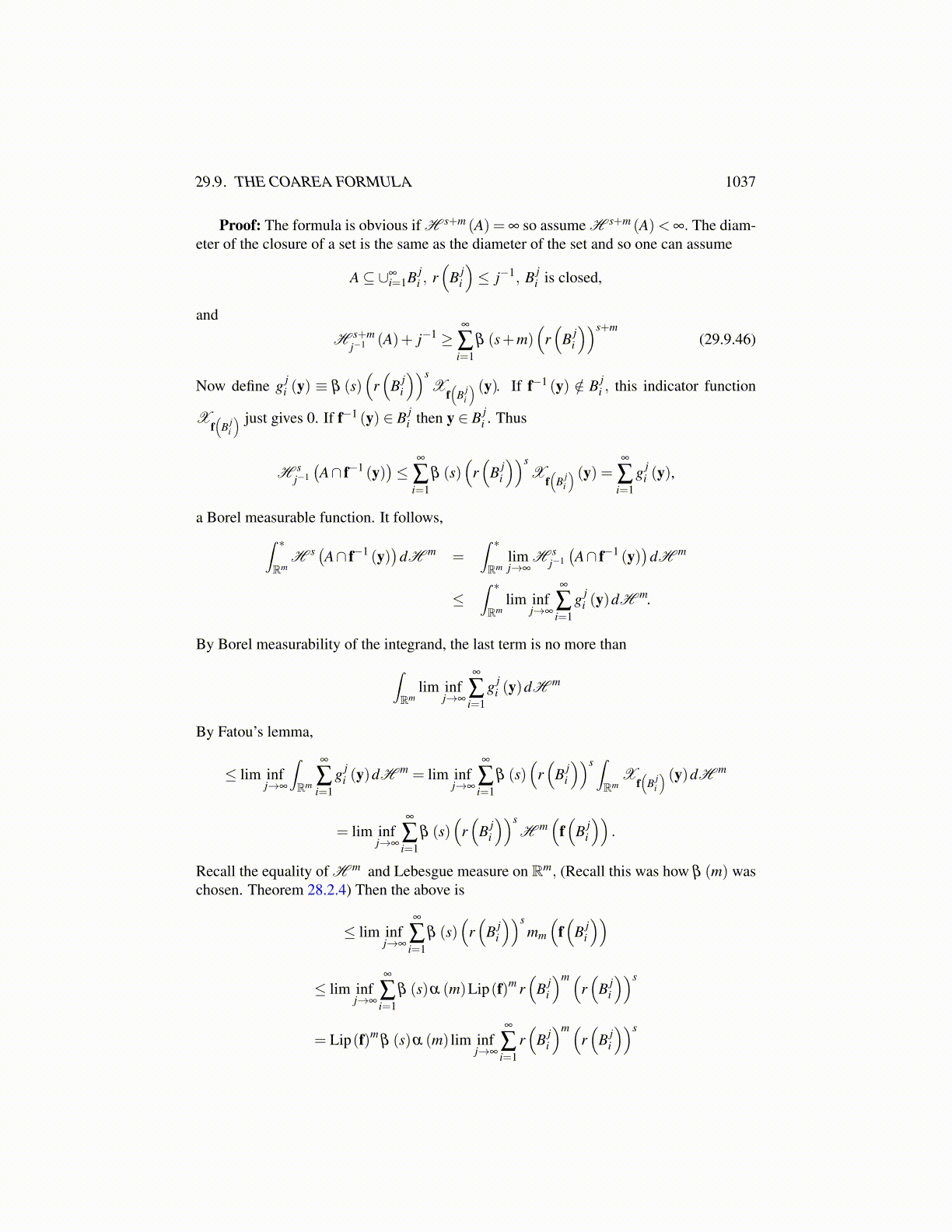
Proof: The formula is obvious if H s+m (A) = ∞ so assume H s+m (A)< ∞. The diam-eter of the closure of a set is the same as the diameter of the set and so one can assume
A⊆ ∪∞i=1B j
i , r(
B ji
)≤ j−1, B j
i is closed,
and
H s+mj−1 (A)+ j−1 ≥
∞
∑i=1
β (s+m)(
r(
B ji
))s+m(29.9.46)
Now define g ji (y) ≡ β (s)
(r(
B ji
))sX
f(
B ji
) (y). If f−1 (y) /∈ B ji , this indicator function
Xf(
B ji
) just gives 0. If f−1 (y) ∈ B ji then y ∈ B j
i . Thus
H sj−1
(A∩ f−1 (y)
)≤
∞
∑i=1
β (s)(
r(
B ji
))sX
f(
B ji
) (y) = ∞
∑i=1
g ji (y),
a Borel measurable function. It follows,∫ ∗Rm
H s (A∩ f−1 (y))
dH m =∫ ∗Rm
limj→∞
H sj−1
(A∩ f−1 (y)
)dH m
≤∫ ∗Rm
lim infj→∞
∞
∑i=1
g ji (y)dH m.
By Borel measurability of the integrand, the last term is no more than∫Rm
lim infj→∞
∞
∑i=1
g ji (y)dH m
By Fatou’s lemma,
≤ lim infj→∞
∫Rm
∞
∑i=1
g ji (y)dH m = lim inf
j→∞
∞
∑i=1
β (s)(
r(
B ji
))s ∫Rm
Xf(
B ji
) (y)dH m