1066 CHAPTER 30. INTEGRATION OF DIFFERENTIAL FORMS
and the sum is taken over all ordered lists of indices taken from the set, {1, · · · ,m}. For Ω
an orientable n dimensional manifold with boundary, define∫Ω
ω (30.3.3)
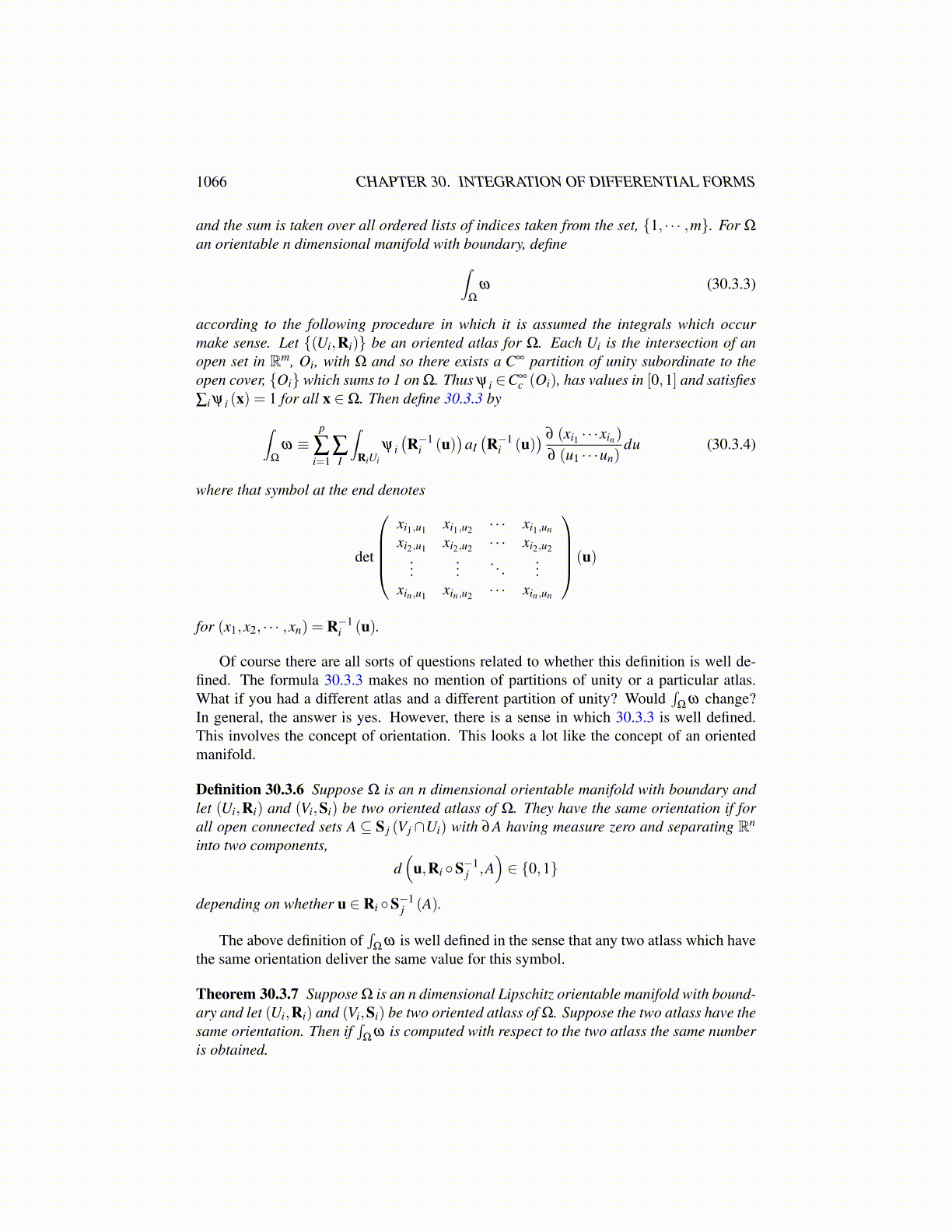
according to the following procedure in which it is assumed the integrals which occurmake sense. Let {(Ui,Ri)} be an oriented atlas for Ω. Each Ui is the intersection of anopen set in Rm, Oi, with Ω and so there exists a C∞ partition of unity subordinate to theopen cover, {Oi} which sums to 1 on Ω. Thus ψ i ∈C∞
c (Oi), has values in [0,1] and satisfies∑i ψ i (x) = 1 for all x ∈Ω. Then define 30.3.3 by
∫Ω
ω ≡p
∑i=1
∑I
∫RiUi
ψ i(R−1
i (u))
aI(R−1
i (u)) ∂ (xi1 · · ·xin)
∂ (u1 · · ·un)du (30.3.4)
where that symbol at the end denotes
det
xi1,u1 xi1,u2 · · · xi1,un
xi2,u1 xi2,u2 · · · xi2,u2...
.... . .
...xin,u1 xin,u2 · · · xin,un
(u)
for (x1,x2, · · · ,xn) = R−1i (u).
Of course there are all sorts of questions related to whether this definition is well de-fined. The formula 30.3.3 makes no mention of partitions of unity or a particular atlas.What if you had a different atlas and a different partition of unity? Would
∫Ω
ω change?In general, the answer is yes. However, there is a sense in which 30.3.3 is well defined.This involves the concept of orientation. This looks a lot like the concept of an orientedmanifold.
Definition 30.3.6 Suppose Ω is an n dimensional orientable manifold with boundary andlet (Ui,Ri) and (Vi,Si) be two oriented atlass of Ω. They have the same orientation if forall open connected sets A ⊆ S j (Vj ∩Ui) with ∂A having measure zero and separating Rn
into two components,
d(
u,Ri ◦S−1j ,A
)∈ {0,1}
depending on whether u ∈ Ri ◦S−1j (A).
The above definition of∫
Ωω is well defined in the sense that any two atlass which have
the same orientation deliver the same value for this symbol.
Theorem 30.3.7 Suppose Ω is an n dimensional Lipschitz orientable manifold with bound-ary and let (Ui,Ri) and (Vi,Si) be two oriented atlass of Ω. Suppose the two atlass have thesame orientation. Then if
∫Ω
ω is computed with respect to the two atlass the same numberis obtained.