30.3. INTEGRATION OF DIFFERENTIAL FORMS ON MANIFOLDS 1067
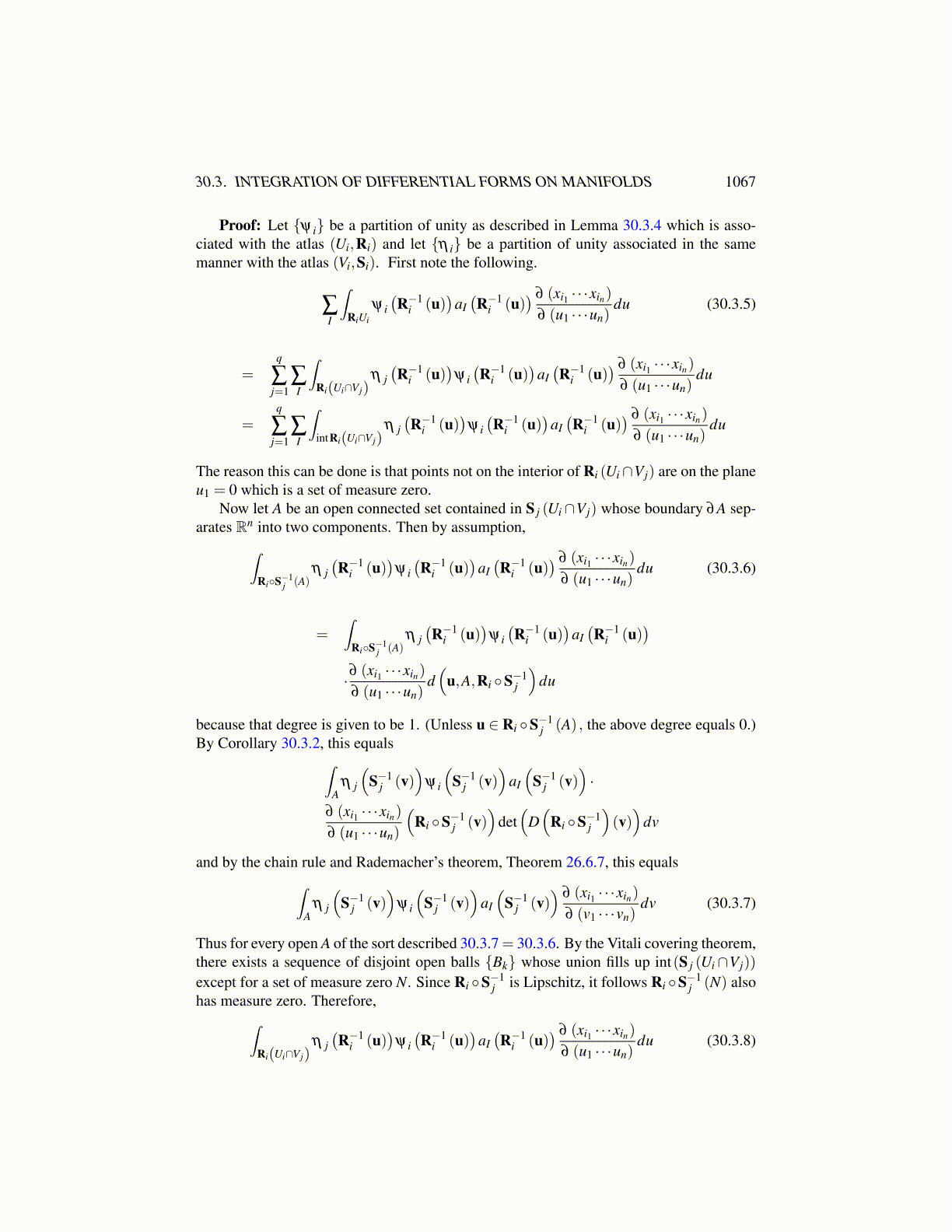
Proof: Let {ψ i} be a partition of unity as described in Lemma 30.3.4 which is asso-ciated with the atlas (Ui,Ri) and let {η i} be a partition of unity associated in the samemanner with the atlas (Vi,Si). First note the following.
∑I
∫RiUi
ψ i(R−1
i (u))
aI(R−1
i (u)) ∂ (xi1 · · ·xin)
∂ (u1 · · ·un)du (30.3.5)
=q
∑j=1
∑I
∫Ri(Ui∩V j)
η j(R−1
i (u))
ψ i(R−1
i (u))
aI(R−1
i (u)) ∂ (xi1 · · ·xin)
∂ (u1 · · ·un)du
=q
∑j=1
∑I
∫intRi(Ui∩V j)
η j(R−1
i (u))
ψ i(R−1
i (u))
aI(R−1
i (u)) ∂ (xi1 · · ·xin)
∂ (u1 · · ·un)du
The reason this can be done is that points not on the interior of Ri (Ui∩Vj) are on the planeu1 = 0 which is a set of measure zero.
Now let A be an open connected set contained in S j (Ui∩Vj) whose boundary ∂A sep-arates Rn into two components. Then by assumption,∫
Ri◦S−1j (A)
η j(R−1
i (u))
ψ i(R−1
i (u))
aI(R−1
i (u)) ∂ (xi1 · · ·xin)
∂ (u1 · · ·un)du (30.3.6)
=∫
Ri◦S−1j (A)
η j(R−1
i (u))
ψ i(R−1
i (u))
aI(R−1
i (u))
·∂ (xi1 · · ·xin)
∂ (u1 · · ·un)d(
u,A,Ri ◦S−1j
)du
because that degree is given to be 1. (Unless u ∈ Ri ◦S−1j (A) , the above degree equals 0.)
By Corollary 30.3.2, this equals∫A
η j
(S−1
j (v))
ψ i
(S−1
j (v))
aI
(S−1
j (v))·
∂ (xi1 · · ·xin)
∂ (u1 · · ·un)
(Ri ◦S−1
j (v))
det(
D(
Ri ◦S−1j
)(v))
dv
and by the chain rule and Rademacher’s theorem, Theorem 26.6.7, this equals∫A
η j
(S−1
j (v))
ψ i
(S−1
j (v))
aI
(S−1
j (v))
∂ (xi1 · · ·xin)
∂ (v1 · · ·vn)dv (30.3.7)
Thus for every open A of the sort described 30.3.7 = 30.3.6. By the Vitali covering theorem,there exists a sequence of disjoint open balls {Bk} whose union fills up int(S j (Ui∩Vj))
except for a set of measure zero N. Since Ri ◦S−1j is Lipschitz, it follows Ri ◦S−1
j (N) alsohas measure zero. Therefore,∫
Ri(Ui∩V j)η j(R−1
i (u))
ψ i(R−1
i (u))
aI(R−1
i (u)) ∂ (xi1 · · ·xin)
∂ (u1 · · ·un)du (30.3.8)