30.4. STOKE’S THEOREM AND THE ORIENTATION OF ∂Ω 1071
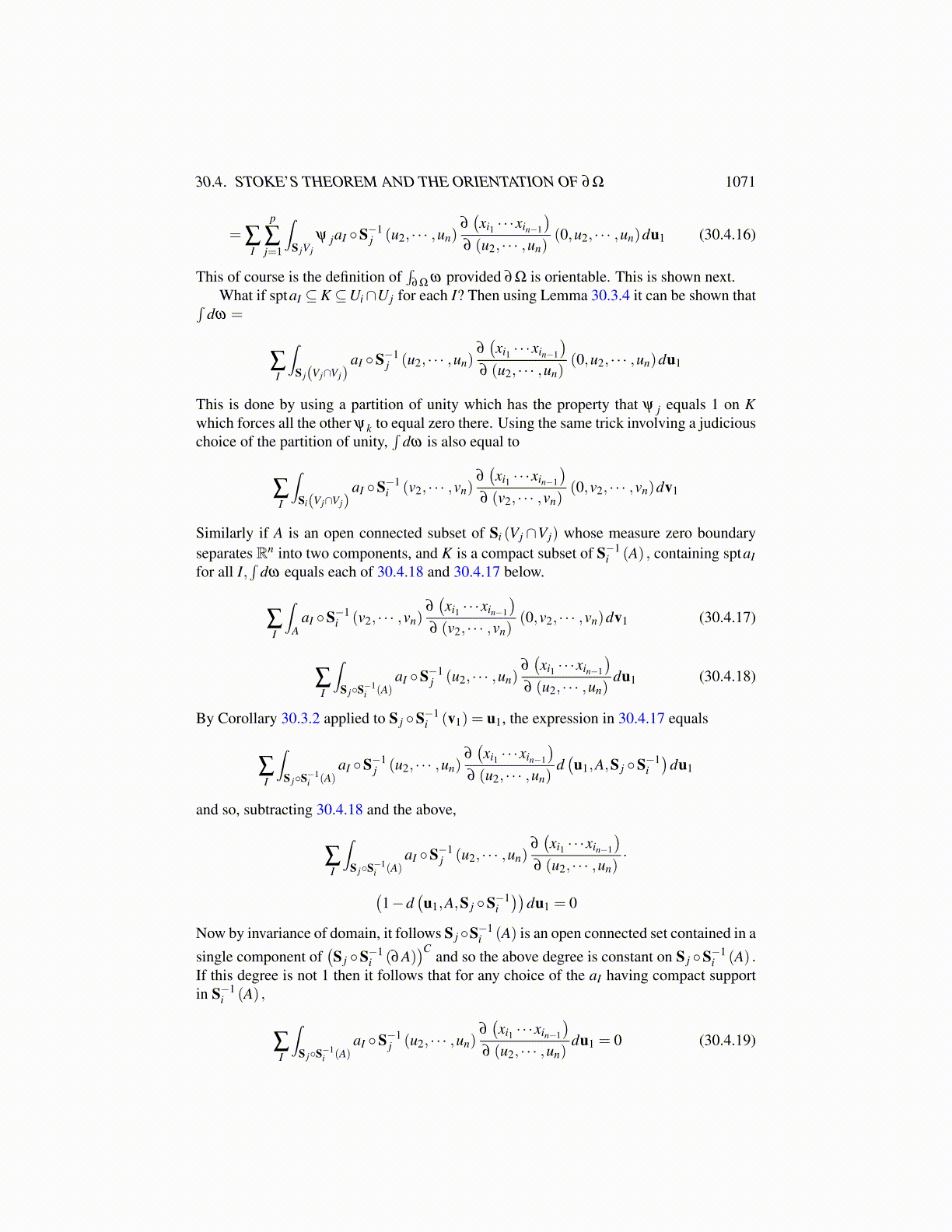
= ∑I
p
∑j=1
∫S jV j
ψ jaI ◦S−1j (u2, · · · ,un)
∂(xi1 · · ·xin−1
)∂ (u2, · · · ,un)
(0,u2, · · · ,un)du1 (30.4.16)
This of course is the definition of∫
∂Ωω provided ∂Ω is orientable. This is shown next.
What if sptaI ⊆ K ⊆Ui∩U j for each I? Then using Lemma 30.3.4 it can be shown that∫dω =
∑I
∫S j(V j∩V j)
aI ◦S−1j (u2, · · · ,un)
∂(xi1 · · ·xin−1
)∂ (u2, · · · ,un)
(0,u2, · · · ,un)du1
This is done by using a partition of unity which has the property that ψ j equals 1 on Kwhich forces all the other ψk to equal zero there. Using the same trick involving a judiciouschoice of the partition of unity,
∫dω is also equal to
∑I
∫Si(V j∩V j)
aI ◦S−1i (v2, · · · ,vn)
∂(xi1 · · ·xin−1
)∂ (v2, · · · ,vn)
(0,v2, · · · ,vn)dv1
Similarly if A is an open connected subset of Si (Vj ∩Vj) whose measure zero boundaryseparates Rn into two components, and K is a compact subset of S−1
i (A) , containing sptaIfor all I,
∫dω equals each of 30.4.18 and 30.4.17 below.
∑I
∫A
aI ◦S−1i (v2, · · · ,vn)
∂(xi1 · · ·xin−1
)∂ (v2, · · · ,vn)
(0,v2, · · · ,vn)dv1 (30.4.17)
∑I
∫S j◦S−1
i (A)aI ◦S−1
j (u2, · · · ,un)∂(xi1 · · ·xin−1
)∂ (u2, · · · ,un)
du1 (30.4.18)
By Corollary 30.3.2 applied to S j ◦S−1i (v1) = u1, the expression in 30.4.17 equals
∑I
∫S j◦S−1
i (A)aI ◦S−1
j (u2, · · · ,un)∂(xi1 · · ·xin−1
)∂ (u2, · · · ,un)
d(u1,A,S j ◦S−1
i)
du1
and so, subtracting 30.4.18 and the above,
∑I
∫S j◦S−1
i (A)aI ◦S−1
j (u2, · · · ,un)∂(xi1 · · ·xin−1
)∂ (u2, · · · ,un)
·
(1−d
(u1,A,S j ◦S−1
i))
du1 = 0
Now by invariance of domain, it follows S j ◦S−1i (A) is an open connected set contained in a
single component of(S j ◦S−1
i (∂A))C
and so the above degree is constant on S j ◦S−1i (A) .
If this degree is not 1 then it follows that for any choice of the aI having compact supportin S−1
i (A) ,
∑I
∫S j◦S−1
i (A)aI ◦S−1
j (u2, · · · ,un)∂(xi1 · · ·xin−1
)∂ (u2, · · · ,un)
du1 = 0 (30.4.19)