1070 CHAPTER 30. INTEGRATION OF DIFFERENTIAL FORMS
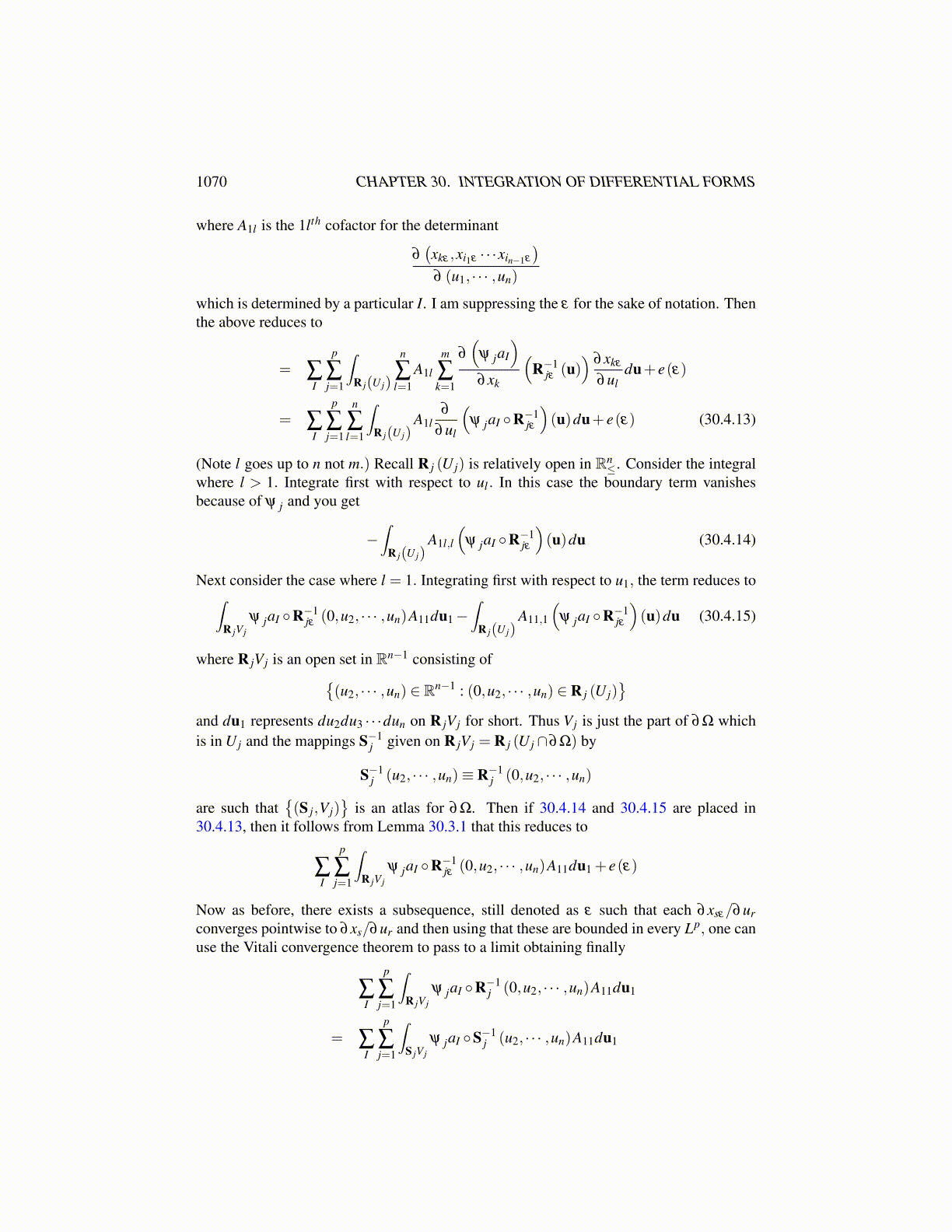
where A1l is the 1lth cofactor for the determinant
∂(xkε ,xi1ε · · ·xin−1ε
)∂ (u1, · · · ,un)
which is determined by a particular I. I am suppressing the ε for the sake of notation. Thenthe above reduces to
= ∑I
p
∑j=1
∫R j(U j)
n
∑l=1
A1l
m
∑k=1
∂
(ψ jaI
)∂xk
(R−1
jε (u))
∂xkε
∂uldu+ e(ε)
= ∑I
p
∑j=1
n
∑l=1
∫R j(U j)
A1l∂
∂ul
(ψ jaI ◦R−1
jε
)(u)du+ e(ε) (30.4.13)
(Note l goes up to n not m.) Recall R j (U j) is relatively open in Rn≤. Consider the integral
where l > 1. Integrate first with respect to ul . In this case the boundary term vanishesbecause of ψ j and you get
−∫
R j(U j)A1l,l
(ψ jaI ◦R−1
jε
)(u)du (30.4.14)
Next consider the case where l = 1. Integrating first with respect to u1, the term reduces to∫R jV j
ψ jaI ◦R−1jε (0,u2, · · · ,un)A11du1−
∫R j(U j)
A11,1
(ψ jaI ◦R−1
jε
)(u)du (30.4.15)
where R jVj is an open set in Rn−1 consisting of{(u2, · · · ,un) ∈ Rn−1 : (0,u2, · · · ,un) ∈ R j (U j)
}and du1 represents du2du3 · · ·dun on R jVj for short. Thus Vj is just the part of ∂Ω whichis in U j and the mappings S−1
j given on R jVj = R j (U j ∩∂Ω) by
S−1j (u2, · · · ,un)≡ R−1
j (0,u2, · · · ,un)
are such that{(S j,Vj)
}is an atlas for ∂Ω. Then if 30.4.14 and 30.4.15 are placed in
30.4.13, then it follows from Lemma 30.3.1 that this reduces to
∑I
p
∑j=1
∫R jV j
ψ jaI ◦R−1jε (0,u2, · · · ,un)A11du1 + e(ε)
Now as before, there exists a subsequence, still denoted as ε such that each ∂xsε/∂urconverges pointwise to ∂xs/∂ur and then using that these are bounded in every Lp, one canuse the Vitali convergence theorem to pass to a limit obtaining finally
∑I
p
∑j=1
∫R jV j
ψ jaI ◦R−1j (0,u2, · · · ,un)A11du1
= ∑I
p
∑j=1
∫S jV j
ψ jaI ◦S−1j (u2, · · · ,un)A11du1