30.4. STOKE’S THEOREM AND THE ORIENTATION OF ∂Ω 1069
30.4 Stoke’s Theorem And The Orientation Of ∂Ω
Here Ω will be an n dimensional orientable Lipschitz manifold with boundary in Rm. Letan oriented manifold for it be {Ui,Ri}p
i=1 and let a C∞ partition of unity be {ψ i}pi=1. Also
letω = ∑
IaI (x)dxi1 ∧·· ·∧dxin−1
be a differential form such that aI is C1(Ω). Since ∑ψ i (x) = 1 on Ω,
dω = ∑I
m
∑k=1
p
∑j=1
∂
(ψ jaI
)∂xk
(x)dxk ∧dxi1 ∧·· ·∧dxin−1
It follows
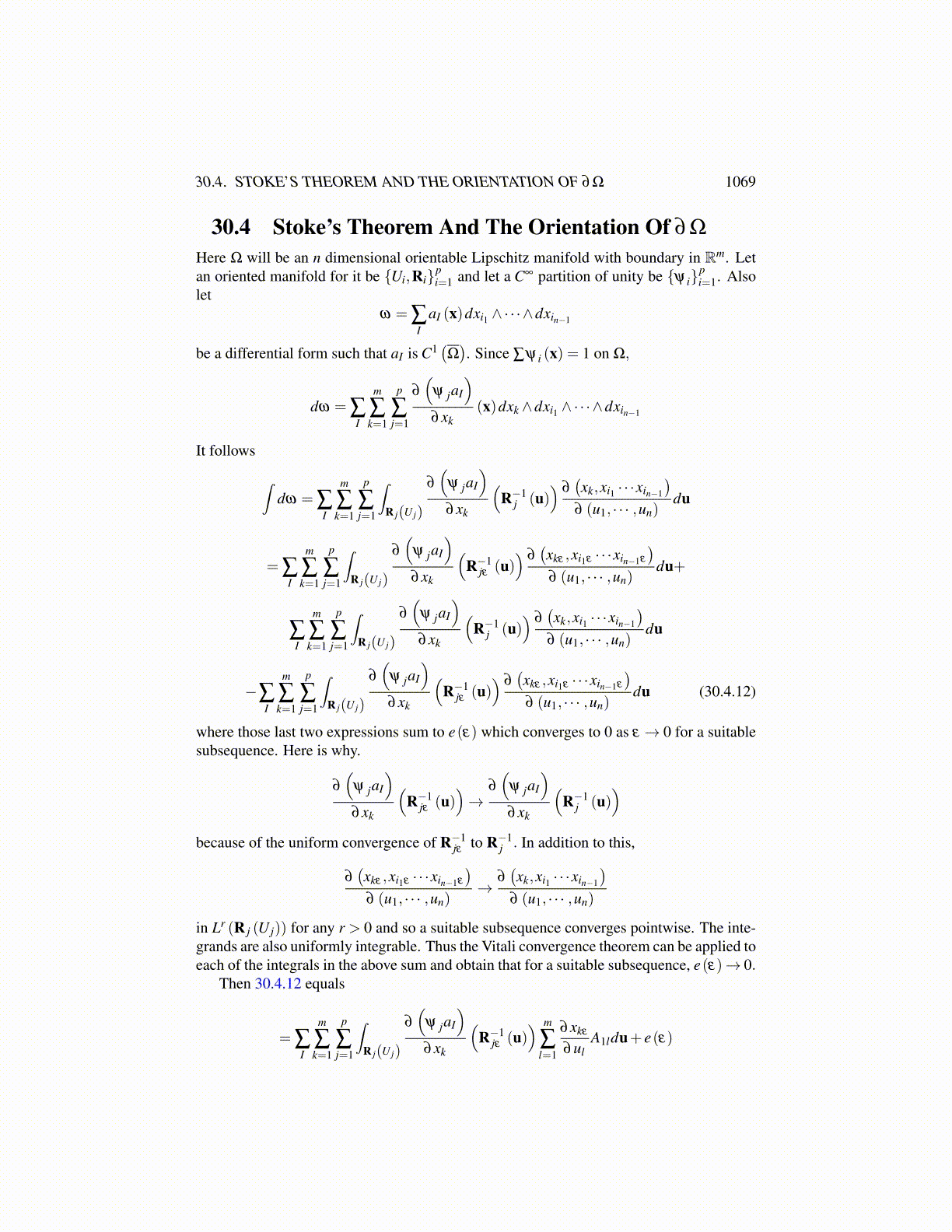
∫dω = ∑
I
m
∑k=1
p
∑j=1
∫R j(U j)
∂
(ψ jaI
)∂xk
(R−1
j (u))
∂(xk,xi1 · · ·xin−1
)∂ (u1, · · · ,un)
du
= ∑I
m
∑k=1
p
∑j=1
∫R j(U j)
∂
(ψ jaI
)∂xk
(R−1
jε (u))
∂(xkε ,xi1ε · · ·xin−1ε
)∂ (u1, · · · ,un)
du+
∑I
m
∑k=1
p
∑j=1
∫R j(U j)
∂
(ψ jaI
)∂xk
(R−1
j (u))
∂(xk,xi1 · · ·xin−1
)∂ (u1, · · · ,un)
du
−∑I
m
∑k=1
p
∑j=1
∫R j(U j)
∂
(ψ jaI
)∂xk
(R−1
jε (u))
∂(xkε ,xi1ε · · ·xin−1ε
)∂ (u1, · · · ,un)
du (30.4.12)
where those last two expressions sum to e(ε) which converges to 0 as ε → 0 for a suitablesubsequence. Here is why.
∂
(ψ jaI
)∂xk
(R−1
jε (u))→
∂
(ψ jaI
)∂xk
(R−1
j (u))
because of the uniform convergence of R−1jε to R−1
j . In addition to this,
∂(xkε ,xi1ε · · ·xin−1ε
)∂ (u1, · · · ,un)
→∂(xk,xi1 · · ·xin−1
)∂ (u1, · · · ,un)
in Lr (R j (U j)) for any r > 0 and so a suitable subsequence converges pointwise. The inte-grands are also uniformly integrable. Thus the Vitali convergence theorem can be applied toeach of the integrals in the above sum and obtain that for a suitable subsequence, e(ε)→ 0.
Then 30.4.12 equals
= ∑I
m
∑k=1
p
∑j=1
∫R j(U j)
∂
(ψ jaI
)∂xk
(R−1
jε (u)) m
∑l=1
∂xkε
∂ulA1ldu+ e(ε)