32.2. FOURIER TRANSFORMS OF FUNCTIONS IN G 1099
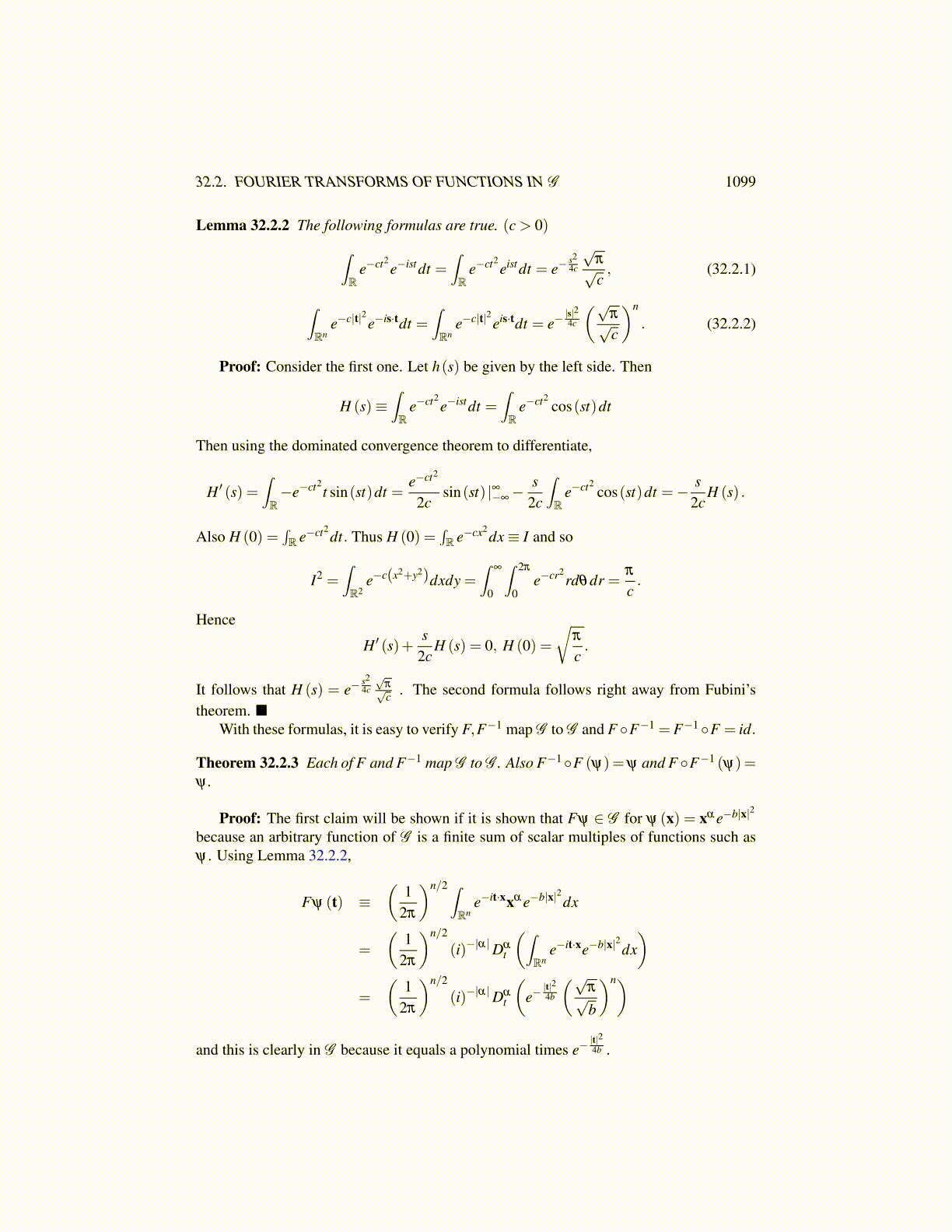
Lemma 32.2.2 The following formulas are true. (c > 0)∫R
e−ct2e−istdt =
∫R
e−ct2eistdt = e−
s24c
√π√c, (32.2.1)
∫Rn
e−c|t|2e−is·tdt =∫Rn
e−c|t|2eis·tdt = e−|s|24c
(√π√c
)n
. (32.2.2)
Proof: Consider the first one. Let h(s) be given by the left side. Then
H (s)≡∫R
e−ct2e−istdt =
∫R
e−ct2cos(st)dt
Then using the dominated convergence theorem to differentiate,
H ′ (s) =∫R−e−ct2
t sin(st)dt =e−ct2
2csin(st) |∞−∞−
s2c
∫R
e−ct2cos(st)dt =− s
2cH (s) .
Also H (0) =∫R e−ct2
dt. Thus H (0) =∫R e−cx2
dx≡ I and so
I2 =∫R2
e−c(x2+y2)dxdy =∫
∞
0
∫ 2π
0e−cr2
rdθdr =π
c.
Hence
H ′ (s)+s
2cH (s) = 0, H (0) =
√π
c.
It follows that H (s) = e−s24c
√π√c . The second formula follows right away from Fubini’s
theorem.With these formulas, it is easy to verify F,F−1 map G to G and F ◦F−1 = F−1 ◦F = id.
Theorem 32.2.3 Each of F and F−1 map G to G . Also F−1◦F (ψ)=ψ and F ◦F−1 (ψ)=ψ .
Proof: The first claim will be shown if it is shown that Fψ ∈ G for ψ (x) = xα e−b|x|2
because an arbitrary function of G is a finite sum of scalar multiples of functions such asψ . Using Lemma 32.2.2,
Fψ (t) ≡(
12π
)n/2 ∫Rn
e−it·xxα e−b|x|2dx
=
(1
2π
)n/2
(i)−|α|Dαt
(∫Rn
e−it·xe−b|x|2dx)
=
(1
2π
)n/2
(i)−|α|Dαt
(e−|t|24b
(√π√b
)n)
and this is clearly in G because it equals a polynomial times e−|t|24b .