1100 CHAPTER 32. FOURIER TRANSFORMS
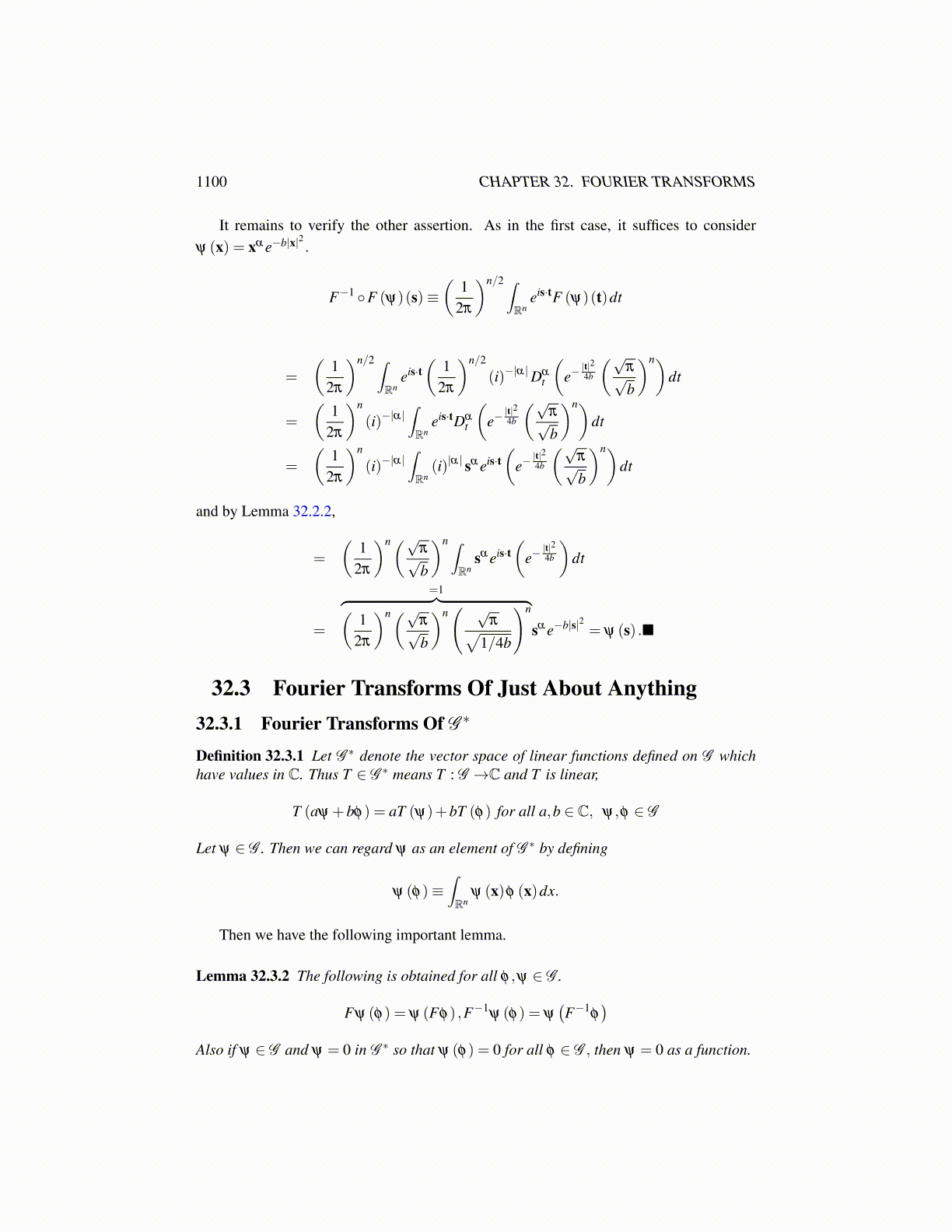
It remains to verify the other assertion. As in the first case, it suffices to considerψ (x) = xα e−b|x|2 .
F−1 ◦F (ψ)(s)≡(
12π
)n/2 ∫Rn
eis·tF (ψ)(t)dt
=
(1
2π
)n/2 ∫Rn
eis·t(
12π
)n/2
(i)−|α|Dαt
(e−|t|24b
(√π√b
)n)dt
=
(1
2π
)n
(i)−|α|∫Rn
eis·tDαt
(e−|t|24b
(√π√b
)n)dt
=
(1
2π
)n
(i)−|α|∫Rn
(i)|α| sα eis·t(
e−|t|24b
(√π√b
)n)dt
and by Lemma 32.2.2,
=
(1
2π
)n(√π√b
)n ∫Rn
sα eis·t(
e−|t|24b
)dt
=
=1︷ ︸︸ ︷(1
2π
)n(√π√b
)n( √
π√1/4b
)n
sα e−b|s|2 = ψ (s) .
32.3 Fourier Transforms Of Just About Anything32.3.1 Fourier Transforms Of G ∗
Definition 32.3.1 Let G ∗ denote the vector space of linear functions defined on G whichhave values in C. Thus T ∈ G ∗ means T : G →C and T is linear,
T (aψ +bφ) = aT (ψ)+bT (φ) for all a,b ∈ C, ψ,φ ∈ G
Let ψ ∈ G . Then we can regard ψ as an element of G ∗ by defining
ψ (φ)≡∫Rn
ψ (x)φ (x)dx.
Then we have the following important lemma.
Lemma 32.3.2 The following is obtained for all φ ,ψ ∈ G .
Fψ (φ) = ψ (Fφ) ,F−1ψ (φ) = ψ
(F−1
φ)
Also if ψ ∈ G and ψ = 0 in G ∗ so that ψ (φ) = 0 for all φ ∈ G , then ψ = 0 as a function.