1132 CHAPTER 33. FOURIER ANALYSIS IN Rn
Let φ (x)≡ ψ (x)g(x)−1. Then
∞
∑k=−∞
φ
(2kx)=
∞
∑k=−∞
ψ(2kx)
g(2kx)= g(x)−1
∞
∑k=−∞
ψ
(2kx)= 1
for each x ̸= 0. This proves the lemma.Now define
ρm (x)≡m
∑k=−m
ρ (x)φ
(2kx), γk (x)≡ ρ (x)φ
(2kx).
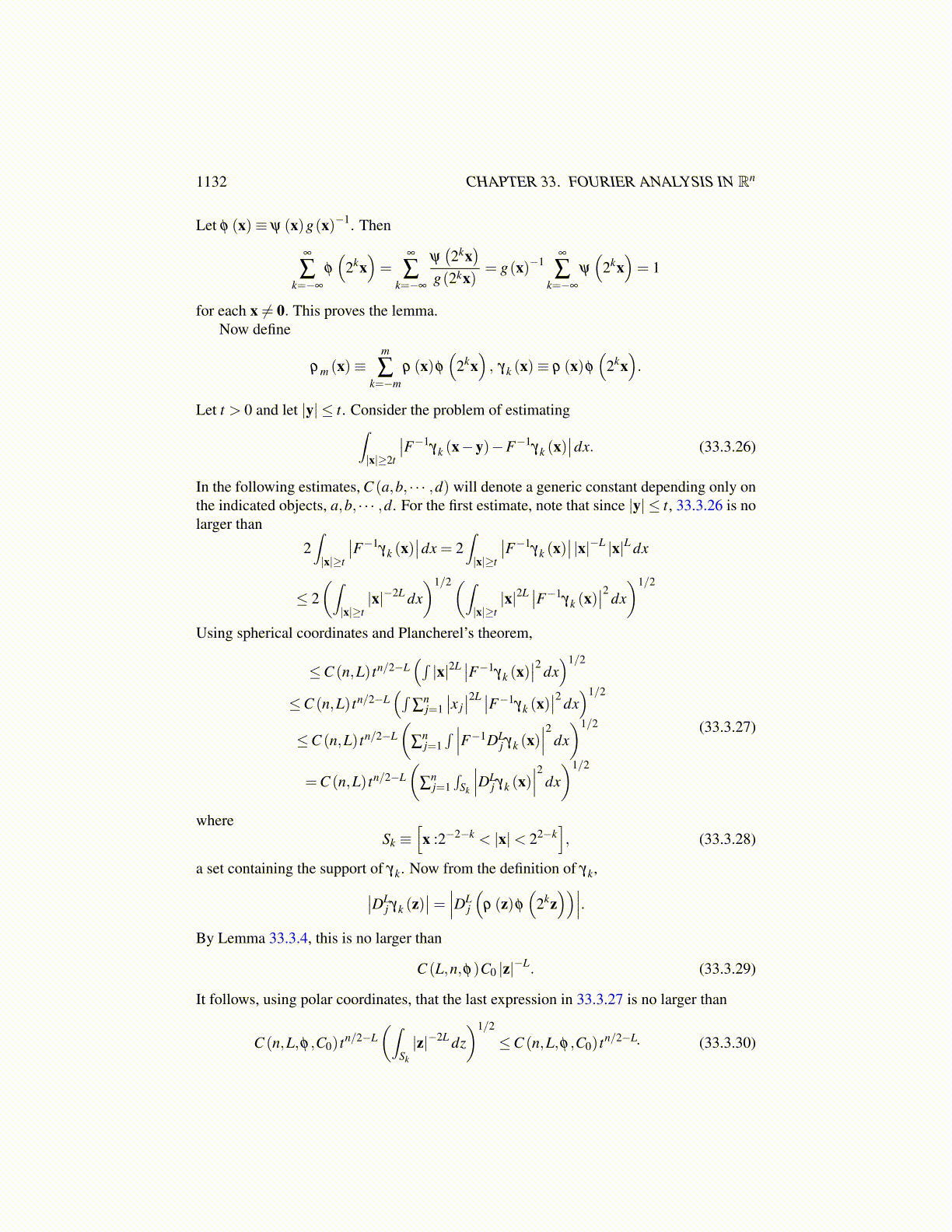
Let t > 0 and let |y| ≤ t. Consider the problem of estimating∫|x|≥2t
∣∣F−1γk (x−y)−F−1
γk (x)∣∣dx. (33.3.26)
In the following estimates, C (a,b, · · · ,d) will denote a generic constant depending only onthe indicated objects, a,b, · · · ,d. For the first estimate, note that since |y| ≤ t, 33.3.26 is nolarger than
2∫|x|≥t
∣∣F−1γk (x)
∣∣dx = 2∫|x|≥t
∣∣F−1γk (x)
∣∣ |x|−L |x|L dx
≤ 2(∫|x|≥t|x|−2L dx
)1/2(∫|x|≥t|x|2L ∣∣F−1
γk (x)∣∣2 dx
)1/2
Using spherical coordinates and Plancherel’s theorem,
≤C (n,L) tn/2−L(∫|x|2L ∣∣F−1γk (x)
∣∣2 dx)1/2
≤C (n,L) tn/2−L(∫
∑nj=1
∣∣x j∣∣2L ∣∣F−1γk (x)
∣∣2 dx)1/2
≤C (n,L) tn/2−L(
∑nj=1∫ ∣∣∣F−1DL
j γk (x)∣∣∣2 dx
)1/2
=C (n,L) tn/2−L(
∑nj=1∫
Sk
∣∣∣DLj γk (x)
∣∣∣2 dx)1/2
(33.3.27)
whereSk ≡
[x :2−2−k < |x|< 22−k
], (33.3.28)
a set containing the support of γk. Now from the definition of γk,∣∣DLj γk (z)
∣∣= ∣∣∣DLj
(ρ (z)φ
(2kz))∣∣∣.
By Lemma 33.3.4, this is no larger than
C (L,n,φ)C0 |z|−L. (33.3.29)
It follows, using polar coordinates, that the last expression in 33.3.27 is no larger than
C (n,L,φ ,C0) tn/2−L(∫
Sk
|z|−2L dz)1/2
≤C (n,L,φ ,C0) tn/2−L· (33.3.30)