33.3. MIHLIN’S THEOREM 1133
(∫ 22−k
2−2−kρ
n−1−2Ldρ
)1/2
≤C (n,L,φ ,C0) tn/2−L2k(L−n/2).
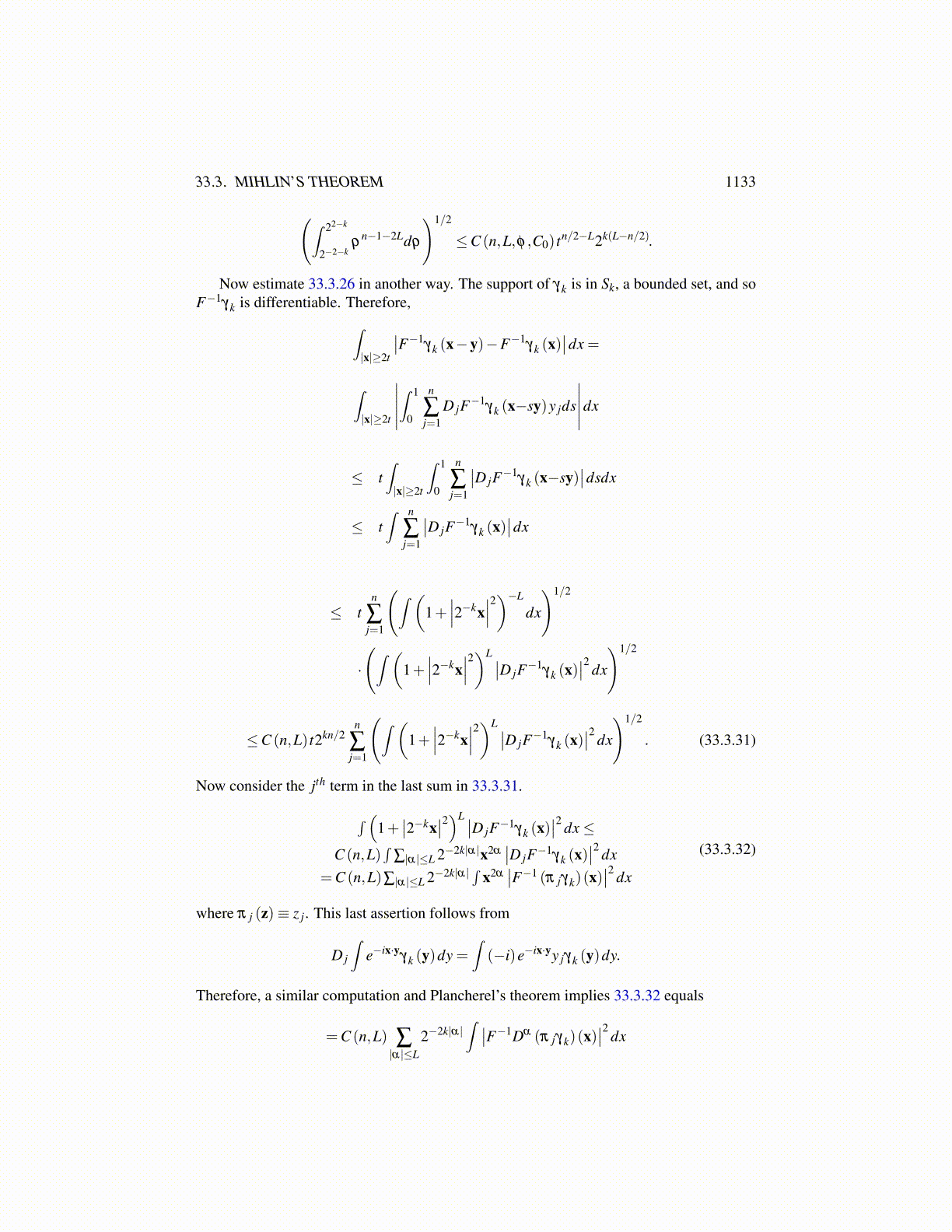
Now estimate 33.3.26 in another way. The support of γk is in Sk, a bounded set, and soF−1γk is differentiable. Therefore,∫
|x|≥2t
∣∣F−1γk (x−y)−F−1
γk (x)∣∣dx =
∫|x|≥2t
∣∣∣∣∣∫ 1
0
n
∑j=1
D jF−1γk (x−sy)y jds
∣∣∣∣∣dx
≤ t∫|x|≥2t
∫ 1
0
n
∑j=1
∣∣D jF−1γk (x−sy)
∣∣dsdx
≤ t∫ n
∑j=1
∣∣D jF−1γk (x)
∣∣dx
≤ tn
∑j=1
(∫ (1+∣∣∣2−kx
∣∣∣2)−L
dx
)1/2
·
(∫ (1+∣∣∣2−kx
∣∣∣2)L ∣∣D jF−1γk (x)
∣∣2 dx
)1/2
≤C (n,L) t2kn/2n
∑j=1
(∫ (1+∣∣∣2−kx
∣∣∣2)L ∣∣D jF−1γk (x)
∣∣2 dx
)1/2
. (33.3.31)
Now consider the jth term in the last sum in 33.3.31.
∫ (1+∣∣2−kx
∣∣2)L ∣∣D jF−1γk (x)∣∣2 dx≤
C (n,L)∫
∑|α|≤L 2−2k|α|x2α∣∣D jF−1γk (x)
∣∣2 dx=C (n,L)∑|α|≤L 2−2k|α| ∫ x2α
∣∣F−1 (π jγk)(x)∣∣2 dx
(33.3.32)
where π j (z)≡ z j. This last assertion follows from
D j
∫e−ix·y
γk (y)dy =∫
(−i)e−ix·yy jγk (y)dy.
Therefore, a similar computation and Plancherel’s theorem implies 33.3.32 equals
=C (n,L) ∑|α|≤L
2−2k|α|∫ ∣∣F−1Dα (π jγk)(x)
∣∣2 dx