33.4. SINGULAR INTEGRALS 1137
Lemma 33.4.2 Suppose
K ∈ L2 (Rn) , ||FK||∞≤ B < ∞, (33.4.39)
and ∫|x|>2|y|
|K (x−y)−K (x)|dx≤ B.
Then for all p > 1, there exists a constant, A(p,n,B), depending only on the indicatedquantities such that
||K ∗ f ||p ≤ A(p,n,B) || f ||pfor all f ∈ G .
Proof: Let FK = ρ so F−1ρ = K. Then from 33.4.39 ρ ∈ L2 (Rn)∩L∞ (Rn) and K =F−1ρ . By Theorem 33.3.3 listed above,
||K ∗ f ||p =∣∣∣∣F−1
ρ ∗ f∣∣∣∣
p ≤ A(p,n,B) || f ||p
for all f ∈ G . This proves the lemma.The next lemma provides a situation in which the above conditions hold.
Lemma 33.4.3 Suppose|K (x)| ≤ B |x|−n , (33.4.40)∫
a<|x|<bK (x)dx = 0, (33.4.41)
∫|x|>2|y|
|K (x−y)−K (x)|dx≤ B. (33.4.42)
Define
Kε (x) ={
K (x) if |x| ≥ ε,0 if |x|< ε.
(33.4.43)
Then there exists a constant C (n) such that∫|x|>2|y|
|Kε (x−y)−Kε (x)|dx≤C (n)B (33.4.44)
and||FKε ||∞ ≤C (n)B. (33.4.45)
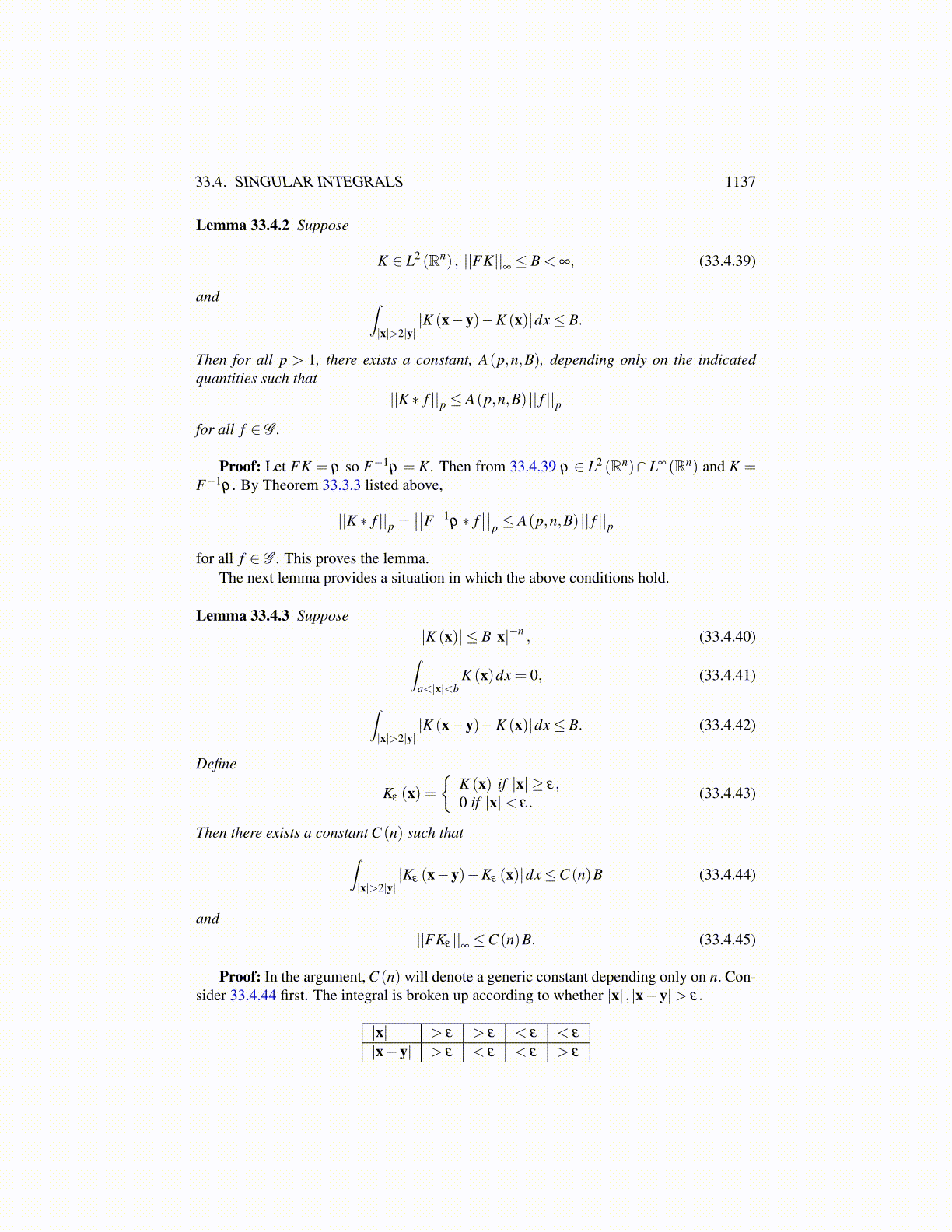
Proof: In the argument, C (n) will denote a generic constant depending only on n. Con-sider 33.4.44 first. The integral is broken up according to whether |x| , |x−y|> ε.
|x| > ε > ε < ε < ε
|x−y| > ε < ε < ε > ε