1138 CHAPTER 33. FOURIER ANALYSIS IN Rn
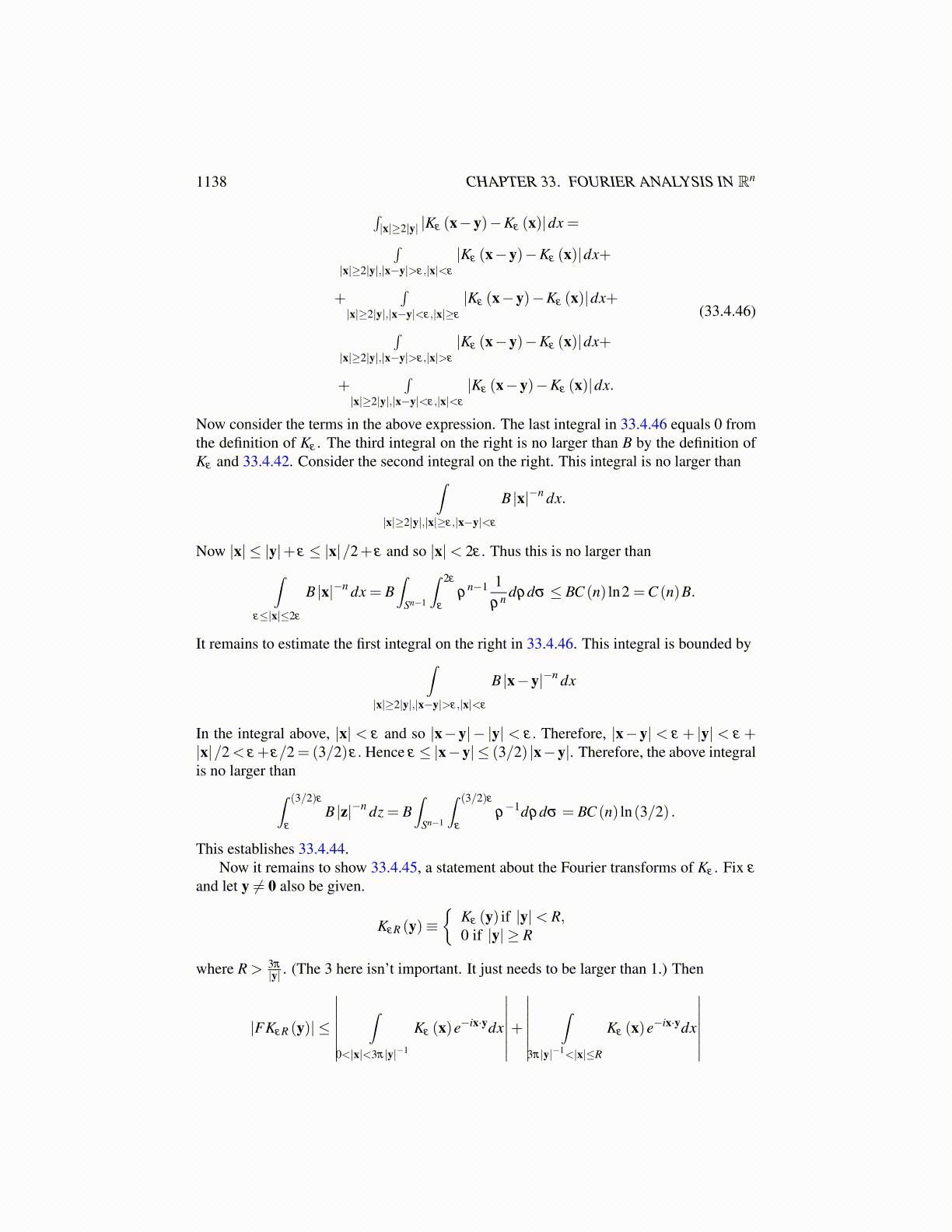
∫|x|≥2|y| |Kε (x−y)−Kε (x)|dx =∫
|x|≥2|y|,|x−y|>ε,|x|<ε
|Kε (x−y)−Kε (x)|dx+
+∫
|x|≥2|y|,|x−y|<ε,|x|≥ε
|Kε (x−y)−Kε (x)|dx+
∫|x|≥2|y|,|x−y|>ε,|x|>ε
|Kε (x−y)−Kε (x)|dx+
+∫
|x|≥2|y|,|x−y|<ε,|x|<ε
|Kε (x−y)−Kε (x)|dx.
(33.4.46)
Now consider the terms in the above expression. The last integral in 33.4.46 equals 0 fromthe definition of Kε . The third integral on the right is no larger than B by the definition ofKε and 33.4.42. Consider the second integral on the right. This integral is no larger than∫
|x|≥2|y|,|x|≥ε,|x−y|<ε
B |x|−n dx.
Now |x| ≤ |y|+ ε ≤ |x|/2+ ε and so |x|< 2ε . Thus this is no larger than∫ε≤|x|≤2ε
B |x|−n dx = B∫
Sn−1
∫ 2ε
ε
ρn−1 1
ρn dρdσ ≤ BC (n) ln2 =C (n)B.
It remains to estimate the first integral on the right in 33.4.46. This integral is bounded by∫|x|≥2|y|,|x−y|>ε,|x|<ε
B |x−y|−n dx
In the integral above, |x| < ε and so |x−y| − |y| < ε. Therefore, |x−y| < ε + |y| < ε +|x|/2 < ε +ε/2 = (3/2)ε. Hence ε ≤ |x−y| ≤ (3/2) |x−y|. Therefore, the above integralis no larger than∫ (3/2)ε
ε
B |z|−n dz = B∫
Sn−1
∫ (3/2)ε
ε
ρ−1dρdσ = BC (n) ln(3/2) .
This establishes 33.4.44.Now it remains to show 33.4.45, a statement about the Fourier transforms of Kε . Fix ε
and let y ̸= 0 also be given.
KεR (y)≡{
Kε (y) if |y|< R,0 if |y| ≥ R
where R > 3π
|y| . (The 3 here isn’t important. It just needs to be larger than 1.) Then
|FKεR (y)| ≤
∣∣∣∣∣∣∣∫
0<|x|<3π|y|−1
Kε (x)e−ix·ydx
∣∣∣∣∣∣∣+∣∣∣∣∣∣∣
∫3π|y|−1<|x|≤R
Kε (x)e−ix·ydx
∣∣∣∣∣∣∣