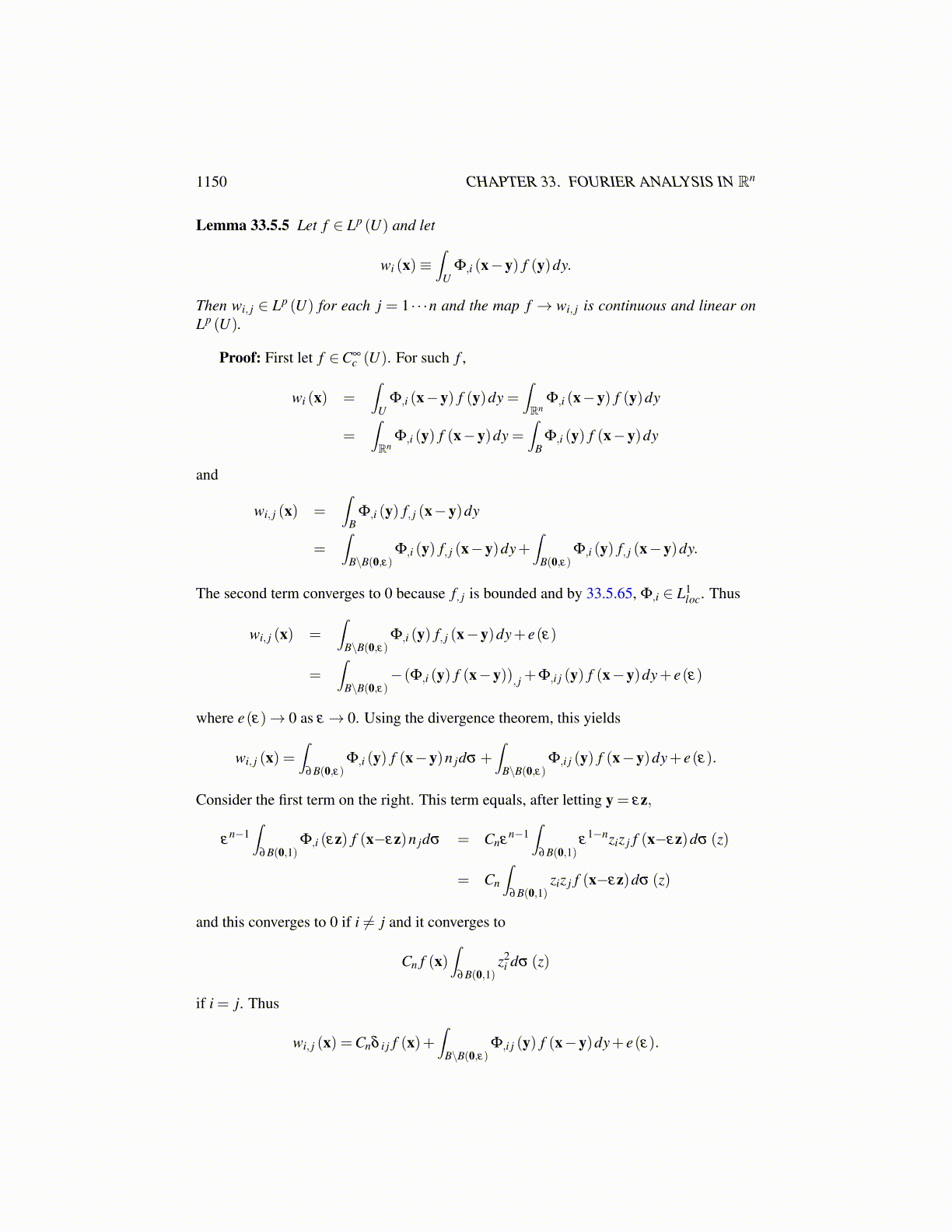
1150 CHAPTER 33. FOURIER ANALYSIS IN Rn
Lemma 33.5.5 Let f ∈ Lp (U) and let
wi (x)≡∫
UΦ,i (x−y) f (y)dy.
Then wi, j ∈ Lp (U) for each j = 1 · · ·n and the map f → wi, j is continuous and linear onLp (U).
Proof: First let f ∈C∞c (U). For such f ,
wi (x) =∫
UΦ,i (x−y) f (y)dy =
∫Rn
Φ,i (x−y) f (y)dy
=∫Rn
Φ,i (y) f (x−y)dy =∫
BΦ,i (y) f (x−y)dy
and
wi, j (x) =∫
BΦ,i (y) f, j (x−y)dy
=∫
B\B(0,ε)Φ,i (y) f, j (x−y)dy+
∫B(0,ε)
Φ,i (y) f, j (x−y)dy.
The second term converges to 0 because f, j is bounded and by 33.5.65, Φ,i ∈ L1loc. Thus
wi, j (x) =∫
B\B(0,ε)Φ,i (y) f, j (x−y)dy+ e(ε)
=∫
B\B(0,ε)−(Φ,i (y) f (x−y)), j +Φ,i j (y) f (x−y)dy+ e(ε)
where e(ε)→ 0 as ε → 0. Using the divergence theorem, this yields
wi, j (x) =∫
∂B(0,ε)Φ,i (y) f (x−y)n jdσ +
∫B\B(0,ε)
Φ,i j (y) f (x−y)dy+ e(ε).
Consider the first term on the right. This term equals, after letting y = εz,
εn−1
∫∂B(0,1)
Φ,i (εz) f (x−εz)n jdσ = Cnεn−1
∫∂B(0,1)
ε1−nziz j f (x−εz)dσ (z)
= Cn
∫∂B(0,1)
ziz j f (x−εz)dσ (z)
and this converges to 0 if i ̸= j and it converges to
Cn f (x)∫
∂B(0,1)z2
i dσ (z)
if i = j. Thus
wi, j (x) =Cnδ i j f (x)+∫
B\B(0,ε)Φ,i j (y) f (x−y)dy+ e(ε).