33.5. HELMHOLTZ DECOMPOSITIONS 1151
Letting
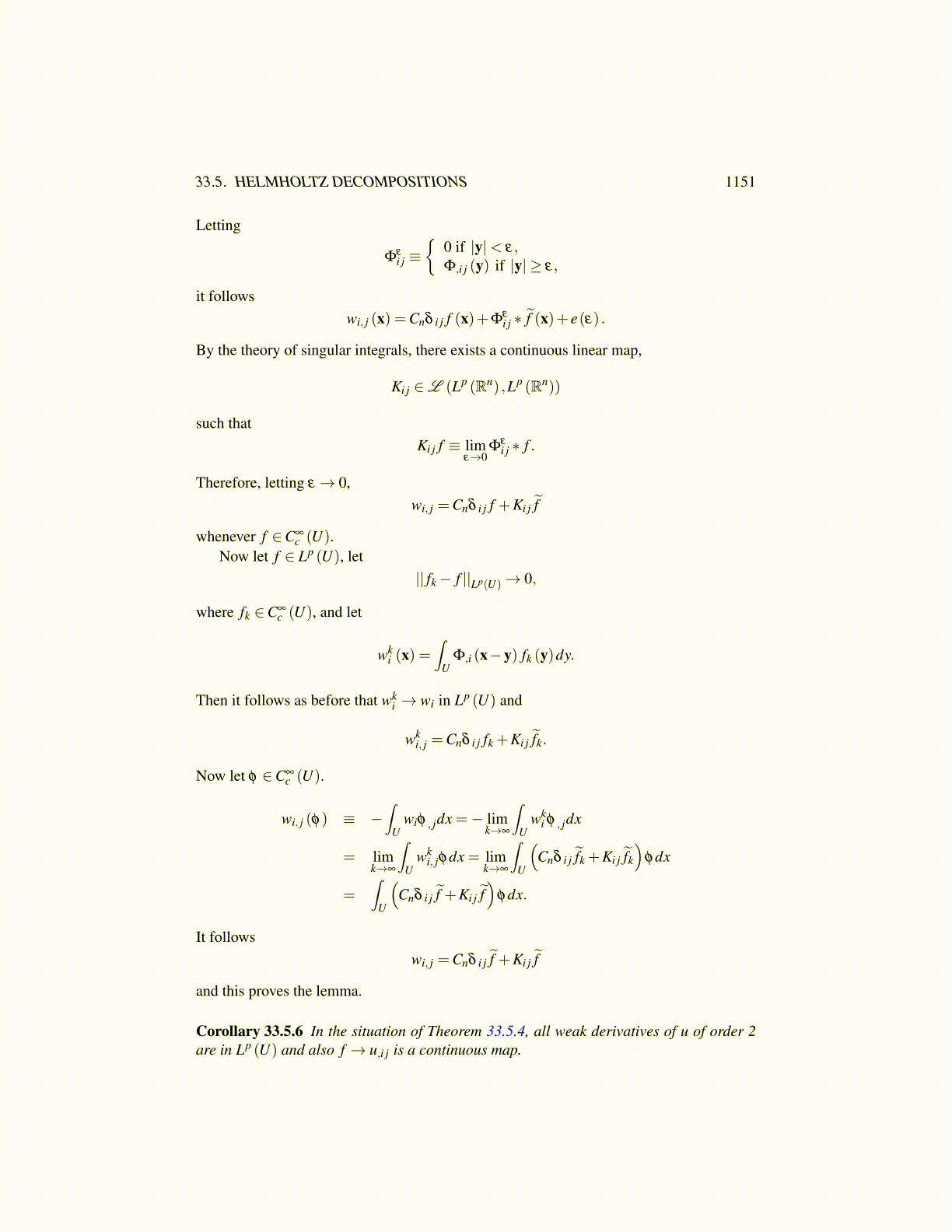
Φεi j ≡
{0 if |y|< ε,Φ,i j (y) if |y| ≥ ε,
it followswi, j (x) =Cnδ i j f (x)+Φ
εi j ∗ f̃ (x)+ e(ε) .
By the theory of singular integrals, there exists a continuous linear map,
Ki j ∈L (Lp (Rn) ,Lp (Rn))
such thatKi j f ≡ lim
ε→0Φ
εi j ∗ f .
Therefore, letting ε → 0,wi, j =Cnδ i j f +Ki j f̃
whenever f ∈C∞c (U).
Now let f ∈ Lp (U), let|| fk− f ||Lp(U)→ 0,
where fk ∈C∞c (U), and let
wki (x) =
∫U
Φ,i (x−y) fk (y)dy.
Then it follows as before that wki → wi in Lp (U) and
wki, j =Cnδ i j fk +Ki j f̃k.
Now let φ ∈C∞c (U).
wi, j (φ) ≡ −∫
Uwiφ , jdx =− lim
k→∞
∫U
wki φ , jdx
= limk→∞
∫U
wki, jφdx = lim
k→∞
∫U
(Cnδ i j f̃k +Ki j f̃k
)φdx
=∫
U
(Cnδ i j f̃ +Ki j f̃
)φdx.
It followswi, j =Cnδ i j f̃ +Ki j f̃
and this proves the lemma.
Corollary 33.5.6 In the situation of Theorem 33.5.4, all weak derivatives of u of order 2are in Lp (U) and also f → u,i j is a continuous map.