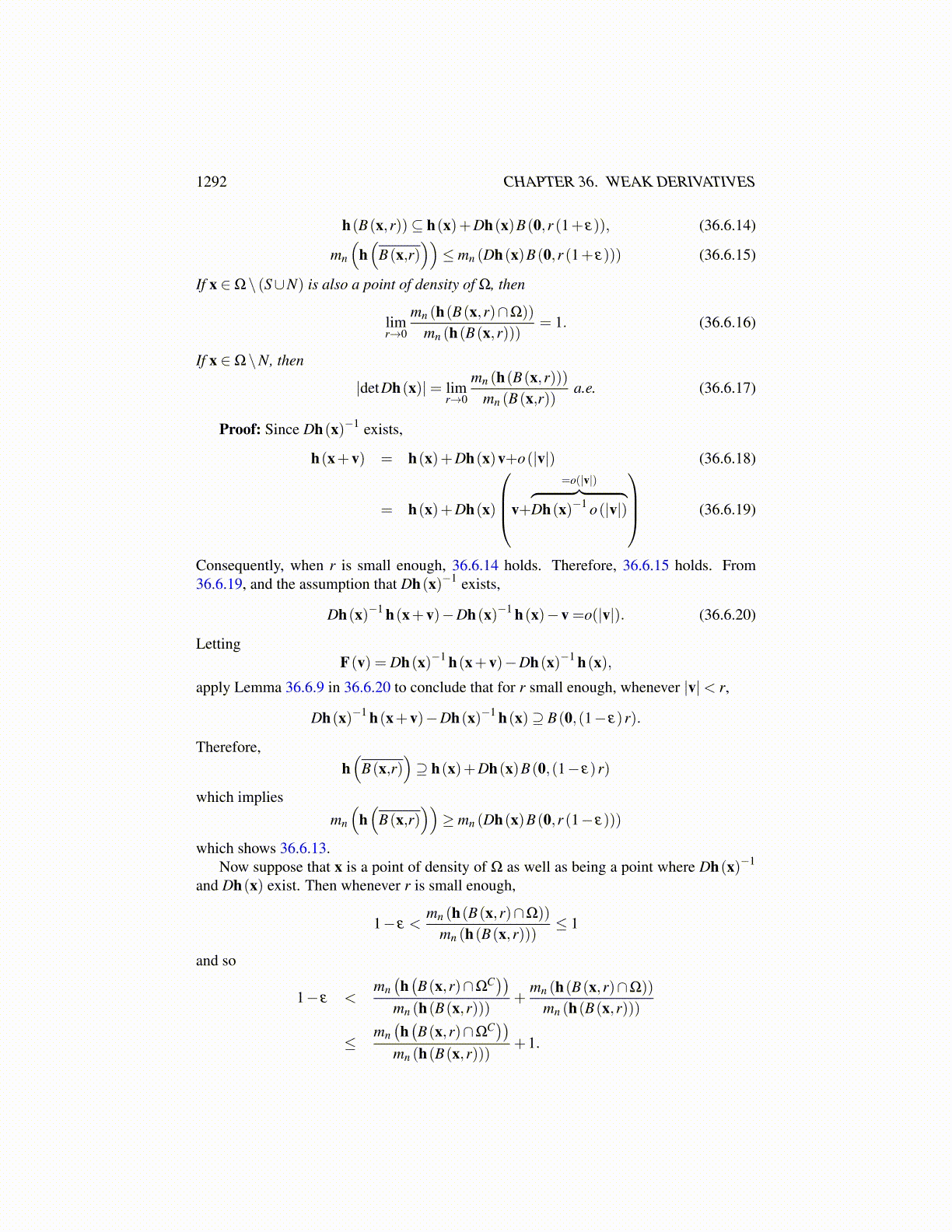
1292 CHAPTER 37. BASIC THEORY OF SOBOLEV SPACES
R(Q∩U) = {y ∈ Rn : ŷ ∈ B, a < yn < g(ŷ)} (37.2.32)
where g is Lipschitz continuous on B,a < min{
g(x) : x ∈ B}, and
ŷ≡ (y1, · · · ,yn−1).
Letting W = Q∩U the following picture describes the situation.
xW
Q
R R(W )
a
bR(Q)
y
Lemma 37.2.6 In the situation of Definition 37.2.1 let u ∈C1(U)∩C1
c (Q) and define
Eu≡ R∗E0(RT )∗ u.
where(RT)∗ maps W 1,p (U ∩Q) to W 1,p (R(W )) . Then E is linear and satisfies
||Eu||W 1,p(Rn) ≤C ||u||W 1,p(Q∩U) , Eu(x) = u(x) for x ∈ Q∩U.
where C depends only on the dimension and Lip(g) .
Proof: This follows from Theorem 37.0.14 and Lemma 37.2.4.The following theorem is a general extension theorem for Sobolev spaces.
Theorem 37.2.7 Let U be a bounded open set which has Lipschitz boundary. Then foreach p≥ 1, there exists E ∈L
(W 1,p (U) ,W 1,p (Rn)
)such that Eu(x) = u(x) a.e. x ∈U.
Proof: Let ∂U ⊆ ∪pi=1Qi Where the Qi are as described in Definition 37.2.5. Also let
Ri be the orthogonal trasformation and gi the Lipschitz functions associated with Qi as inthis definition. Now let Q0 ⊆ Q0 ⊆U be such that U ⊆ ∪p
i=0Qi, and let ψ i ∈C∞c (Qi) with
ψ i (x) ∈ [0,1] and ∑pi=0 ψ i (x) = 1 on U . For u ∈C∞
(U), let E0 (ψ0u)≡ ψ0u on Q0 and 0
off Q0. Thus ∣∣∣∣E0 (ψ0u)∣∣∣∣
1,p,Rn = ||ψ0u||1,p,U .
For i≥ 1, letE i (ψ iu)≡ R∗i E0
(RT )∗ (ψ iu) .
Thus, by Lemma 37.2.6 ∣∣∣∣E1 (ψ iu)∣∣∣∣
1,p,Rn ≤C ||ψ iu||1,p,Qi∩U