1310 CHAPTER 38. SOBOLEV SPACES BASED ON L2
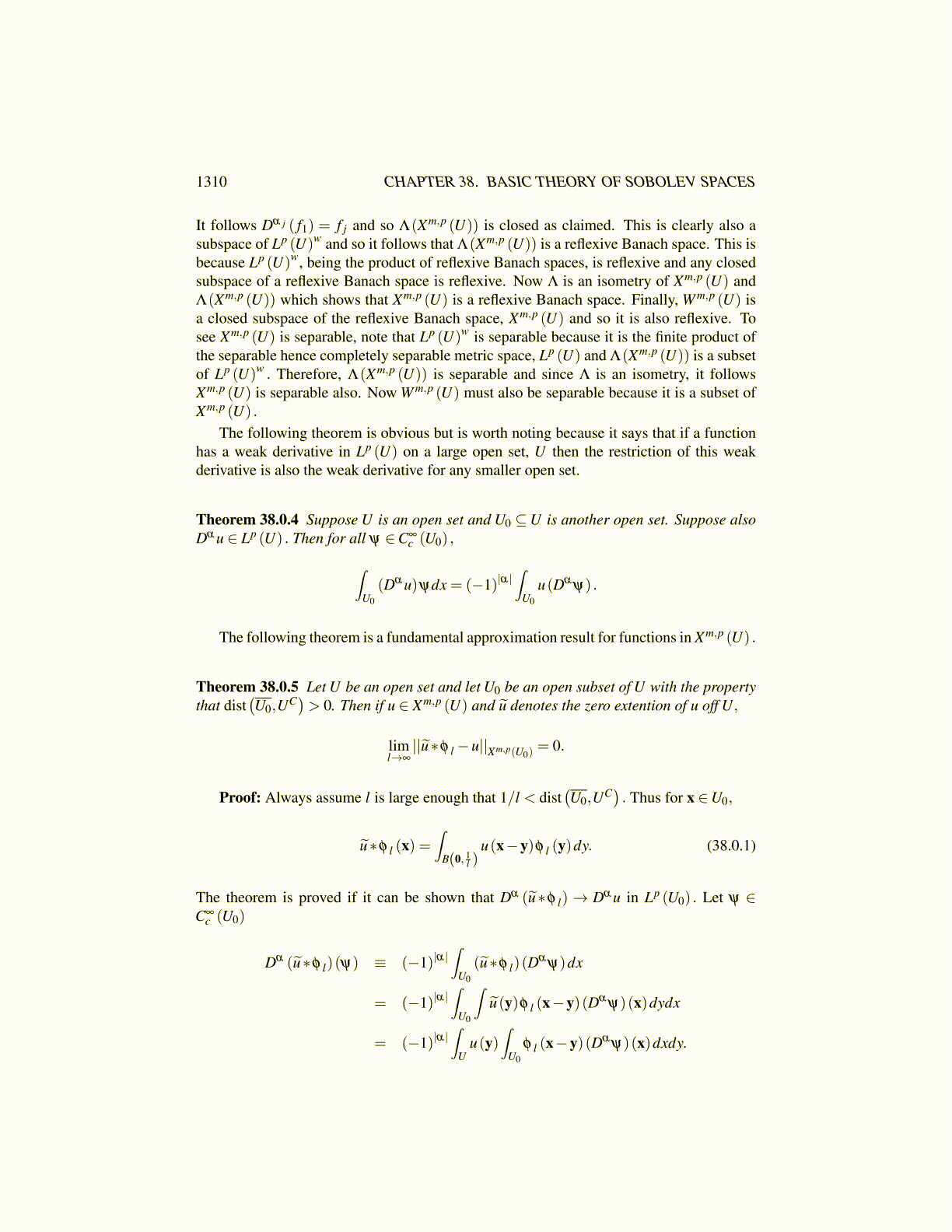
Therefore, where C (n,m) is the largest of the multinomial coefficients obtained in the ex-pansion, (
1+n
∑j=1
z2j
)m
.
Therefore,
|||u|||2m+s
≤ C∫ (
1+ |z|2)m|Fu(z)|2 dz+M (s)
∫|Fu(z)|2 ∑
|α|=m|zα |2 |z|2s dz
≤ C∫ (
1+ |z|2)m+s
|Fu(z)|2 dz+M (s)∫|Fu(z)|2
(1+ |z|2
)m|z|2s dz
≤ C∫ (
1+ |z|2)m+s
|Fu(z)|2 dz =C ||u||Hm+s(Rn) .
It remains to show the other inequality. From 38.3.11,∫ ∫|Dα u(x)−Dα u(y)|2 |x−y|−n−2s dxdy
≥ m(s)∫|FDα u(z)|2 |z|2s dz
= m(s)∫|Fu(z)|2 |zα |2 |z|2s dz.
No reference was made to |α| = m and so this establishes the bottom half of 38.3.10.Therefore, from 38.3.12,
|||u|||2m+s
≥ C∫ (
1+ |z|2)m|Fu(z)|2 dz+m(s)
∫|Fu(z)|2 ∑
|α|=m|zα |2 |z|2s dz
≥ C∫ (
1+ |z|2)m|Fu(z)|2 dz+C
∫|Fu(z)|2
(1+ |z|2
)m|z|2s dz
= C∫ (
1+ |z|2)m(
1+ |z|2s)|Fu(z)|2 dz
≥ C∫ (
1+ |z|2)m(
1+ |z|2)s|Fu(z)|2 dz
= C∫ (
1+ |z|2)m+s
|Fu(z)|2 dz = ||u||Hm+s(Rn) .
This proves the theorem.With the above intrinsic norm, it becomes possible to prove the following version of
Theorem 38.2.7.
Lemma 38.3.2 Let h : Rn → Rn be one to one and onto. Also suppose that Dα h andDα(h−1)
exist and are Lipschitz continuous if |α| ≤ m for m a positive integer. Then
h∗ : Hm+s (Rn)→ Hm+s (Rn)