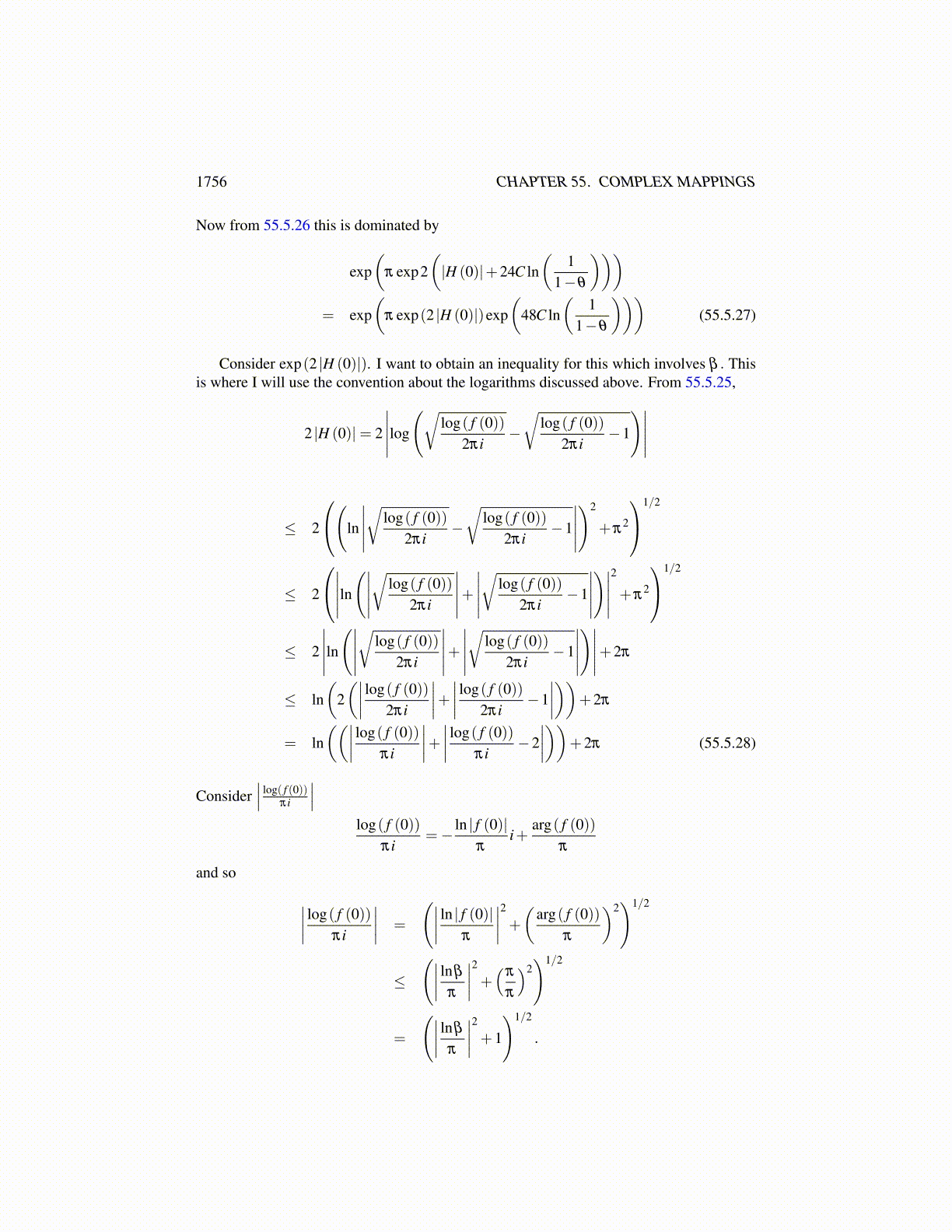
1756 CHAPTER 55. COMPLEX MAPPINGS
for all z ∈ B(0,θR) , where M (β ,θ) is a function of only the two variables β ,θ . (Inparticular, there is no dependence on R.)
Proof: Consider the function, H (z) used in Lemma 55.5.4 given by
H (z)≡ log
(√log( f (z))
2πi−√
log( f (z))2πi
−1
). (55.5.23)
You notice there are two explicit uses of logarithms. Consider first the logarithm inside theradicals. Choose this logarithm such that
log( f (0)) = ln | f (0)|+ iarg( f (0)) , arg( f (0)) ∈ (−π,π]. (55.5.24)
You can do this because
elog( f (0)) = f (0) = eln| f (0)|eiα = eln| f (0)|+iα
and by replacing α with α + 2mπ for a suitable integer, m it follows the above equationstill holds. Therefore, you can assume 55.5.24. Similar reasoning applies to the logarithmon the outside of the parenthesis. It can be assumed H (0) equals
ln
∣∣∣∣∣√
log( f (0))2πi
−√
log( f (0))2πi
−1
∣∣∣∣∣+ iarg
(√log( f (0))
2πi−√
log( f (0))2πi
−1
)(55.5.25)
where the imaginary part is no larger than π in absolute value.Now if ξ ∈ B(0,R) is a point where H ′ (ξ ) ̸= 0, then by Lemma 55.5.2
H (B(ξ ,R−|ξ |))⊇ B(
H (a) ,|H ′ (ξ )|(R−|ξ |)
24
)where a is some point in B(ξ ,R−|ξ |). But by Lemma 55.5.4 H (B(ξ ,R−|ξ |)) containsno balls of radius C where C depended only on the maximum diameters of those rectan-gles having vertices ln
(√n±√
n−1)+ 2mπi for n a positive integer and m an integer.
Therefore,|H ′ (ξ )|(R−|ξ |)
24<C
and consequently ∣∣H ′ (ξ )∣∣< 24CR−|ξ |
.
Even if H ′ (ξ ) = 0, this inequality still holds. Therefore, if z ∈ B(0,R) and γ (0,z) is thestraight segment from 0 to z,
|H (z)−H (0)| =
∣∣∣∣∫γ(0,z)
H ′ (w)dw∣∣∣∣= ∣∣∣∣∫ 1
0H ′ (tz)zdt
∣∣∣∣≤
∫ 1
0
∣∣H ′ (tz)z∣∣dt ≤
∫ 1
0
24CR− t |z|
|z|dt
= 24C ln(
RR−|z|
).