Chapter 57
Infinite ProductsThe Mittag-Leffler theorem gives existence of a meromorphic function which has specifiedsingular part at various poles. It would be interesting to do something similar to zeros of ananalytic function. That is, given the order of the zero at various points, does there exist ananalytic function which has these points as zeros with the specified orders? You know thatif you have the zeros of the polynomial, you can factor it. Can you do something similarwith analytic functions which are just limits of polynomials? These questions involve theconcept of an infinite product.
Definition 57.0.1 ∏∞n=1 (1+un) ≡ limn→∞ ∏
nk=1 (1+uk) whenever this limit exists. If
un = un (z) for z ∈ H, we say the infinite product converges uniformly on H if the partialproducts, ∏
nk=1 (1+uk (z)) converge uniformly on H.
The main theorem is the following.
Theorem 57.0.2 Let H ⊆ C and suppose that ∑∞n=1 |un (z)| converges uniformly on H
where un (z) bounded on H. Then
P(z)≡∞
∏n=1
(1+un (z))
converges uniformly on H. If (n1,n2, · · ·) is any permutation of (1,2, · · ·) , then for all z∈H,
P(z) =∞
∏k=1
(1+unk (z)
)and P has a zero at z0 if and only if un (z0) =−1 for some n.
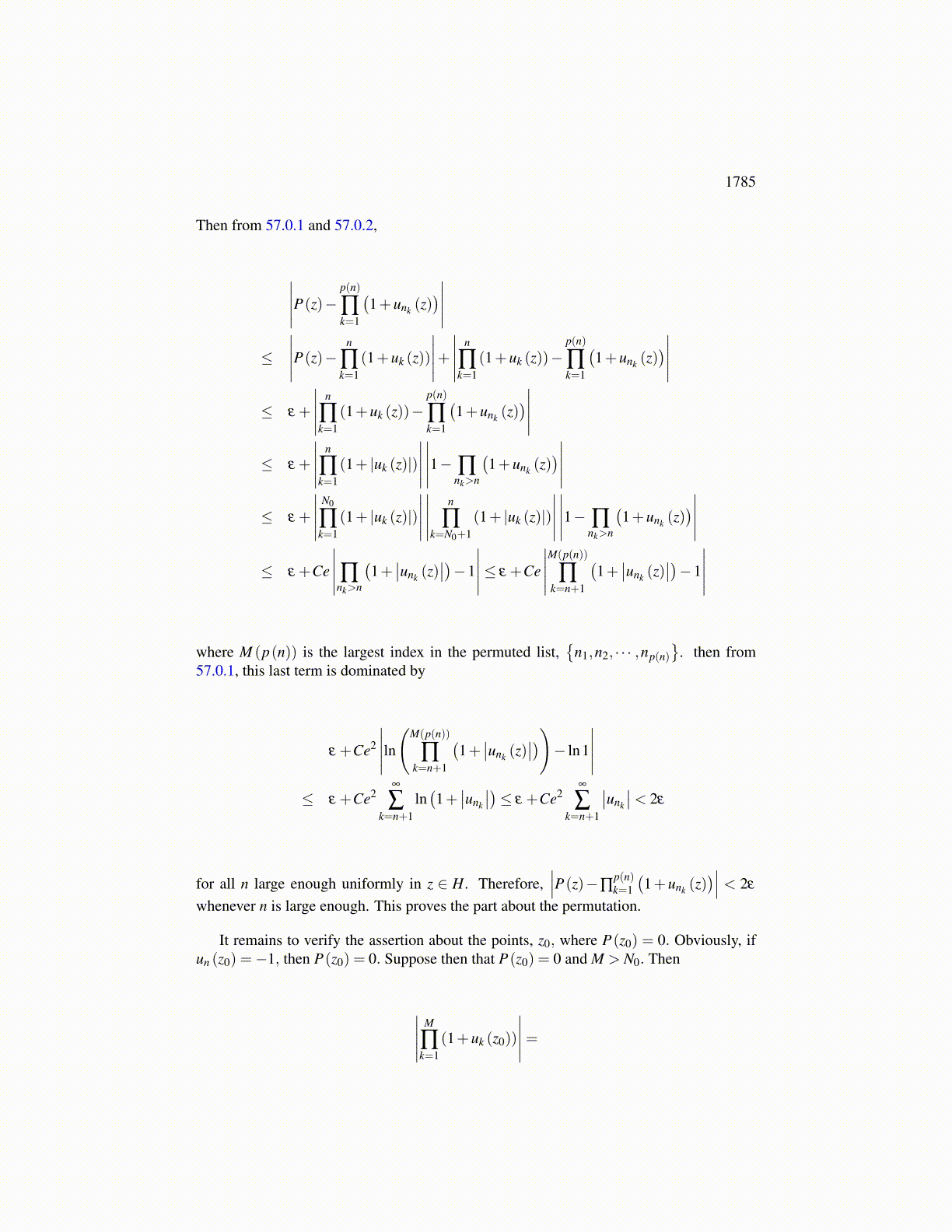
Proof: First a simple estimate:
n
∏k=m
(1+ |uk (z)|)
= exp
(ln
(n
∏k=m
(1+ |uk (z)|)
))= exp
(n
∑k=m
ln(1+ |uk (z)|)
)
≤ exp
(∞
∑k=m|uk (z)|
)< e
for all z ∈ H provided m is large enough. Since ∑∞k=1 |uk (z)| converges uniformly on H,
|uk (z)| < 12 for all z ∈ H provided k is large enough. Thus you can take log(1+uk (z)) .
Pick N0 such that for n > m≥ N0,
|um (z)|< 12,
n
∏k=m
(1+ |uk (z)|)< e. (57.0.1)
1785