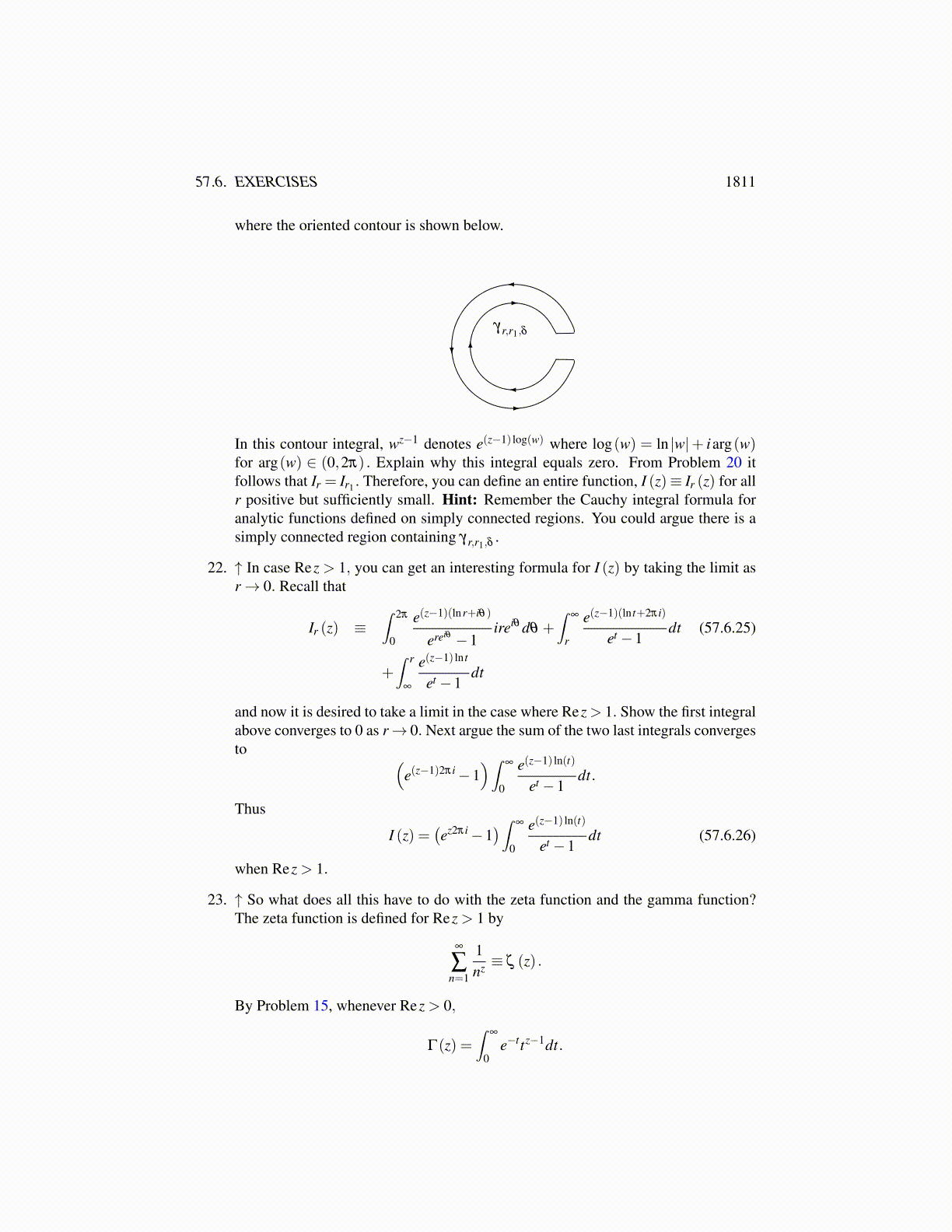
57.6. EXERCISES 1811
Show(1− t
n
)n ≤ e−t for t ∈ [0,n] . Then show∫ n
0
(1− t
n
)ntx−1dt =
n!nx
x(x+1) · · ·(x+n).
Use the first part to conclude that
Γ1 (x) = limn→∞
n!nx
x(x+1) · · ·(x+n)= Γ(x) .
Hint: To show(1− t
n
)n ≤ e−t for t ∈ [0,n] , verify this is equivalent to showing(1−u)n ≤ e−nu for u ∈ [0,1].
15. ↑Show Γ(z) =∫
∞
0 e−ttz−1dt. whenever Rez > 0. Hint: You have already shown thatthis is true for positive real numbers. Verify this formula for Rez > 0 yields ananalytic function.
16. ↑Show Γ( 1
2
)=√
π. Then find Γ( 5
2
).
17. Show that∫
∞
−∞e−s2
2 ds =√
2π . Hint: Denote this integral by I and observe that
I2 =∫R2 e−(x2+y2)/2dxdy. Then change variables to polar coordinates, x = r cos(θ),
y = r sinθ .
18. ↑ Now that you know what the gamma function is, consider in the formula forΓ(α +1) the following change of variables. t = α +α1/2s. Then in terms of thenew variable, s, the formula for Γ(α +1) is
e−αα
α+ 12
∫∞
−√
α
e−√
αs(
1+s√α
)α
ds
= e−αα
α+ 12
∫∞
−√
α
eα
[ln(
1+ s√α
)− s√
α
]ds
Show the integrand converges to e−s22 . Show that then
limα→∞
Γ(α +1)e−α αα+(1/2) =
∫∞
−∞
e−s2
2 ds =√
2π.
Hint: You will need to obtain a dominating function for the integral so that you canuse the dominated convergence theorem. You might try considering s∈
(−√
α,√
α)
first and consider something like e1−(s2/4) on this interval. Then look for anotherfunction for s >
√α . This formula is known as Stirling’s formula.
19. This and the next several problems develop the zeta function and give a relationbetween the zeta and the gamma function. Define for 0 < r < 2π
Ir (z) ≡∫ 2π
0
e(z−1)(lnr+iθ)
ereiθ −1ireiθ dθ +
∫∞
r
e(z−1)(ln t+2πi)
et −1dt (57.6.24)
+∫ r
∞
e(z−1) ln t
et −1dt