58.1. PERIODIC FUNCTIONS 1839
Ω
C l2l1
112
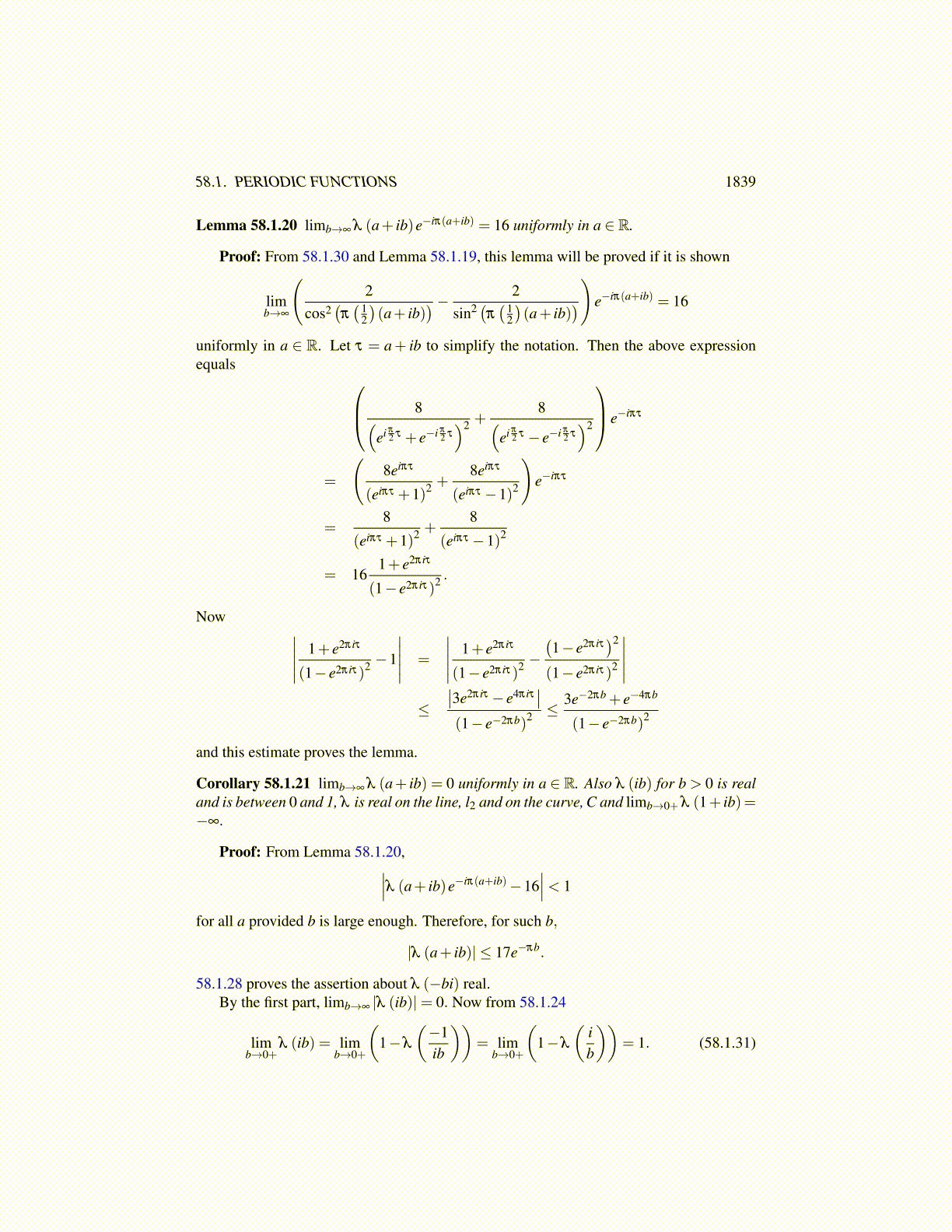
In this picture, l1 is the y axis and l2 is the line, x = 1 while C is the top half of the circlecentered at
( 12 ,0)
which has radius 1/2. Note the above formula implies λ has real valueson l1 which are between 0 and 1. This is because 58.1.23 implies
λ (ib) =∑m
1cos2(π(m+ 1
2 )ib)− 1
sin2(π(m+ 12 )ib)
∑m1
cos2(πmib) −1
sin2(π(m+ 12 )ib)
=∑m
1cosh2(π(m+ 1
2 )b)+ 1
sinh2(π(m+ 12 )b)
∑m1
cosh2(πmb)+ 1
sinh2(π(m+ 12 )b)
∈ (0,1) . (58.1.28)
This follows from the observation that
cos(ix) = cosh(x) , sin(ix) = isinh(x) .
Thus it is clear from 58.1.28 that limb→0+ λ (ib) = 1.Next I need to consider the behavior of λ (τ) as Im(τ)→ ∞. From 58.1.23 listed here
for convenience,
λ (τ) =∑m
1cos2(π(m+ 1
2 )τ)− 1
sin2(π(m+ 12 )τ)
∑m1
cos2(πmτ)− 1
sin2(π(m+ 12 )τ)
, (58.1.29)
it follows
λ (τ) =
1cos2(π(− 1
2 )τ)− 1
sin2(π(− 12 )τ)
+ 1cos2(π
12 τ)− 1
sin2(π12 τ)
+A(τ)
1+B(τ)
=
2cos2(π( 1
2 )τ)− 2
sin2(π( 12 )τ)
+A(τ)
1+B(τ)(58.1.30)
Where A(τ) ,B(τ)→ 0 as Im(τ)→ ∞. I took out the m = 0 term involving 1/cos2 (πmτ)in the denominator and the m = −1 and m = 0 terms in the numerator of 58.1.29. In fact,e−iπ(a+ib)A(a+ ib) ,e−iπ(a+ib)B(a+ ib) converge to zero uniformly in a as b→ ∞.
Lemma 58.1.19 For A,B defined in 58.1.30, e−iπ(a+ib)C (a+ ib)→ 0 uniformly in a forC = A,B.