1842 CHAPTER 58. ELLIPTIC FUNCTIONS
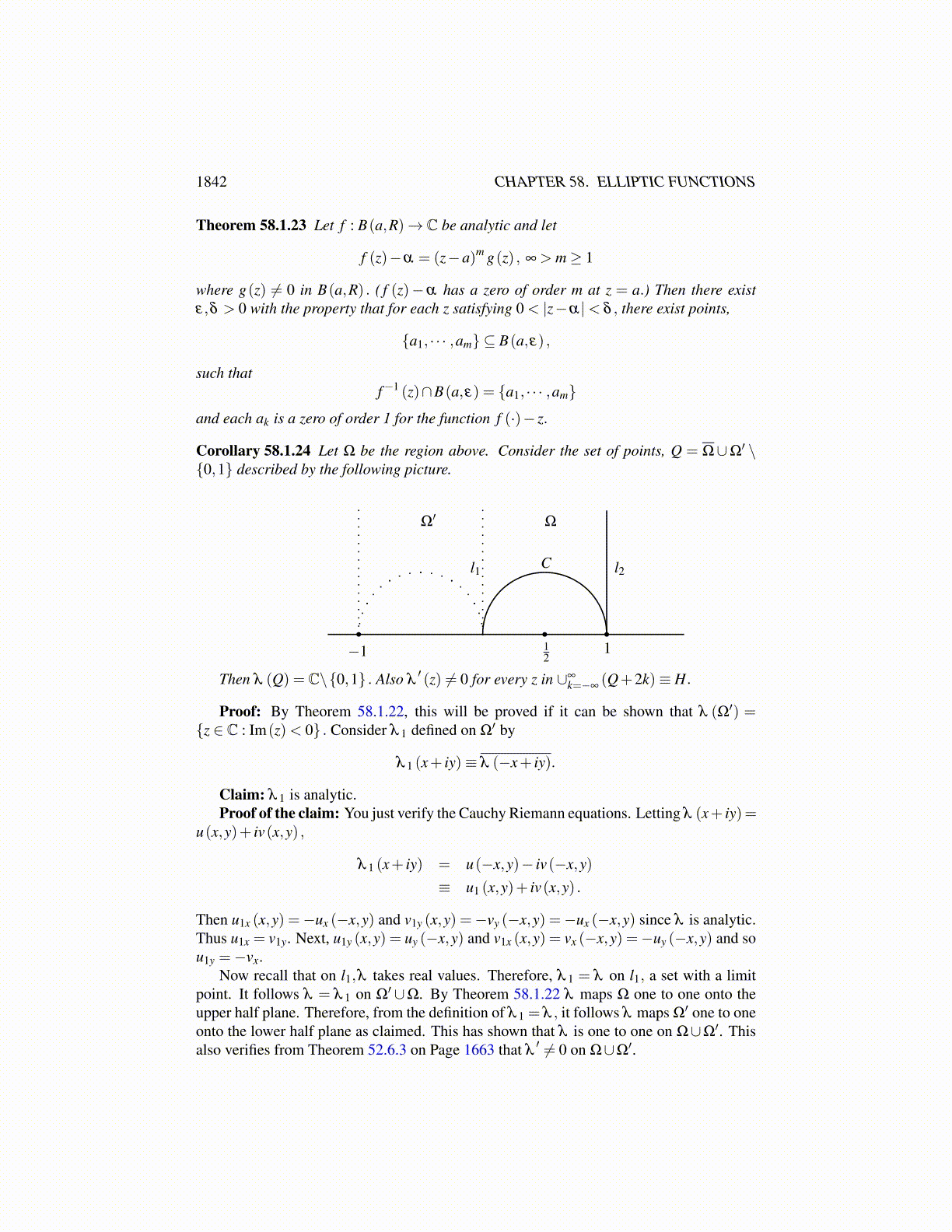
by Corollary 58.1.21.Next consider the behavior of λ on line l2 in the above picture. From 58.1.17 and
58.1.28,
λ (1+ ib) =λ (ib)
λ (ib)−1< 0
and so as b→ 0+ in the above, λ (1+ ib)→−∞.It is left as an exercise to show that the map τ → 1− 1
τmaps l2 onto the curve, C.
Therefore, by 58.1.25, for τ ∈ l2,
λ
(1− 1
τ
)=
λ(−1
τ
)λ(−1
τ
)−1
(58.1.32)
=1−λ (τ)
(1−λ (τ))−1=
λ (τ)−1λ (τ)
∈ R (58.1.33)
It follows λ is real on the boundary of Ω in the above picture. This proves the corollary.Now, following Alfors [3], cut off Ω by considering the horizontal line segment, z =
a+ ib0 where b0 is very large and positive and a ∈ [0,1] . Also cut Ω off by the imagesof this horizontal line, under the transformations z = 1
τand z = 1− 1
τ. These are arcs of
circles because the two transformations are fractional linear transformations. It is left asan exercise for you to verify these arcs are situated as shown in the following picture. Theimportant thing to notice is that for b0 large the points of these circles are close to the originand (1,0) respectively. The following picture is a summary of what has been obtained sofar on the mapping by λ .
real small positive
near 1 and realC2C1
large, real, negative
small, real, negativez = a+ ib0
Ω
C
l2l1
112
In the picture, the descriptions are of λ acting on points of the indicated boundary of Ω.Consider the oriented contour which results from λ (z) as z moves first up l2 as indicated,then along the line z = a+ ib and then down l1 and then along C1 to C and along C tillC2 and then along C2 to l2. As indicated in the picture, this involves going from a largenegative real number to a small negative real number and then over a smooth curve whichstays small to a real positive number and from there to a real number near 1. λ (z) stays