64.5. HILBERT SPACE VALUED WIENER PROCESSES 2195
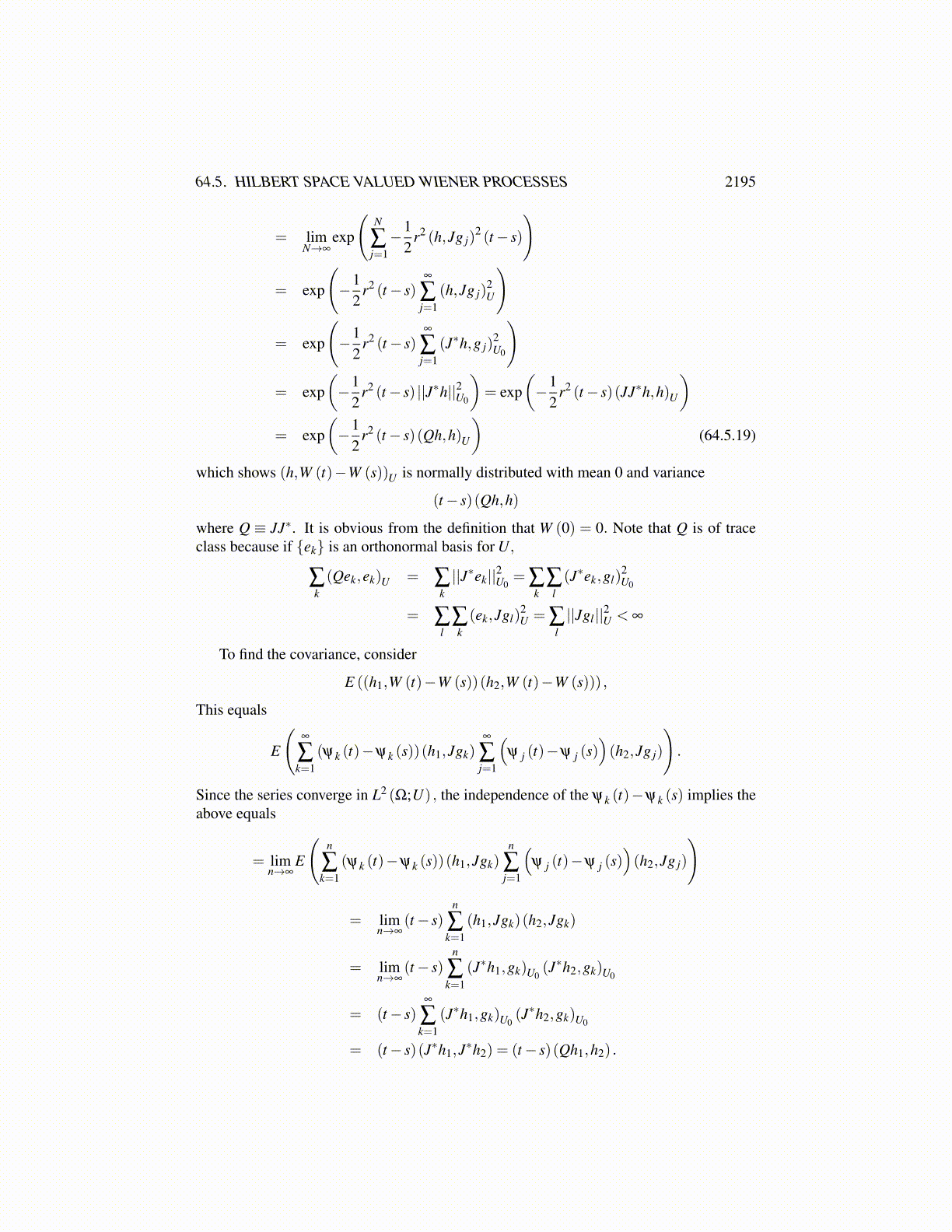
Note the characteristic function of a Q Wiener process is
E(
ei(h,W (t)))= e−
12 t2(Qh,h) (64.5.18)
Note that by Theorem 61.8.5 if you simply say that the distribution measure of W (t)is Gaussian, then it follows there exists a trace class operator Qt and mt ∈ H such that thismeasure is N (mt ,Qt) . Thus for W (t) a Wiener process, Qt = tQ and mt = 0. In addition,the increments are independent so this is much more specific than the earlier definition ofa Gaussian measure.
What is a Q Wiener process if the Hilbert space is Rn? In particular, what is Q? It isgiven that
L ((h,W (t)−W (s))) = N (0,(t− s)(Qh,h))
In this case everything is a vector in Rn and so for h ∈ Rn,
E(
eiλ (h,W (t)−W (s)))= e−
12 λ
2(t−s)(Qh,h)
In particular, letting λ = 1 this shows W (t)−W (s) is normally distributed with covariance(t− s)Q because its characteristic function is e−
12 h∗(t−s)Qh.
With this and definition, one can describe Hilbert space valued Wiener processes in afairly general setting.
Theorem 64.5.2 Let U be a real separable Hilbert space and let J : U0→U be a HilbertSchmidt operator where U0 is a real separable Hilbert space. Then let {gk} be a completeorthonormal basis for U0 and define for t ∈ [0,T ]
W (t)≡∞
∑k=1
ψk (t)Jgk
Then W (t) is a Q Wiener process for Q = JJ∗ as in Definition 64.5.1. Furthermore, thedistribution of W (t)−W (s) is the same as the distribution of W (t− s) , and W is Holdercontinuous with exponent γ for any γ < 1/2. There also is a subsequence denoted by Nsuch that the convergence of the series
N
∑k=1
ψk (t)Jgk
is uniform for all ω not in some set of measure zero.
Proof: First it is necessary to show the series converges in L2 (Ω;U) for each t. Forconvenience I will consider the series for W (t)−W (s) . (Always, it is assumed t > s.)Then since ψk (t)−ψk (s) is normal with mean 0 and variance (t− s) and ψk (t)−ψk (s)and ψ l (t)−ψ l (s) are independent,
∫Ω
∣∣∣∣∣ n
∑k=m
(ψk (t)−ψk (s))Jgk
∣∣∣∣∣2
U
dP
=∫
Ω
n
∑k,l=m
((ψk (t)−ψk (s))Jgk,(ψ l (t)−ψ l (s))Jgl)